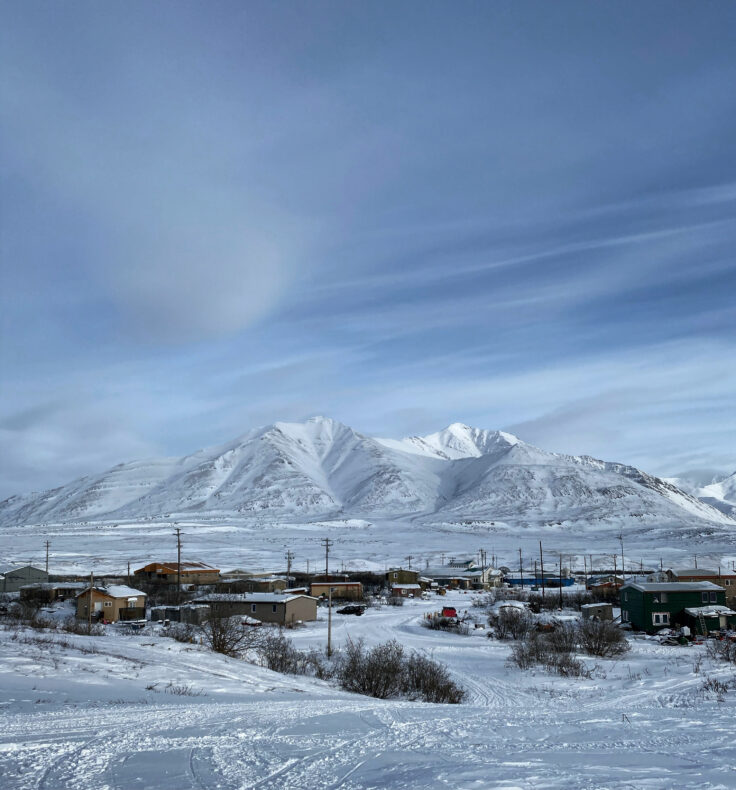
Many years ago, some birds started breeding on an island. Several thousand of them still do. The world changes around them, but their basic needs have stayed the same. Will they be on the island much longer? We don’t know. We hope so. The signs are ambiguous.
Keywords: Seabirds, oceans, uncertainty
Introduction
A good introduction is a funnel. A funnel takes an otherwise unruly amount of material and feeds it through a small opening. It is a tool not so much of order as of constraint. Here, the unruly amount of material is the ecological state of the world. But we constrained ourselves to the changing nature of the ocean, and how that change affects some of the things that depend on it. That is a topic we can reasonably wrap our heads around, given the areas of our expertise.
We focused on birds. (We happen to like birds.) One species in particular, in one particular place. We have been watching this bird in this place for a while. During that time the ocean went through an especially severe change that lasted a few years. Thousands and thousands of animals died—not just birds, and not just here. (We are still determining the extent of the loss.) Then conditions returned more or less to “normal.” Whatever that means anymore.
We wanted to know how the birds we watched fared. More broadly, we want to know how they will survive in this world we’re making for them. But we can’t phrase our research question quite that way, so we will say something like: Given such-and-such marine states that we believe we can measure with some degree of accuracy, what did the birds do? How many laid an egg in a burrow, how many chicks hatched from those eggs, how many of those chicks survived to set off on their own?
To refine our thinking we reviewed the literature. It was often contradictory. We are left with our simple questions. Some of the answers were easier to come by than others. Here we report a few of the former.
In April, the sun started rising early enough so that I started walking or running near dawn. Each time I returned, there were people gathered underneath the same cluster of eucalyptus trees in the park and I didn’t ask why. I mean, I wondered why, but people do strange things sometimes.
Then, a few weeks ago, my friend Annie asked if I’d seen the owlets.
The next time I walked by the small knot of people beneath the trees, I stopped and looked up. Where are they? Someone pointed. And there they were: three fluffy white owlets lined up on a branch like bowling pins, and overlooking them, a stern-faced great horned owl.
The owls, I later learned, had been nesting there for months. Great horned owls usually move into another species’ nest over the winter. They need to start early, because once hatched, their owlets need more time under the watchful, night-seeing eyes of their parents compared to many other birds. A local naturalist told me that the owlets, even once they’re flying — one already is — will still return to their parents throughout the summer, maybe even into fall. The parents will continue to feed them, even though the young owls can hunt on their own. “Like college students,” the naturalist told me.
I like to run this post on Memorial Day (the first version ran May 28, 2012) because when I think about soldiers and wars and Memorial Day, I think about Uncle Bundy. He was awfully opinionated and excessively direct but I admired him greatly and listened when he talked. Not he ever talked about the war, he didn’t. But in this case, what he was talking about is an ancient link between war, technology, and humans — a link began when someone first improved a stone into both the first hammer and the first spear. I’ve heard it about this link from many technologically-inclined people; I heard it again just the other day. Uncle Bundy has since died — at a nice old age with his family around him — and I miss him.
It’s Memorial Day in the U.S. but this is not a war story. It does have a little war in it, but the real reason I’m writing it is because of this ball bearing my uncle had. My uncle’s name was Leverne, some of his buddies called him Vernie, all his relatives called him Bundy – no reason for that – and he’d always been a mechanic. One summer day a long time ago, he was out in his garage working on a car and I was watching him. “Look at this,” he said, “it’s a ball bearing.” It was a grooved ring, and running in the groove were little metal balls. “I just greased it,” he said, “and look how pretty it goes.” He ran his finger over the little balls and, one after another, they turned smoothly and easily in their groove. “Isn’t it pretty?” he asked. No, it isn’t, I thought, but I didn’t answer. I was in high school and an English major. It’s greasy and dirty, I thought. Poetry was pretty, not ball bearings.
Bundy was a farm boy who went to high school, then in November, 1942, joined the army. He was sent first to the University of Utah, then went back to regular duty. Then he requested to be sent to the Fort Sill Motor School, then went back to regular duty. Then he requested to be sent to the 668th Field Artillery School, then went back to regular duty. Then he requested to be sent to the Schofield Barracks Motor School in Hawaii, and he learned to be a mechanic. He never got a college degree.
In 1944, he got on a Liberty troop ship, a little hollow tub short enough and the Pacific waves big enough that the ship went up one side of a wave and down the other while the seasick troops lined up along the deck and threw up over the side. The ship was headed for the Philippines, to the battle of Leyte in which 3,000 Allied troups and 10,500 Japanese troops were being killed. By this time Bundy wasn’t really mad at anyone any more and didn’t want to fight; and anyway Leyte turned out to need materiel, not troops; and besides the war was ending, so Bundy was just as glad when the Liberty ship turned around and went to Oahu, where he spent the rest of the war.
He came home to Illinois in November, 1945. He and Mitzi, his new wife, lived in an unheated upstairs room in his sister’s house. He got a job fixing cars and tried to figure out a place to live. He found a little octagonal house that had been built for either hired hands or pigs, and bought it for $2,300 which he borrowed from his mother. The house was too far from work so he bought a lot nearer by, and then he measured up the house and measured up the lot. Next he dug two rows of post holes and in the holes he stuck stove pipes which he filled with concrete, and this would be a foundation. Then he asked his two brothers and his brother-in-law if they’d be willing to help move the house; and next he asked a customer at work if he could rent the customer’s flatbed truck for a Saturday at the going rate of $3 an hour. His plan was to raise the house enough to back the flatbed under it.
He remembered seeing some 30-foot timbers somebody had left out along Route 66, and he and his brothers went out and picked them up. They brought the timbers back to the house and with two hydraulic jacks, jacked up first one corner of the house and wedged a timber under it; then jacked up another corner of the house and wedged a timber under it, then went back to the first corner and jacked up the timber and wedged another timber under that one; and pretty soon the house was perched on the timbers up higher than the truck. Then they backed the truck under the house, timbers and all, and headed out — Bundy stood on the roof to lift up any telephone or electric wires. When they got to the lot, they backed up to the foundation, unloaded the house, trimmed it up, and reversed the jacking-up process, removed the timbers, and rested the house on its foundations. It worked exactly as planned. Bundy paid the customer $9 for three hours rental, plus $1 tip.
Bundy and Mitzi lived in the house for five years, then sold it to his mother and moved to a house that could fit the six kids they eventually had, and where they lived the rest of their lives. Bundy kept being an auto mechanic and by the time he retired, he owned his own garage. Once my brother had questions about his college physics problems, and Bundy figured out the vectors and derivatives intuitively and got the answers. Bundy told me in the 1970’s to hold on to the Dodge slant-six but for my next car, give up and buy Japanese because otherwise Detroit wasn’t ever going to learn. At age 91, he was fairly creaky but as bossy, opinionated, righteous, and as impressively, precisely competent, smart, and ingenious as he ever was.
Mom spreads maps over the dining room table. They’re oldish, not ancient, but the home I see in them is not the home I know. They are all of Colorado—mostly cities at the nexus of Rocky Mountains and High Plains, 40, 50, 60 years ago. The outpost of Ward, a funky old mining town up a sinuous dry canyon, guarded by two guys with broadswords. The hopping university town of Fort Collins, then just a smallish scatter of purple squares along a tidy grid of streets. And there’s Boulder in 1957, my hometown, where I’m visiting my family.
We press the map folds flat with our fingers and lean closer. The city then was a tiny yolk at the core of its current footprint, pressed hard against the mountains. The mesa where my parents live formed its eastward boundary, a new neighborhood then, not yet swallowed and sprawled miles beyond with malls and business parks and subdivisions and natural gas wells, the fingers of the city and its neighbors creeping outward over the plains, grasping each other to form an amoeba of light and noise that pulses with traffic along a vasculature of roads. A place forever swallowing itself. Becoming new and new again, without becoming better.
Every time I come back, I grumble about how much things have changed since I was a kid. For all my sharp words, though, there’s something unchanging here. It rises in me when I see the rolling, ponderosa-covered waves of the foothills breaking on the treeless slopes of the high Rockies to the west, when I see the plains reaching boundlessly east, haloed pink at the days’ two turns, from and towards darkness.
A Norse comb from the Middle Ages unearthed in southern Greenland.
The comb was found in a trash pile, what the archeologists call a midden, not far above the sea and just outside the remains of a longhouse. From the sit of the house and the site of the midden we know it was an easy toss: you could practically step outside and hurl food scraps, bits of wood, leather or whatever onto the pile. And so the ancient homesteaders did: Ashes from the hearth, bones from meals of seal, a tiny wooden horse with braids carved into its mane. And this curved comb, held together with rivets that still shine in the right light.
The people who lived beside the midden more than 500 years ago, along the edge of fjord in southern Greenland, are generally called Norse, though they are often called Vikings, too. What we know is that they arrived in Greenland around the first millennium and survived up into the 15th century. Then they vanished, somewhat abruptly, and more or less without a trace. This is to say we don’t know how or why they disappeared. We don’t know where they went, or if they went, or how they died. Theirs is among the mutest of all endings I can think of, for no one in the Middle Ages seems to have noticed, or recorded, or even wondered what happened to them. By the time Europeans returned to Greenland, in the early 1700s, this comb had lain buried for at least 300 years.
One afternoon last September I sat in the attic of the Greenland National Museum and Archives considering the comb. Arranged on a table before me were a dozen or so other artifacts—bits of wood decorated with interwoven, almost Celtic designs; sticks carved with enigmatic Old Norse runes, a pair of rust-caked shears still sharp enough to be dangerous. But the comb held my attention.
It was in good shape, seemed ready for use. I gently lifted it from a tissue-lined tray and tried to imagine who had last pulled it through their beard or hair, or tugged it across the head of a reluctant child. Nearby on the table was a lock of braided hair that had somehow survived from Viking times. The two relics were not related—they came from different sites—and yet here in the attic they formed an unsettling pair. While I handled the comb (with a curator’s permission), something kept me from touching the hair. It seemed too intimate, even though its owner was many centuries gone. I’d discovered, to my surprise, a line I would not cross.
Norse shears.
What I’m learning now about the comb is that it tell us more about the Vikings than I’d ever imagined. Similar examples have been found across an astonishing sweep of territory: western Greenland, Iceland, the British Isles, the Scandinavian homelands, and deep into eastern Europe. More than almost any other object, the combs reveal how far Norse travelers moved. Map the places where they turn up and a vast network emerges—routes of trade, migration, raiding, and settlement stretching across much of the medieval world.
The combs reveal something else, as well. In them we glimpse what mattered to the people who carried them. Grooming. Craftsmanship. Daily ritual. These are not the kinds of details that tend to survive in the popular imagination of the Viking Age. We think swords, spears, armor. We think boats, burial mounds, hoards of silver. We think of their terrible raids into Britain, or the way they once or twice attacked Constantinople. Or we remember stories of sacrifices made to old gods who loved a good battle.
The comb told about none of that. When I mentioned this to a curator he laughed and said personal grooming kit didn’t make for good TV. But perhaps it’s the nature of the comb itself: simple, practical, intimate. What is a comb but an undramatic tool for a small personal act that after a moment on a wind-swept shore leaves no trace. And yet this object may yet undermine generations of violent storytelling. How do you gauge the real reach of Viking culture? Look for their combs.
I thought of the comb I’d carried in my suitcase—black plastic, cheap and forgettable—and I handed the Norse one to the curator. He held it up to catch afternoon sunlight glancing through the attic window. The relic was warm in that light and surprisingly heavy in the hand. It felt good to hold. Later I would pick it up again, and pull it through the air, mimicking the way its last owner might have moved. I would think of my middle child, the one whose long hair I have learned, after much screaming, to untangle from the ends first, not the roots. After a moment the curator turned to me and said, You know,no one’s ever found a sword or a shield or a spear in Greenland. But we have plenty of combs.
My kid is on his way to university this year, and it’s hard not to get swept into doomscrolling opinion pieces. AI is going to take over everything and there will be no entry level jobs left. Did I do the wrong thing by encouraging my child’s interest in knowledge work? Should I have nudged him into a trade? There are, as usual, no maps for this territory, and the territory itself seems to come from another planet.
But then I heard Mexican philosopher Carissa Véliz speak and the picture came into clearer focus. Author of Prophecy: Prediction, Power, and the Fight for the Future, from Ancient Oracles to AI, the Oxford prof reminded me of one key fact: the future doesn’t exist yet, and there are no facts about what does not exist. If someone is telling you that their vision of the future is inevitable, they are trying to shut down conversation. They are trying to control you, and they’re most likely making money off it.
Predictions are often power moves, according to Véliz. If you actually knew the future, it would give you vast power, which is why the kings of old invariably had an astrologer or diviner on hand to advise them of how to conduct their battles or tell them who was plotting against the crown. It’s no different now.
What do I do when I believe someone’s prediction that anyone without AI will be left in the dirt, scrounging for universal basic income handouts if we’re lucky? I go out and buy AI subscriptions and courses. I cancel my plans to write a book, since can’t the readers just get more tailored AI answers on the topic now? I resist buying software because I know I’m supposed to be vibe coding it instead, even though I will likely never get into vibe coding, I just don’t want to be the only sucker paying for software.
In other words, I act in exactly the same way as I would if I were simply obeying orders from the prophets of Silicon Valley. All because I believe their spiel uncritically.
But look how the Iran War is going. How many scenarios had I read beforehand about how just such a war would play out? None of them looked remotely like this. The future, especially the complex future of the global economy and geopolitics, is almost totally unknowable.
I’m in the business of prediction, too. That’s what investors do—they make high confidence bets on the future path of businesses. And guess how much time we investors spend with egg on our faces because things went exactly opposite to our predictions? All of it. All of the time that exists, we are looking at you through a three-cheese omelet dripping off our foreheads.
So no, nobody knows what’s going to happen here. There’s a good chance they don’t even directionally know the flavour of it. The important thing is that you and I just write our own futures in a way that’s true to ourselves, refusing to be captive to the forecasters. The future is, and always has been, something for all of us to figure out.
I’m telling you, you’re beautiful. Don’t change a thing. Photo courtesy of Flickr user Jean Fenouil.
Have you noticed Mar-a-Lago face popping up in pop culture? It’s freaky. Certain conservative women and billionaires’ second wives—people who started out looking perfectly fine—now have puffy lips, exaggerated cheeks, and eyes that look perpetually surprised. I finally figured out what they remind me of: marionettes. They look like marionettes. With control-me, make-me-dance strings definitely implied.
Certain conservative men are promoting a hypermasculine version of this display, called “looksmaxxing.” They’re also doping themselves with testosterone and getting injections to enlarge their penis.
Politics isn’t incidental here; the MAGA movement is all about enforcing and glorifying a strict gender binary. We’re being pelted with propaganda about warriors and tradwives, all of it infused with ultra-gendered, white-supremacist beauty standards. (Perversely, the same people who prize gender-caricaturing procedures for cis people are denying gender-affirming care to trans people.) These distortions of true beauty have unfortunately escaped containment from the propaganda channel (Fox News) and the social media Nazi bar (X).
Misuse of GLP-1 agonists is making it easier for people to lose dangerous amounts of weight. Pop culture has celebrated extreme thinness for decades (even though every generation thinks they invented eating disorders (and sex)), but most people couldn’t look like Twiggy. Now Hollywood and fashion shows are bringing back heroin chic.
Plastic surgery procedures doubled from 1999 to 2018. The cosmetics industry attempts to make people so insecure about their appearance that they’ll buy expensive age-defying products that do not, in fact, defy age. The sociopathic, eugenicist head of the Health and Human Services is trying to deny kids vaccines but let them use tanning beds.
We can resist all this nonsense. We do not have to participate, and can instead pity or mock those who do. We can define and appreciate beauty according to our own values, beauty that’s real, beauty that isn’t complicit with oppression. And by beauty I mean any flavor of beauty: masculine, feminine, nonbinary, gender-conforming, gender-nonconforming beauty. Trans people, you are beautiful, and I’m so proud of you.
I want to say to anybody who is worried about their appearance: Honey, you look great. Nobody’s judging you, and if they are, they’re no good for you. You’re glorious! Your eyes sparkle when you smile.
When I was in my 20s, I had one friend with super straight hair and another friend with super curly hair. They got into a conversation about hair, and the first told the second she’d always wanted curly hair and the second told the first she’d always wished her hair were straight. They both, of course, had beautiful hair. And so do you! And if you don’t have much hair, that’s beautiful, too.
You know what else is beautiful? Kindness. Attentiveness. Competence. Enthusiasm. Courage. Making people feel welcome. Your sunglasses look sharp! Did someone make that bracelet for you? It’s beautiful. So are those shoes that let you walk with confidence, not like a wobbly marionette in high heels.
You don’t have to be skinny to be beautiful, or to be healthy. In fact, people who are overweight according to their body mass index have a lower risk of death than people who have a “normal” BMI. Eat plenty of vegetables and find an exercise that’s fun for you; you’ll be fine.
You don’t have to be young to be beautiful. For anybody who is worried about looking old: You are as young as you will ever be. In 20 or 40 years, your future self will wish your current self had appreciated the body you have now. Enjoy what works and don’t worry about wrinkles or whatnot. It’s fine if you have age spots—I hope you had fun in the sun. (If they’re from tanning beds, well, now we know better.) Your hair is still beautiful, or if it’s gone, that’s beautiful. Not caring if you look old is beautiful. Did you know older people have bigger vocabularies than younger people? Think of all the books you’ve read, people you’ve met, lessons you’ve learned. Wisdom is beautiful. You’re alive and that’s beautiful, you gorgeous old thing.
Over the last decade as my obsession with jumping spiders has grown, I’ve often wondered why some most people hate spiders. What is it about spiders that makes them particularly aversive? At first I was mostly just curious, but my conversations with arachnologists convinced me this question is actually important. Many researchers struggle to find funding to study spiders, which some of them attribute, at least in part, to the fact that people don’t like spiders. People are the ones deciding which studies get funded, as well as which animals are worth conserving and protecting. This is bad news for spiders.
So figuring out why people feel this way is a worthy goal. A couple years ago I wrote an essay for KnowableMagazine arguing that part of the problem is our lack of knowledge about spiders, which is partly the fault of this anti-spider bias in research funding, which is partly the fault of our lack of knowledge. I suggested we need something like the Backyard Bird Count for spiders which would serve the dual purposes of generating data about spider populations while helping people get to know these animals better — and hopefully fear them less. In researching that essay, I found only a few relevant studies looking into why people dislike spiders, along with a lot of speculation on the topic.