Birds of the District of Columbia used to be a weird little secret at the Smithsonian’s National Museum of Natural History, an exhibit I often had all to myself – a bunch of taxidermied birds in old-school wood and glass cases, lining the hallway around the basement auditorium.
On a recent visit to the museum, I discovered that the birds – with new labels, but cases that looked like they could be the originals – had been moved to a place that, while not exactly prominent, is at least stumble-upon-able, if you enter the dinosaur hall from the front, wander all the way to the back, and keep on going.
This appeared to be a common path, because a lot of other people were looking at the birds with me this time, speaking many languages.
The exhibit is supposed to cover all of the birds that have been sighted in the District of Columbia, and many of them are familiar – the house sparrow, various herons, a couple dozen ducks. Various thrushes and shorebirds. Raptors, like the ospreys I’ve seen flying along the Anacostia and the Potomac and fishing in the Tidal Basin. Seven species of woodpecker.
Three species that have been seen in D.C. are extinct now – the passenger pigeon and the Carolina parakeet, which I knew about, and the heath hen, which I didn’t. The internet tells me it’s a grouse that’s been extinct since the 1930s.
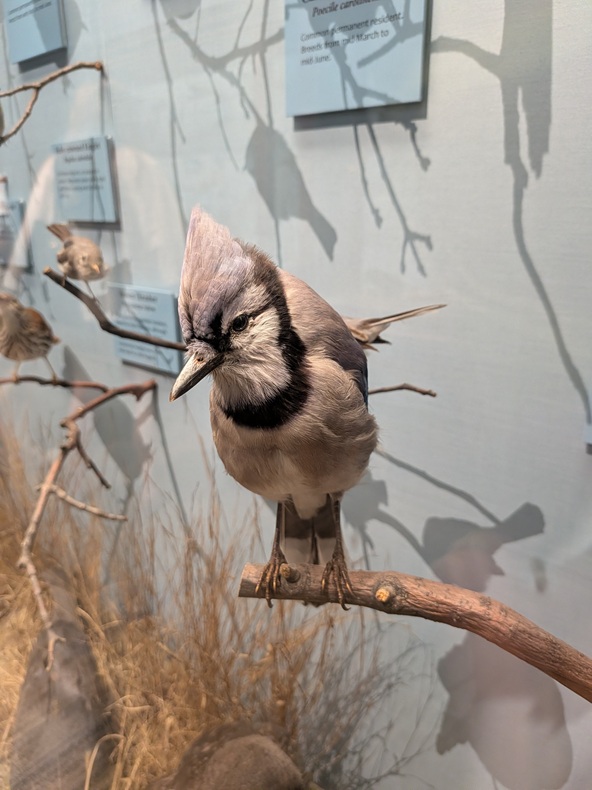
As I admired the cedar waxwing, remembering the flock that passed through my neighborhood last spring, two women burbled up on my right, speaking a European-sounding language that I couldn’t immediately pin down, stopped at the blue jay, and pointed, excited – “Ah, Mordecai! Mordecai!”
I was already holding my phone so I googled – in what language is a blue jay called a “Mordecai”? Google’s AI gently broke it to me that this is not a foreign word for “blue jay” but is in fact the name of an anthropomorphic blue jay on the Cartoon Network animated series Regular Show.
Ah. So, humanity being brought together not really by nature, but by pop culture. One of the women took a picture of Mordecai and a minute later I did, too, because a blue jay is a damn fine bird, wherever you find it.
Photo: Helen Fields, obviously
