
I died a little inside when I heard about the recent Today Show interview in which Jeff Bezos said, “I think printed newspapers on actual paper may be a luxury item. It’s sort of like, you know, people still have horses, but it’s not their primary way of commuting to the office.” As founder of Amazon.com and the new owner of The Washington Post, Bezos’s opinion on this matters. (Disclosure: I write a health column for the Post.)
I’m no luddite. I read Bezos’s comment on Twitter. I own two Kindles, and more than once, I’ve pulled up an electronic book on my iPhone while standing in line at the grocery store. I understand the convenience of reading news electronically — the news arrives instantly, snow or shine, it fits in your pocket, and there are no recyclables piling up on the kitchen table.
Like most of my peers, I read news online, but I still have three newspapers delivered to my house — the local daily, the weekly paper covering my rural county, and the Sunday Denver Post, which I read daily until they stopped delivery in my part of the state a few years ago.
Reading the newspaper has been my morning ritual since I could read, and online news has yet to replicate the experience in a satisfying way. I know what all you 20-somethings are thinking — oh, another curmudgeonly rant about new technology — tl;dr. And it’s true that I’m nostalgic for a way of delivering news that’s probably hopelessly impractical in the digital age.
A story in newsprint has a genuine quality to it — a paper’s signature columns and font make the words seem weighty and bona fide. It exists in the physical world, not just the cloud. Continue reading →
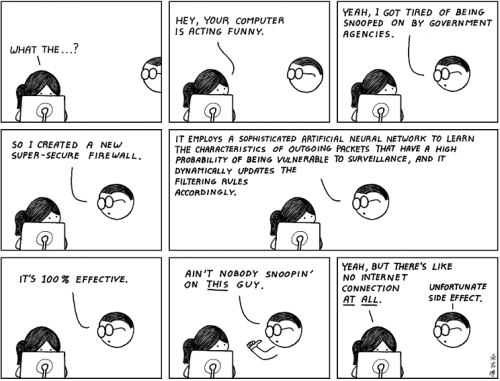 This subject is dear to me at the moment: I’ve been working forever on a short, cheap news story on the National Security Agency. One thing I’m learning — or I think I’m learning, with this stuff you can’t be sure — is more or less what AG is saying, that an internet without back doors and side channels is probably not an internet. Now that I’ve said that, I’m not sure what it means.


 The first time I heard Queen’s “Bohemian Rhapsody,” there were a lot of things I was on the verge of understanding. My first contact with the song was in the movie Wayne’s World, which also highlighted some of this dawning awareness. I knew it was funny when the main characters, Wayne and Garth, said “Schwing!” but I didn’t know why. And there was a nebulous cloud of comprehension around why Wayne thought the rocker played by Tia Carrere was so foxy.

