Time is escaping me today. What day is this, anyway? This post first ran in February of 2016, and this morning I landed in Frankfurt, Germany, after a chain of cancelled and delayed flights from Colorado, which has my head swimming. What day is this, anyway, is a real question. It turns out to be the day I was supposed to have a post ready to go, but I was thinking it was due tomorrow, or maybe yesterday. Last month I flew back from Tokyo and I landed at home four hours before I took off from Japan, and I’m still uncertain where that day went, or if I got an extra day in return. In the real world, neither is true. Time is a construct I hear and right now the springs and wheels are flying apart for me. This post from the last decade might help.
Time is a jail that we’ve built for ourselves, I think as I look at the clock and realize this post is due by some daunting hour of the morning. How could this day have been contained by a big hand and little hand on the face of a clock?
Sometimes, or some places, the clock flies apart. Human footprints 3,000 years old were discovered in Arizona recently during a road project north of Tucson. Archaeologists came upon what had once been a layer of wet clay marked by the tracks of passing adults, children and even a domestic dog. The impressions were left as if they’d just walked through yesterday. An article in the Arizona Daily Star described the find, an archaeologist brushing away sand and dirt, revealing “the impression of a heel, then toes and finally a complete set of human footprints.” The archaeologist who made the discovery said, “The closer I came to the toe I started shaking.”
This is what it feels like to step out of time. We break from cell walls made of seconds, hours, days, centuries and millennia. Somehow we think we’ve got a better grasp on time than the average Stone Age hunter-gatherer whose language likely had no past or future tense. I think otherwise. I believe we lost something. It’s why we start shaking when we make contact with the ancient past. We realize that it’s actually real. Our language and its many tenses has turned the past into an abstraction. We start to believe that because the photos are black and white, history was colorless. Finding a footprint from thousands of years ago, color comes flooding back in.
Have you heard about “zombie squirrels”? These squirrels, suffering from squirrel fibroma virus, grow strange-looking sores all over their bodies. In most cases, they recover from the virus. Still, I feel badly for them. It looks uncomfortable, even if they are not actually zombies.
I do not feel badly for this squirrel. I saw it (him? her? I didn’t get close enough to find out) in the walnut tree. It stood there, looking overly pleased about its enormous bounty, and daring me to do something about it.
I cowered.
Our squirrels are mean. They flick their tail at the dog from high places and shriek. The dog is scared of them. I thought squirrels would be too small to be scared of, and the cartoon versions always seemed fun and friendly. Then a squirrel buzzed me as it crossed the yard, headed for the fence. Squirrels have many more sharp edges than I realized.
The one nice thing about the squirrels is that they are a source of neighborhood commiseration. People discuss live traps and less-alive BB guns. Then yesterday, my neighbor sent me this video. If we make it happen, you will see it here first!
This first ran on August 17, 2022. Three years later, August 20, 2025, same. Except this year we also have infrastructure, (it’s like measles: you get it, you suffer, it goes away) which we have often enough that I know code for the street markings: gas is yellow, electric is red, sewer is green, water is blue. This time it’s blue and we’re waiting for the city DPW to get its leisurely butt out here and turn off our water and dig up the street just in time for the afternoon Armageddon to hit.
I have nothing good to say about Baltimore in August. Ok, the farmers’ market is moving into high season, peaches & tomatoes, also okra — that’s good. Digression: I spent childhood on a small farm in the midwest making internal proclamations and declarations about freezing beans and canning applesauce in a hot kitchen, like, if I ever get outa here I’m never doing this again, not me. Until decades later, I ran into the irrevocable fact that peaches and tomatoes have a few-weeks’ season and the rest of the year aren’t worth eating, so now I’m freezing peach crisp and tomato sauce and apologizing to the sweaty irritated young Ann. Anyway, I think that’s it for anything good about Baltimore in August.
The sun is out, temperatures are in the 90s and dew points are in the 70s, dew points being the temperature at which water condenses out of the air so that was 20 degrees ago — meaning that gills would have been the better evolutionary option here because the air is 52.76% water. At these dew points, the air is holding all the water it can so you can’t cool by sweating; these dew points, says our beloved Capital Weather Gang, are not just oppressive but offensive and “very gross.” Digression: I asked a neighbor who was a public health scientist just back from equatorial Africa what it was like there and she said, “About like here.”
Nights might get down to the upper 70s, same dew points; another neighbor had a friend visiting from California ask when the evening would cool off, and the neighbor just snorted. Digression: once I asked my gyn when I was going to stop having hot flashes and she too just snorted. So anyhow, that’s the Baltimore days and nights.
The afternoons, however, are terrifying, due to a hair-raising alliance between physics and chemistry. More heat means more action in the air and less density, meaning as we all know, that hot air rises. More water — for chemistry reasons having to do with molecular weight that I don’t understand — also means less density, also rising. So whooop, up she goes, wet hot air, rising rising, juicing up the atmosphere, and the more juice, the more convective instability — digression: I read that phrase first as “collective instability” which, yes, we are, aren’t we — which is measured as CAPE, Convective Available Potential Energy, the operative words being “potential energy.” Because that wet hot air rises up into the high atmosphere where it’s cooler, then condenses and carries all that juicy potential energy into thunderheads which grow crazy big, bigger every minute, blooming over the city like an alien invasion.
And inside those thunderheads, all the molecules and things get charged and the electric fields get more intense and the energy that’s been potential now just lets loose, the fields discharge and become lightning, also in a way I don’t understand but neither do scientists. Lightning heats the air to 55,000 degrees until the air explodes into thunder, and the closer in time the lightning is to the thunder, the more it seems personal. Digression: a neighbor and I were on his porch, the neighbor holding his cat, and a simultaneous lightning/thunder hit, CRACK BAM, and the cat (also) exploded out of my neighbor’s hands, and the rest of my life I’ll remember that cat, feet outstretched, hanging like a bat in the air above us.
Anyway, afternoons in Baltimore: watchful anxiety, the thunderheads get bigger, the chances of storms go up and up until finally and with some probability all hell breaks loose, physics and chemistry unconstrained by human desires.
Windows rattle, transformers blow up, trees crash down, the power goes out — recently for days — and so does the AC, and you sit there in the dark in a puddle of your own sweat if you can even sweat. Streets flood, and the Capital Weather Gang repeatedly advises TURN AROUND DON’T DROWN; flights are delayed, then cancelled, then you can’t get home until the afternoon of next Thursday when thunderstorms will again be likely — these weather patterns are stable — and flights will be cancelled again.
The best you can say about Baltimore is that it’s not in the midwest where cells of convection become supercells and your house gets blown into the next county. So I guess that’s a second good thing about August in Baltimore — catastrophes here, as with so much else, are not sensational; here we have only unassuming Armageddons.
_________
Chuck Patch via Flickr Creative Commons: Baltimore’s Artscape, when it’s so routinely hot and/or rainy, it’s called Artscape weather. Yianni Mathioudakis, also Flickr Creative Commons: also Baltimore
A few days ago, I was walking idly along a mountainside near my house when I noticed the lower branches of a ponderosa pine, heavy with bullet-sized pollen cones. Intrigued by their purplish color, I plucked one, piercing it with my thumbnail. The juice came out magenta as a beet.
Natural inks have been enjoying something of a contemporary resurgence, at least in my Instagram feed. There, I had recently noticed that the Toronto Ink Company had teamed with New York Times illustrator Wendy MacNaughton to show kids how to make inks out of common kitchen items like black beans and blueberries. So why not pollen cones? I thought, loading my pockets with the sticky orbs.
Naturally, I didn’t do anything so practical as follow an ink recipe. I just got witchy, figuring I could cover them with water and boil them until the solution was sufficiently concentrated to produce a vivid stain. Having only one saucepan to my name, and feeling uncertain about the relative wisdom of boiling resinous cones of unknown toxicity in a container I use to make food, I piled the cones into a mason jar instead, filled it halfway with water, stuck it in the microwave, and watched.
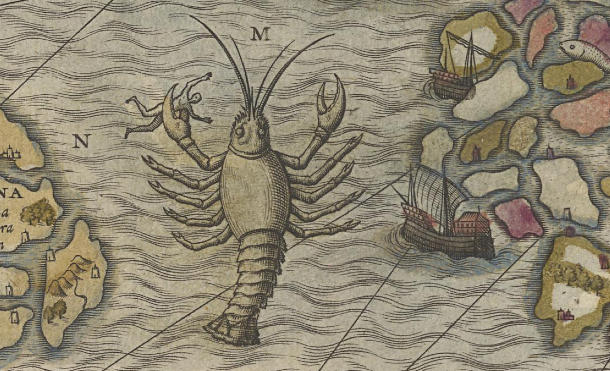
Illustration from The Carta Marina of Olaus Magnus, 1539.
Hello, LWON community! I’m new to the blog, and I’m thrilled to be included in this excellent company of writers and readers. I hope you’ll enjoy my first post.
———
Lauren drew her feet up slowly from the water and gave me a look somewhere between worry and wonder. It was late afternoon, and we sat together beside a swimming hole in upstate New York. Deep shade, cool breeze, a reprieve from the scorch of August. Nearby, water bugs the size of pinto beans surfed in tight formation and our kids scuttled over moss-skinned rocks.
She said, “What might be in the water that was biting me?”
This was a question I had not expected, and I felt my eyebrow rise, Spock-like. It wasn’t that I doubted her, but she was from California and this was an eastern river. In a lifetime spent wading and wandering, canoeing, swimming and skating over water like this I had never been bitten by anything that I had not first harassed with a pole or a net or my own dumb hands. Lauren hadn’t done any of that. She’d simply slipped into the current with her young daughter and sat there.
I ran quickly through a list of suspects—fish, snakes, turtles, crayfish—and quickly dismissed most of them. Sort of feebly I suggested that sunfish or minnows had done it, something small and harmless. Think of those spas, I offered, where people let fish nibble on their toes.
“I think they call it ichthyotherapy.”
Lauren’s eyes narrowed.
“It was more than a nibble,” she said.
I stood and looked back at the swimming hole. It lay below a wall of sedimentary rock, over which ribbons of white water fell into a broad emerald pool. Earlier I’d stood at the top of the wall, peering down, scanning for hazards before I leapt. I’d seen sunfish floating near the surface, and way down deep I’d glimpsed several carp. They were huge, Devonian. Some as big as my four-year-old. But even those monsters wouldn’t come for human flesh.
Suddenly I felt thrilled and also unnerved. What lived here that I did not know, that I could not name?
———
I hadn’t expected much from that particular river. It ran just south of Albany, not far beyond the city’s industrial fringe. Also it was wedged between a highway and the Hudson River—twin channels of traffic and trash. But I’ve learned that with my kids, all of them Brooklyn-raised, I must take every chance to be with them in nature. So even if the swimming wasn’t great, even if the water was sludgy and looked mean, even if we didn’t go swimming at all, the trip would be worthwhile. Because it took us into the woods.
The swimming turned out to be perfect. Jumping in you felt yourself slice through gradients of light and heat, from green to gray to shivering black. That there were not only fish in the depths but also snakes along shore and many birds in the trees above settled my worry about water quality and added an extra dimension of joy. We weren’t merely swimming, we were sharing space with other beings.
But now there was a mystery, and I badly wanted to know who the biter was. I was embarrassed that I hadn’t been able to figure it out. I’d been raised in the East. I’d been a park ranger in Massachusetts, worked as an outdoor educator in Maine and New Hampshire. When I was a kid we’d even lived on a river: it was called Neponset, a word of the Massachusett people that might mean “harvest river,” or “river that flows through meadows.”
By the time of my childhood, in the 80’s and 90’s, the meadows were mostly gone and the river had been so tamed with embankments and spillways, so constrained by yards and highways, that no one considered it a wild thing anymore. It was shallow, sluggish, colonized. Not the sort of water that held many mysteries. Though for my three brothers and me it did hold treasure. Wading there we found freshwater mussel shells (though almost never a living mussel), old bowling balls, automobile brake pads, purple patent medicine bottles, once a license plate and many times a netful of leather scrap—ancient waste from the mills that had thrived upstream.
Looking back, we probably shouldn’t have been wading. There wasn’t much alive in that river but what did survive there we found, and caught, and came to know. It set the stage for later discovery, and I see now that it also made me feel too sure of myself. By the time I brought my kids to the swimming hole in New York I didn’t think little rivers could still surprise me.
———
Out on the water a local kid floated face down over the deepest part of the pool. He looked dead but was just watching fish, wearing a diving mask. He’d told me earlier that I could borrow the mask and now I had a reason. I started for him, wading into the shallows, stepping slowly for I was barefoot and the rocks were shingled and sharp. Suddenly my four-year old leaped onto my back. I wobbled, caught myself, and tried to right his squirming, squealing weight. Then something bit me.
It wasn’t painful but it also was not the soft pucker of a goldfish. I felt sharply, assertively tasted, and I sort of leaped and yelped and almost toppled over, to the delight of my son who hooted like a cowboy. What the fuck! I said, too loudly, and then I was bitten again.
It was more of a pinch this time and still not painful, but I jumped anyway and when the sediment swirling around my feet washed downstream I saw something coiled in the shallows. It was pale yellow, wound up like a viper. For a moment I thought it was a snake and I fumbled backward in alarm. But then the thing flashed away so fast and fluidly that I knew it was no reptile. This was an eel.
———
I went briefly manic with joy. Of all eastern riverine creatures I had never seen an eel in the wild.
I shouted to Lauren. “Eels! Eels! That’s what was biting you!”
She looked up and made a face like eew. My partner looked up blankly from where she was feeding our six-month old. My other son, still on my back, had no idea what was happening, only that this was the best piggyback ride ever. I turned to the water and laughed. Then I waded in. I stuck my big toe forward, an offering, trying to lure the eel back for a closer look.
I didn’t see him again. When I finally caught up to the kid with the diving mask he was not impressed with my story. Maybe he was 10. Already he’d seen it all, at least in swimming hole terms. Yeah, he said. They hang out with the carp.
———
That night, after showers and tick-checks, I stayed up late reading about American eels. I knew they’d once been ubiquitous—thickly present in rivers up and down the East Coast—and that like many other indigenous creatures they’d suffered staggering declines under pressure from fishing, pollution, habitat destruction, you name it. But that was where my understanding fell off.
For many years I’d thought of eels as one more fading star in the constellation of native North American wildlife. So many of those stars had already blinked out, and lately I had started to notice more and more of the dark spots, the emptiness left where life had once been. Maybe it was a function of parenthood, or middle age. I had become so inured to absences that it hadn’t even occurred to me that eels might dwell in that swimming hole, living out their curious catadromous lives, waiting for some secret signal to swim back home, to the Sargasso Sea, where they would reproduce and die.
———
About a week later I told my dad the story. He laughed and said, “You know there were eels in the river behind our house.” I had not known that, and right then my mind was blown. Not once in a decade of living beside the Neponset had I ever seen an eel.
“Yeah,” he said, like it wasn’t news at all. “They lived under the bridge.”
I have still not quite recovered from this revelation. And it has strange consequences. Over the last few days I have felt the cloud of memories that is my childhood rearranging itself, pushing out at the edges to accommodate eels. This sort of thing does not happen often, not for me anyway—that memories get updated, the past gets edited, grows larger. Usually our lives go the other way. They close in.
The other thing is that, before I sleep, I find myself trying to imagine the eels now swimming into my memory. I can almost see them, feel them pushing upstream. They are silver and slimy in the moonlight. They burrow into the mud and wait. The river is no longer little but vast, linked to the sea and busy bodies. I am trying to make sense of it all. How they’d been there the whole time.
My violin teacher had a special style. When I had finished fussing with my shoulder rest and rosined up my bow, I would step up to the music stand where she was waiting for me, her own resonant, professional instrument in hand. Together, we would play the assigned music.
I don’t remember ever feeling alone or judged in that carpeted basement with my father waiting in her family’s living room upstairs. Whether I had practiced at home or not, we were two friends playing music together. She would take me to concerts at the arts center and when I giggled at the funny way the pianist bounced out of his seat playing the stronger chords, she would giggle along with me.
I once took a babysitting course where the most valuable instruction was that on meeting a new child I was not to go up to the kid and start asking questions. Rather, I was to sit on the floor and engage myself with play. Soon enough the child would come over to see what was so interesting, and I would invite them to join in the construction or crafting or make-believe scenario, whatever the play was. Before long the project would be under the child’s direction, with my role to facilitate and offer the odd suggestion.
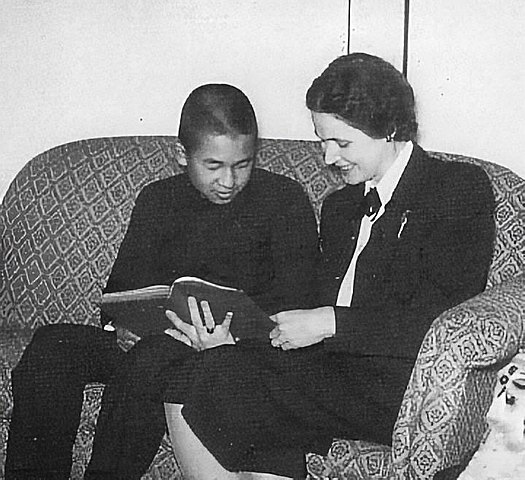
This natural way of learning works well for collaborative work, for modes of expression like music, and also for language. Vocabulary lists and ‘repeat after me’ have never given a single student fluency, because communication is a shared activity. That’s why Elizabeth Gray Vining, the American Quaker who tutored the Crown Prince of Japan after World War Two, started his English lessons by playing tennis with him. She managed to impart the idea of a world without war while gradually building his English proficiency through natural conversation from ages 12 through 16.
I don’t think this style of teaching needs to be one-on-one, but it’s hard to deliver as a system. You find the child’s zone of proximal development—a level of performance they can’t reach alone yet but can do with a bit of scaffolding—and you just explore it together. It’s a form of cognitive apprenticeship that may be what some unschooling parents are aiming for these days in their home schooling.
As AI tutors start rolling out, there is potential for this feeling of solidarity in learning at scale. OpenAI has a model spec called “Seek the truth together” that expresses it well, and I sometimes have the sense—in glimpses, at least—that I’m working alongside a curious companion.
In a time when it’s not at all obvious what we should be teaching children to prepare them for the near-future world, perhaps it’s time to let go of adversarial, evaluative instruction altogether and simply explore together. The teacher of the 21st century is, whether she likes it or not, a novice. She might as well walk alongside a child, equal but for the length of her stride and the measure of her days.
One of the great joys of gardening is learning how stuff grows. Did you know that green beans are just baby bean-beans? You harvest them when the pods have developed but before the beans inside get plump and then hard. Green peppers are just unripe red (or orange or yellow) peppers. Green olives are just young black olives. Cherry tomatoes are just … no, they’re just bite-size tomatoes. The green tomatoes in fried green tomatoes are just unripe tomatoes, but some tomato varieties are green (or black or yellow or orange) when they’re ripe. White button mushrooms grow into cremini (baby bella) mushrooms, which grow into portobello mushrooms.
Artichokes are the flower pods of a gigantic thistle plant. Seriously.
Do you know how to grow ginger? Plant ginger. It’s a root, so if you stick it in the dirt, it’ll send up grassy shoots and spread, and at the end of the season you’ll have more ginger. Same goes for potatoes and garlic. Coriander is just cilantro that has gone to seed. Hops grow on vines and smell like beer. Bay leaves come from bay trees. Asparagus shoots up out of long, ropey, horizontal roots, and if you let the stalks keep developing, they’ll grow wispy fronds out of their tips and get as tall as you are.
I was showing a (very smart) visitor my garden the other day and she was delighted to learn that blueberries grow on bushes. There’s so much about food we don’t know! Or didn’t always know. The first time I grew corn, I ordered a packet from a seed company and laughed and laughed when I tore it open and found … corn. Obviously corn grows from corn, but I hadn’t really thought about it before. You grow beans from beans, peas from peas.
I love to see people share their garden porn photos on social media this time of year. People are so proud of the produce they’re harvesting, as they should be.
I garden out of interest in how stuff grows and for flavor. Fresh-picked herbs and vegetables make it a lot easier and more delicious to get your five servings a day. (Even if you’ll get so sick of kale after a couple of weeks of kale.) It’s fun to eat produce varieties that you can’t easily find in groceries because they’re too delicate (like tart cherries, which grow on trees) or weird (like tie-dye tomatoes). But you can’t sustain yourself on a backyard plot, no matter how many potatoes you plant.
Gardening is itchy, achy, tedious, hot, endless work. The people who grow, harvest, process, and prepare food for a living are heroes and deserve safe working conditions, honest wages, and protection from being abducted, imprisoned, and separated from their children.
Anyway, this is a fuck ICE post. Fuck ICE. May the thugs in the U.S. Gestapo never be welcomed into a restaurant again or know the pleasure of a fresh vegetable.
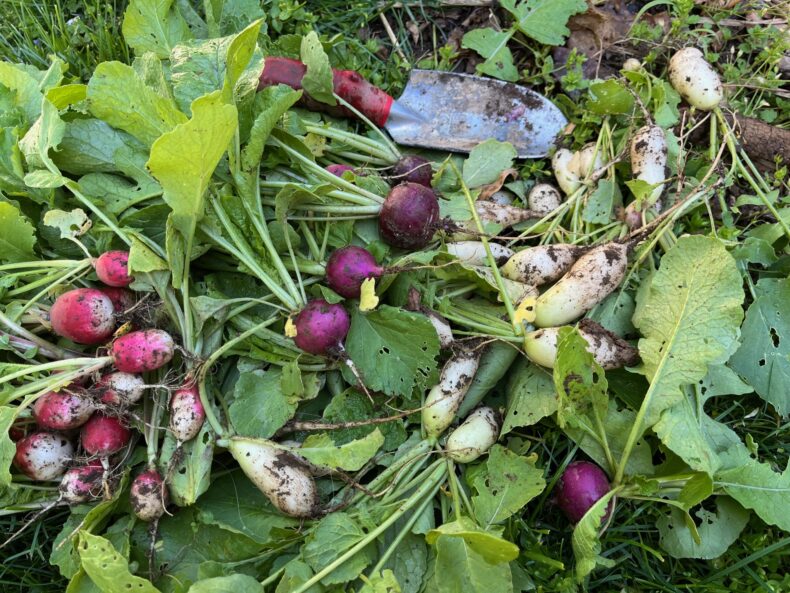
Photo by Laura Helmuth, who planted way too many radishes this year.
My daughter’s obsession with capybaras began about six months ago. One day she was drawing mushrooms with cat ears, the next she was drawing capybaras and only capybaras. She watches videos of capybaras. She sings the capybara song. She purchased a capybara stuffie that is also, improbably, a burger. She taped a piece of notebook paper to her wall that reads: