The Body is a Compass

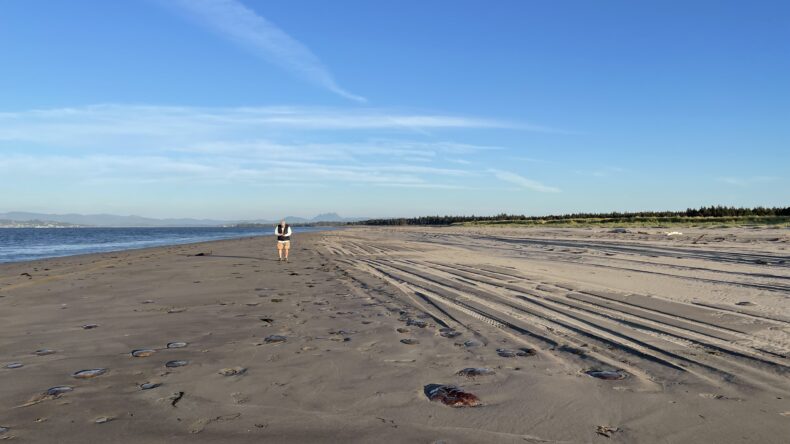
The picture is of a bit of soft mountain lion fur plucked off the barb of a sagging barbed wire fence. I’m on day 87 of 100 walking 200 square miles around my house in Colorado, mostly on public lands where wild animals hold sway. Today was a steep, wooded draw choked with boulders and their puzzles of green, crusty lichens. I’ve come down this draw a couple times since last winter when I followed fresh mountain lion tracks into a snowy slope of boulders as big as garbage trucks and the ringing in my head grew loud enough I decided to stop and not follow the cat any farther. I was coming into ambush terrain and though chances of an attack or any negative encounter are astronomically small, I heeded the bell. 

What I’ve learned in 87 days has come slowly and steadily. I started following animal trails a year ago for a book I’m working on in western Colorado almost to the Utah line, transecting this 200-square-mile area back and forth through gullies, canyons, mountains, and mesas. Pretty much every day has significantly upped the learning curve. Today’s recognition was that the map in my head is becoming a map in my body. I don’t mean this on any grand scale, but the draw I walked down I could feel coming for miles. I no longer refer to the map on my phone. I’m going by memory, which is how a mountain lion would perceive geography, knowing this draw like many animals do — the deer, elk, bobcats, bears — as a ladder connecting into a lower, deeper canyon where a crystalline creek babbles day and night. I wouldn’t say I’m no longer capable of being lost as I have been a few times so far, my heart beating faster among columns of ponderosa pines that have started to look all the same. I can still get lost, can still screw up, but my senses tingled with a fresh awareness of how the land lies.

Continue reading

Rocket, Maybe?

Rockets used to be fun. There was a time when, if we heard there was going to be a launch at Vandenberg Space Force Base—about 50 miles away—we’d head outside with binoculars and cheer when the rocket crossed the sky overhead.

Last year, there were 51 launches. During most of them, we were shaking our fists at the sky instead.

When I told one of my kids that I was going to write about rockets, he said I should call it, “Residents disturbed by extremely loud noises.” One night the sonic boom that hit at dinner sounded like the rocket had fallen on our roof. (I might have jumped out of my chair.) Another time, before dawn, the boom shook a window shade off our bedroom window. I’m not sure if I woke up before or after it crashed to the floor.

A passing rocket can feel like an earthquake, or like a semi is about to crash through the front door. (We’re feeling thankful that our extremely anxious old dog is no longer here to suffer through it.) People across the region have been starting to pay very close attention to the launch schedule, planning to be home with pets, or to avoid being surprised themselves.

Continue reading

Farewell My Fun Friend: A Tribute to Donni Reddington

From the moment I met her, I knew that Donni Reddington would be a Fun Friend. A Fun Friend is someone who brings the party and is always game. A fun friend sings out loud to the radio and breaks into dance without ever worrying about looking foolish. Donni was all of those things and more. She would hoot and holler while mountain biking and she had a special connection with her animals — horses and dogs and even a bearded dragon. 

Our friendship revolved around doing things — skate skiing and hiking and mountain biking and drinking beer. When we went adventuring, we generally just tried to have as much fun as our dogs. We also talked about work and marriage and aging parents and the weird shit that perimenopause was inflicting on our bodies. 

I only knew Donni a few years, and with our busy lives we didn’t get together as often as we wanted. But every time we did, it was a blast. Shortly after Christmas, she confided to me that she had just been diagnosed with cancer for the sixth (!!) time in something like 12 years. I hadn’t known her history. She seemed so full of health and vigor, it was hard to believe. 

Continue reading

When Deer Attack

Two deer in a suburban backyard.
Dangerous animals (truly) in a suburban backyard. Credit: Laura Helmuth

I witnessed a minor Drama in Real Life the other day while biking along the Western Maryland Rail Trail. Several deer were foraging by the side of the trail as I passed them, then I heard a bang and a scream (deer) and another scream (human). A full-grown deer had leapt into the trail and rammed another biker, throwing her off her bike. The biker had scrapes all over her arms and knees, and she was pretty shaken up. She’d just been attacked by a wild animal!  Fortunately, she didn’t hit her head (no helmet) or get kicked by the deer, but she was a mess.

My biking companion and I had some ancient first-aid kits and helped her get cleaned up with alcohol prep pads and some antibiotic cream. Our band-aids were too small and not very sticky anymore, so that didn’t help much. We gave her some water, made sure she hadn’t broken her wrist, and talked with her for a while until she was steady enough to get back on the bike. Again, a very minor Drama in Real Life, but I took away a few lessons that I’ll share in case they’re useful for you.

(For anyone who hasn’t read Reader’s Digest, Drama in Real Life was a regular column recounting just what the title says, and the dramas were typically life-or-death. I remember reading one when I was a kid about a Boy Scout who saw someone in a horrible accident that caused an abdominal wound, and their intestines were spilling out. The scout helped push their guts back in (in my distant memory of the story), and it was the most disturbing thing I’d ever read in all my 9 or so years.) 

Anyway, take-aways. Always wear a bike helmet! This trail is wide and smooth and level, with only a few back-road crossings and no car traffic. If it’s okay to skip the helmet anywhere, you’d think it’s there. Even if you don’t get rammed by a deer, there are so many ways to fall off a bike. Skulls are so thick but so fragile. 

Refresh your first-aid kit. I’m getting a bunch of new and bigger bandages to stick in my bike bag and backpacks, and more antibiotic and antiseptic stuff. Skin is so thin and so fragile. 

Deer are big and strong and fast and stupid, and that is a dangerous combination in a non-human (or human) animal. And they are deadly. Depending on how you do the estimates, 150 to 440 people in the United States die from interactions with deer each year, most involving car crashes. The most dangerous time is in the fall, during rutting season (stupid things are stupider when they’re looking to breed). Deer typically run in groups, so if you see one deer crossing a road, assume there are others behind it and watch out. They’re most active at dawn and dusk, so keep an eye on the side of the road and be prepared to stop. If you can’t stop in time, it may be safer to hit the deer than to swerve and potentially hit a tree or another car. 

The deer population in the East is probably higher than it’s ever been. In addition to causing dangerous accidents, deer sustain and distribute disease-vector ticks, and they destroy habitat for ground-nesting birds. I’d love to see a wolf- or cougar-reintroduction project that would bring back their predators, but for now the only thing that kills them is hunters and cars. Be careful out there? And please share your own nemesis-deer stories in the comments. 

The Benefits of Tiny Friends

Zebra jumping spider (Salticus scenicus). Betsy Mason

If you ever have the opportunity, I highly recommend making a tiny friend.

How tiny, you ask? I think it helps if your friend is big enough to be visible to you (though this isn’t strictly necessary) but small enough to be outside of the category of beings you would normally consider friend material.

The act of befriending someone small and unlikely can change the way you think, about friendship and about who is worth knowing and caring for. It may change your perspective on who matters. And it could offer a respite from the complications of being a human.

If you’d like to give it a try, here are some potential tiny friends to consider: spiders, snails, and bees.


Spiders

Those who know me will probably not be surprised that I recently befriended a jumping spider.* She appeared in my house one day in March, tucked into the upper corner of a window frame near the front door. Soon she was exploring the seam where the wall meets the ceiling (if you want to find a jumping spider, or any spider, in your house, this is a good place to look).

Some jumping spiders do fine indoors, assuming there are flies to prey on, but they are often thirsty. So I stood on our entryway bench on tiptoes to offer this spider a drink from a wet Q-tip. She backed away, but then inched toward the offering, pedipalps waving madly. Once she realized there was water, she latched on and drank for a good 10 seconds.

Continue reading

Reclaiming my time

In 2018, I wrote the post below about bedtime procrastination. The term was new to me, the concept was not. I was a bedtime procrastinator. And, spoiler alert, I still am a bedtime procrastinator. Zero improvement.

There’s a new term now, an even more delicious one: Revenge bedtime procrastination. Here’s how a Web MD article defines it: “It means you get ‘revenge’ for your busy daytime schedule by fitting in leisure time at the expense of shut-eye.”

Who am I retaliating against? In this case, I am both the subject and object. Who will win? Me, by reclaiming the time work, children, and chores have stolen from me! Who will lose? Me, by getting so little sleep I am irritable and exhausted the next day (or, because this is habitual, every day). Whee!

*****

Yesterday at 8:23am, my husband texted me a link. No note, just a string of random letters and slashes and dots. I clicked and landed on a research article titled “Why don’t you go to bed on time?”

The manuscript begins like this: “Most people do not get enough sleep on work days despite sleep’s importance for well-being, performance, and health. A phenomenon held responsible for promoting insufficient sleep on work days is bedtime procrastination. Bedtime procrastination is defined as ‘going to bed later than intended, without having external reasons for doing so’, that is, ‘people just fail to [go to bed].’”

Continue reading

The Forgotten Volcano

A couple of weeks ago, I climbed Mount Adams with my good friend Carson. Our plan had been to climb Mount Hood, but schedules being what they were we could only get away from Friday to Saturday. Weekends on Hood can be pretty crowded, so Mount Adams was something of a fallback. A consolation prize.

Mount Adams is one of the five major volcanoes in Washington, but is somewhat anonymous as those peaks go. I’ve seen it referred to as “The Forgotten Giant of Washington” or “The Forgotten Volcano.” A curious fate, given the mountain’s immense size. At 12,280 feet in elevation (give or take), with over 8,000 feet of prominence, it is the second-tallest mountain in Washington, after Mount Rainier. With a volume of some seventy cubic miles, it is the second-most massive of the Cascade volcanoes, after Mount Shasta in California. More than a mere bump on the landscape, in other words.

Second in this, second in that. Maybe that has something to do with Mount Adams’ air of understatedness. Even its present-day name in English nods at a penchant to obscurity. George Vancouver may have named Baker, Rainier, St. Helens, and Hood after British gentry during his 1792 expeditions, but somehow he and his survey parties overlooked the tall peak just beyond Rainier and St. Helens, which was eventually named after John Adams. (The second president!) That said, the mountain would have its moments. In 1805, while canoeing down the Columbia River, Lewis and Clark wrote of seeing “a high mountain of emence hight covered with snow.” They supposed it to be “perhaps the highest pinnacle in America.” Good on Adams! Save for the fact that Lewis and Clark thought they were looking at Mount St. Helens.

Continue reading