I like to run this post on Memorial Day (the first version ran May 28, 2012) because when I think about soldiers and wars and Memorial Day, I think about Uncle Bundy. He was awfully opinionated and excessively direct but I admired him greatly and listened when he talked. Not he ever talked about the war, he didn’t. But in this case, what he was talking about is an ancient link between war, technology, and humans — a link began when someone first improved a stone into both the first hammer and the first spear. I’ve heard it about this link from many technologically-inclined people; I heard it again just the other day. Uncle Bundy has since died — at a nice old age with his family around him — and I miss him.
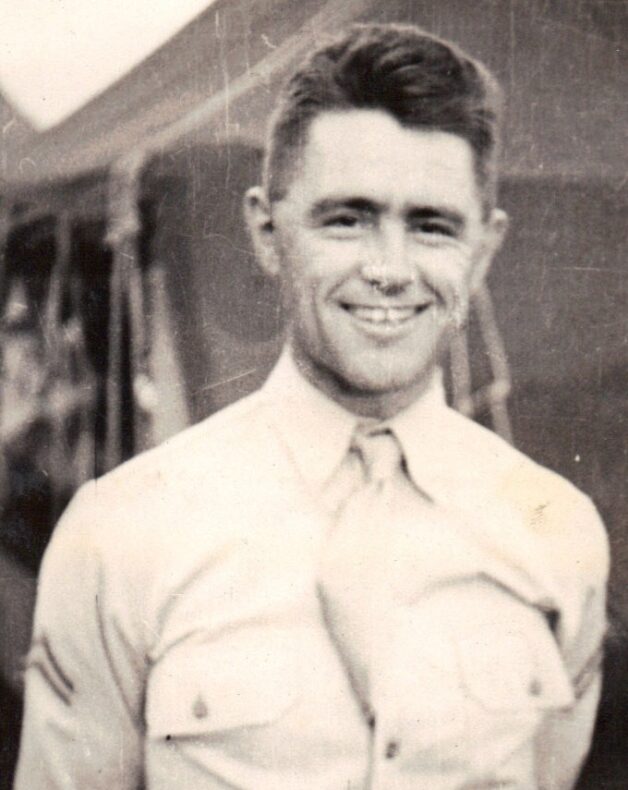
It’s Memorial Day in the U.S. but this is not a war story. It does have a little war in it, but the real reason I’m writing it is because of this ball bearing my uncle had. My uncle’s name was Leverne, some of his buddies called him Vernie, all his relatives called him Bundy – no reason for that – and he’d always been a mechanic. One summer day a long time ago, he was out in his garage working on a car and I was watching him. “Look at this,” he said, “it’s a ball bearing.” It was a grooved ring, and running in the groove were little metal balls. “I just greased it,” he said, “and look how pretty it goes.” He ran his finger over the little balls and, one after another, they turned smoothly and easily in their groove. “Isn’t it pretty?” he asked. No, it isn’t, I thought, but I didn’t answer. I was in high school and an English major. It’s greasy and dirty, I thought. Poetry was pretty, not ball bearings.
Bundy was a farm boy who went to high school, then in November, 1942, joined the army. He was sent first to the University of Utah, then went back to regular duty. Then he requested to be sent to the Fort Sill Motor School, then went back to regular duty. Then he requested to be sent to the 668th Field Artillery School, then went back to regular duty. Then he requested to be sent to the Schofield Barracks Motor School in Hawaii, and he learned to be a mechanic. He never got a college degree.
In 1944, he got on a Liberty troop ship, a little hollow tub short enough and the Pacific waves big enough that the ship went up one side of a wave and down the other while the seasick troops lined up along the deck and threw up over the side. The ship was headed for the Philippines, to the battle of Leyte in which 3,000 Allied troups and 10,500 Japanese troops were being killed. By this time Bundy wasn’t really mad at anyone any more and didn’t want to fight; and anyway Leyte turned out to need materiel, not troops; and besides the war was ending, so Bundy was just as glad when the Liberty ship turned around and went to Oahu, where he spent the rest of the war.
He came home to Illinois in November, 1945. He and Mitzi, his new wife, lived in an unheated upstairs room in his sister’s house. He got a job fixing cars and tried to figure out a place to live. He found a little octagonal house that had been built for either hired hands or pigs, and bought it for $2,300 which he borrowed from his mother. The house was too far from work so he bought a lot nearer by, and then he measured up the house and measured up the lot. Next he dug two rows of post holes and in the holes he stuck stove pipes which he filled with concrete, and this would be a foundation. Then he asked his two brothers and his brother-in-law if they’d be willing to help move the house; and next he asked a customer at work if he could rent the customer’s flatbed truck for a Saturday at the going rate of $3 an hour. His plan was to raise the house enough to back the flatbed under it.
He remembered seeing some 30-foot timbers somebody had left out along Route 66, and he and his brothers went out and picked them up. They brought the timbers back to the house and with two hydraulic jacks, jacked up first one corner of the house and wedged a timber under it; then jacked up another corner of the house and wedged a timber under it, then went back to the first corner and jacked up the timber and wedged another timber under that one; and pretty soon the house was perched on the timbers up higher than the truck. Then they backed the truck under the house, timbers and all, and headed out — Bundy stood on the roof to lift up any telephone or electric wires. When they got to the lot, they backed up to the foundation, unloaded the house, trimmed it up, and reversed the jacking-up process, removed the timbers, and rested the house on its foundations. It worked exactly as planned. Bundy paid the customer $9 for three hours rental, plus $1 tip.
Bundy and Mitzi lived in the house for five years, then sold it to his mother and moved to a house that could fit the six kids they eventually had, and where they lived the rest of their lives. Bundy kept being an auto mechanic and by the time he retired, he owned his own garage. Once my brother had questions about his college physics problems, and Bundy figured out the vectors and derivatives intuitively and got the answers. Bundy told me in the 1970’s to hold on to the Dodge slant-six but for my next car, give up and buy Japanese because otherwise Detroit wasn’t ever going to learn. At age 91, he was fairly creaky but as bossy, opinionated, righteous, and as impressively, precisely competent, smart, and ingenious as he ever was.

Four months before Bundy got out of the service, the war had ended with the atomic bomb. That bomb has famously been called “technically sweet.” Technical sweetness is the perfect match between form and function, between a technology and its purpose. Technical sweetness is the satisfying mental click of a thing that’s exactly what it should be and nothing more; a thing that does perfectly what it was meant to do. Technical sweetness is highly aesthetic and utterly compelling. The U.S. has always been good at technical sweetness, both in training people in it and doing it, for both ill and good — because like other principles, it intrinsically has two sides. The military calls this two-sidedness, “dual use,” and the term makes my blood run cold. But there it is. We’ve always known it. Technology can be good, it can be bad.
Over the years, I’ve interviewed whip-smart country boys who had gone into the service, had gotten a technical education, worked on one bomb or other, then come out of the service and gotten educated as physicists and gone on to stellar careers and even a Nobel Prize. I also interviewed ones who didn’t get educated but got jobs as lab technicians; or they got educated and became all kinds of engineers; or they did or didn’t get educated but they write scientific software.
I’ve always thought Uncle Bundy would have fit right in with them. I wish I’d told him that. In other words, between the time I stood in my uncle’s garage and now, I learned to understand technical sweetness. And as technically sweet as a bomb and much, much prettier? A ball bearing. I wish I could tell him I know that.
__________
Photos: Bundy – unknown; ball bearing – Niabot

As a long time reader, I’m surprised that I haven’t read this story before, but I haven’t. So, thank you for re-posting it.
Your uncle’s life story is interesting but the more impressive story is yours. Although understated, it is clear that you moved beyond the myopic prejudices of your teenage years (woe be it that some don’t) to later appreciate your Uncle Bundy, in all his quirks, and to enjoy the delight that he had for things you barely understood. Such growth and wisdom generated an entire career interviewing visionaries, scientists, and builders.
This probably pushes the boundaries of the term but I think this story too is “technically sweet”.
How nice of you, Tom! Don’t you think we all do that though, grow up, learn some things, change our minds? I’ll bet you do.
Ann,
Overall, yes, I agree most people mature. But, not everyone does. Today, with have a U.S. administration that is peppered with individuals who still have the mindset of a High School Sophomore.
More importantly, regardless of the ubiquity of growth, wisdom and maturity in the general population, I think it’s nice to acknowledge it when I see it, especially when the exhibitor is unassuming. It’s kind of like giving a nod that says “I see what you did, nice move”.
I stand in awe of Uncle Bundy’s willingness to move his own house. That degree of get-the-job-done attitude – and the leeway to pull it off – seems to be in short supply lately. And as for the bearings – I’ve got a choice few that I’ve kept nearby my desk for years, merely because they pleased me as technically sweet.