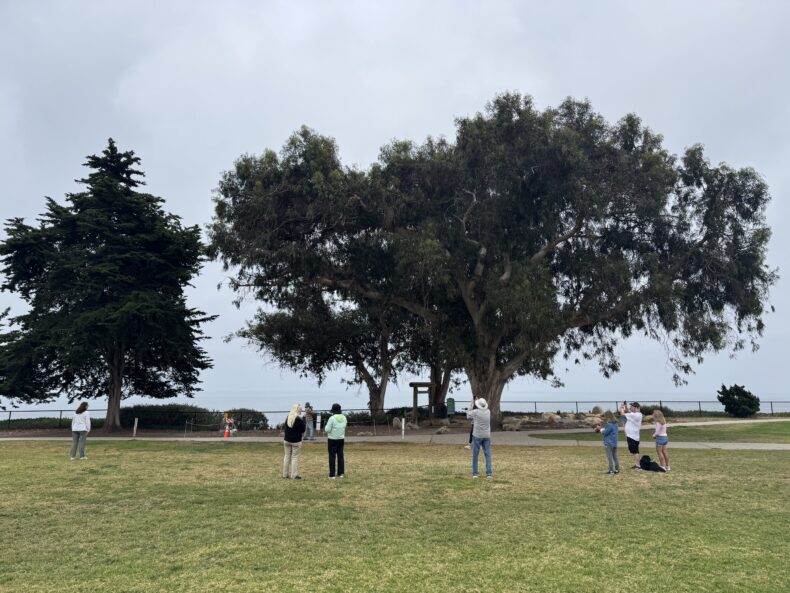
In April, the sun started rising early enough so that I started walking or running near dawn. Each time I returned, there were people gathered underneath the same cluster of eucalyptus trees in the park and I didn’t ask why. I mean, I wondered why, but people do strange things sometimes.
Then, a few weeks ago, my friend Annie asked if I’d seen the owlets.
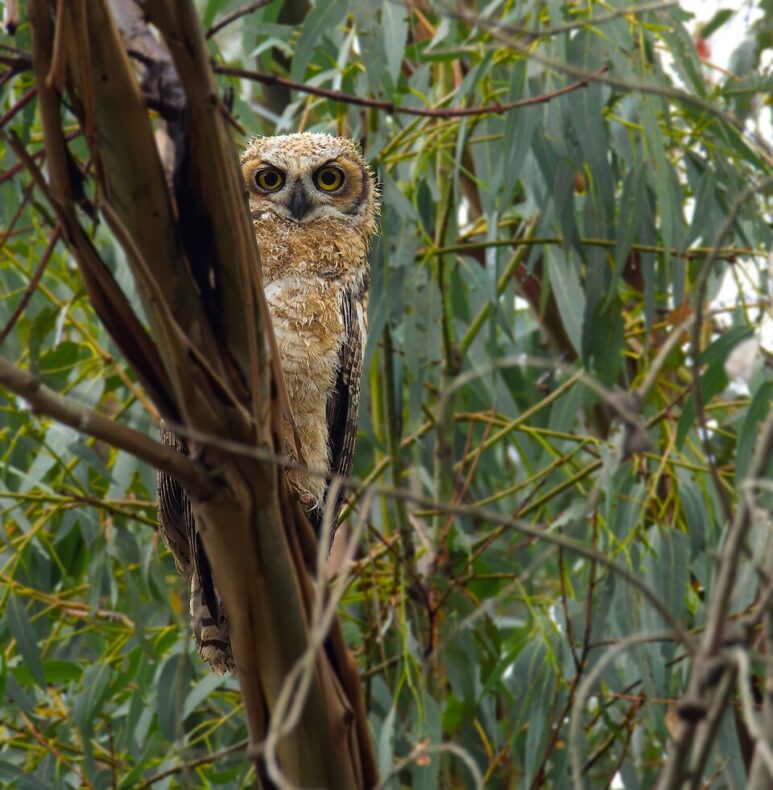
The next time I walked by the small knot of people beneath the trees, I stopped and looked up. Where are they? Someone pointed. And there they were: three fluffy white owlets lined up on a branch like bowling pins, and overlooking them, a stern-faced great horned owl.
The owls, I later learned, had been nesting there for months. Great horned owls usually move into another species’ nest over the winter. They need to start early, because once hatched, their owlets need more time under the watchful, night-seeing eyes of their parents compared to many other birds. A local naturalist told me that the owlets, even once they’re flying — one already is — will still return to their parents throughout the summer, maybe even into fall. The parents will continue to feed them, even though the young owls can hunt on their own. “Like college students,” the naturalist told me.
This is the first place I’ve lived where I’ve gotten to know owls. When the days start to shorten again, a slow hoot starts up from the trees in a nearby yard. Over the weeks, sometimes there is a second owl that starts to call back. Standing outside in the darkness, I can’t tell where the sounds are coming from, only that there are two different owls, and they seem to be calling from everywhere. My next-door neighbor and I text each other when this happens: Do you hear it? Owl emoji! Heart emoji!
At the dusky bookends of the day, a few owls came closer. One owl sat on a stop sign down the street as I walked by with a child who’d woken too early but couldn’t be coaxed back to sleep. Another night, another owl: this one flying above us on silent wings as we stretched out on the trampoline in sleeping bags, wondering whether we could sleep all night out there. (The answer seemed to depend on the age of your back.) At the local natural history museum, where we’d often linger past closing, we’d tiptoe in front of Max, the resident great horned owl. His hoot was too startling for small ears, reverberating from his aviary in the museum’s backyard.
But it’s been so long since I’ve lingered with my kids in the places where owls might find us. I used to linger, too, on the floor of Annie’s kitchen every Friday afternoon, when our kids were small. This fall, her oldest will head off to college. Earlier this week, we watched our eighth graders board a bus to Oregon, where they’d bike and camp to celebrate the end of their time in middle school. Even though they’ve traveled like this before, as they shouldered their duffel bags, they seemed both bigger and so small this time, nearer and so much farther away.
When she first told me about the owls, Annie said that what the fledglings are doing, inching out on their limb, has a name: branching. A parent watches nearby as these owlets, not quite ready to fly, start to learn that they have wings. That’s what she said she was doing, perched nearby her son as he gets ready to fly.
I’ve thought about it ever since, this idea of branching, that this is a step that owlets and other creatures need to take, between close and far, between helpless and free.
I’ve been thinking about something else she said, too. The owls are often so hidden in the eucalyptus tree that you can only find them if someone else is there to help you look.
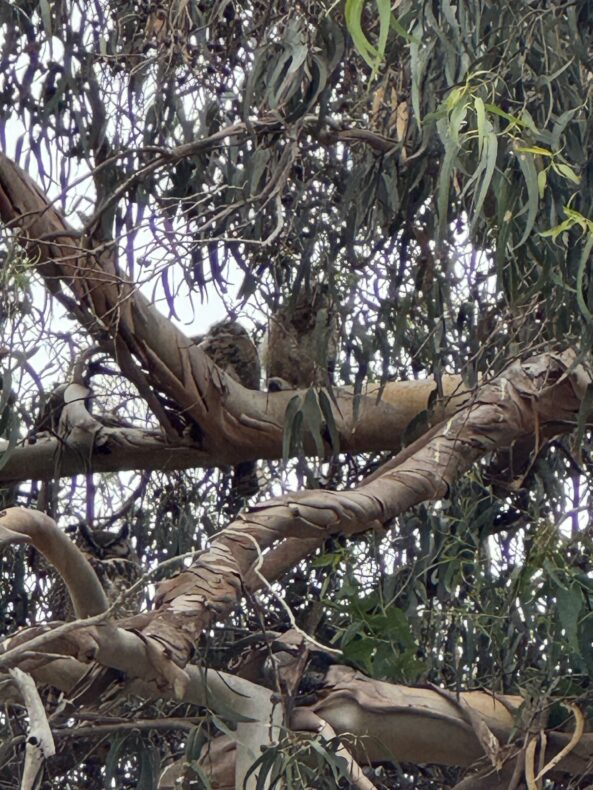
Now I stop every time I pass under the tree. The owls are getting bigger, less fluffy. The city has posted signs and barriers, so people don’t get too close. No one seems to want to bother them. They watch from a distance, some with binoculars, some bringing their heads close together so they can quietly describe it. I came upon them the other morning and got lost in a tangle of owl-like dusky leaves and knobbly tree joints. “Where are they?” I asked the woman next to me.
“See that branch, the one with the fork? Look right above it. You’ll almost think you’re imaging them.” And then they materialized, three fuzzy owlets, and the darker owl, a little farther away this time.
One day, we’ll come to the tree, and the owls will be gone. The signs will be taken down, and people will walk by again without stopping, as if nothing had happened.
But maybe one evening, once the days shorten, I’ll hear a single hoot. A few weeks later, two.
I won’t be alone. My next-door neighbor and I will text each other: Did you hear it? Owl emoji! Heart emoji! We’ll tuck ourselves in our beds, one on each side of the wooden fence between our houses, under the watchful eyes of the owl. Still branching, we fall asleep as the owls echo each other into the night.
**
Top photo: Channel City Camera Club/Steve Colwell, via Wikimedia Commons/Creative Commons license

