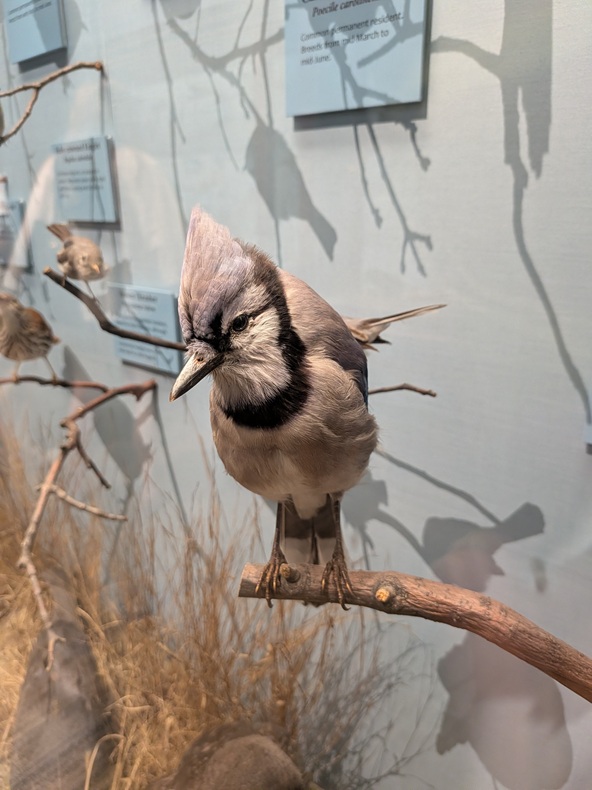
The world is a lot right now, so I want to suggest that you find some little delights to keep your spirits up. Perhaps start with birds. (And if that doesn’t work, there are always dogs.) Last May, I wrote about how I’d become a bird spy. A year later, I’m still obsessed with my birdcam.
What I love most about it is that I can observe the birds in my yard up close and personal. I can watch how they eat the birdseed and the cute little sounds and calls they make and the ways they interact with one another at the feeder. It really does feel like spying, but hopefully in a non-creepy way. I’m just interested in these creatures!
One of the things I especially like about the cam is that it alerts me when there’s a bird at the feeder. Sure, this can get to be a lot, since there are usually birds at the feeder. But oftentimes I get pinged when I’m not home and/or occupied elsewhere and it’s a lovely little reminder to look outside and see what’s happening in nature.
I might be in a board meeting in Washington DC, but I can see that there’s a Lazuli bunting at my feeder, and isn’t it pretty?
See those little round plants? The flat ones? They’re ferns. Ferns! Did you even know ferns came like that? Not a frond in sight? Little flat discs? Well, they do! They grow in many, many wet places in Japan, often among the wee mosses and lichens, which means I’d seen them for a long time and never known what they were – until Google Lens came along to help me. The ones in the photo above have sent up long, skinny sporophytes with orange sporangia on the underside, which means they’re ready to reproduce.
Wee round ferns! Two would fit side by side on my thumbnail! My goodness, the world has wonderful things in it.
Hey Alexa, how long can a beaver hold its breath? I’m asking because I was kayaking last night at Totier Creek off the James River and I spotted a beaver swimming from one bank to another, his little head sticking up like a thumb and his body and paddle of a tail cutting a V through the smooth water. And suddenly he went under and never came back up. Believe me, I watched for him in all directions for, like, 10 minutes. The thing was gone.
Alexa didn’t care much about my explanation for the question, nor my decision to call the animal a “he,” but she did tell me beavers can hold their breath for up to 15 minutes on a single dive, plenty of time to get across a waterway without being bothered by a curious human in a kayak who was hoping for a closer view.
For stuff like that, this AI thing is awesome. It may not have all the answers yet, but it has a lot of them and at least when typing your question into a chatbot you can insist on a certain type of source (give me answers only from Nat Geo or National Wildlife or Beavers International magazine or a professional journal) to ensure the answer is credible. (You got me: There is no Beavers International. But if there were I would trust it fully for beaver facts.)
Next, I’ll admit this, with some hesitation: Recently for work I needed to quickly turn around a Q&A I’d done with a scientist, and the transcribed Zoom interview was all over the place and way too long. Desperate, I pasted the whole thing into a chatbot and asked it to organize it logically and cut out the ums and the time codes and the repetition and put it into a Q&A format at about 1,000 words. CHAT did all those things in less time than it took me to blow my nose, which was so helpful I wanted to cry. (Explains the runny nose.) How can one ignore these tools when facing this type of time-consuming effort? I decided I was okay with using AI in this way.
The Friday before spring break, the handful of students who haven’t cut out early or taken off for Eid are sharing some of their favorite new words gleaned from their independent reading: black hole, sound barrier, bookies, puppets, dime, wrist, Wyoming, information. We talk about what each of these mean, write sentences, consider what new worlds they allow us to either glimpse or explain. They dream up a reality to probe.
My students are all between fourteen and eighteen years old, new to the United States from what feels like everywhere, and learning English with the approximate average literacy level of a first grader. Like any child, their approach to language learning is curious, open, data based—in a word, scientific.
We have just wrapped up stoichiometry, or the “recipes” unit. You remember: How many grams of CO2 do you need to make 71 grams of C6H12O6? Some students speak math very well and this they like. Some students speak math very well but their sibling was just deported by ICE and we haven’t seen them in school for three months, so there’s that.
Chemistry has always been abstract—having taught all the other ones over the years, I find it the most hard to wrap our heads around. Physics is laws sterling yet transformable. You can approach it in any order and it builds and wraps back on itself. Biology is the beautiful scattershot, an exploration of how outrageously those laws can be expressed and an affirmation of how much even the sterling transformationists depend on chance or a nudge in one direction or another (you thought this was simply matter or antimatter, velocity or position? Explain what the hell reproduction is please). But chemistry is somewhere in the middle—sterling laws that explain sterling, if you’ll indulge me. Atoms and molecules that we can only grasp in bulk, obeying rules we can only explain in board game form—jump an electron up or down from this ring here, which isn’t really a ring, and also the electron isn’t really here—or elements we line up in a contentious table with a decidedly Earth-based bias. If that matters.
A table is this, I say patting the lab tables next to me. The tape peels off one of my word labels reading “table” like I also have “clock,” “faucet,” “projector screen” and as many other items as I could name and write in the furtive last days of the previous school year when you try to set up everything to make things easier, if only marginally so, for the following September. It can also mean a way to organize information, rows and columns, up and down, numbers or letters in order. Like your data tables. Like the periodic table. Yes, it is organized. We did a whole unit on it in November, periodic trends? You weren’t here yet. Right.
For years, we’d been trying to entice two kiwi vines to create some shade over the picnic table in the backyard. We gave them questionable water during a drought, fenced them off from predatory puppies and toddlers. As the years passed, they just looked sadder and sadder.
Finally, we dug them up and put in a single passion fruit vine, hoping for — well, hoping for nothing, really, but a bit of green. When a neighbor first offered me the withered purple fruit from her vine, I declined.
The leaves appeared within a season and bolted up to cover the arbor. And then last spring: flowers! Delightful fireworks of purple and white. A flower people see their own stories in: for the Inca and Aztec people, the plant’s original cultivators, the flower’s whirl of spokes may have connected it to the sacred Sun. Friars returning from South America in the early 1600s found the five wounds of Christ and the 10 disciples in its petals. In India is is the Krishna Kamal, representing aspects of the Mahabharata; in Japan, the clock flower, for its dial-like face.
Mine is a conversion story. When the fruit started to drop, I ignored them until there simply were too many. They wore me down. Each morning, I cut one open and scooped the seeds onto my yogurt. I started to look forward to the routine: walking out into the yard to find the fruit that had fallen in the night, then the fruit splitting open like a geode, the bright yellow pulp inside the rough exterior.
When I was in high school, there was a poster of life lessons in the bathroom. One of them: plant zucchini only if you have a lot of friends. Years later, I found myself in need of further instruction. Each day became cloudy with a certainty of passion fruit, an endless purple rain.
Enter the humble cardboard box. Alone, for me, it is a sign of mild shame from ordering online. But filled with surplus passion fruit and left by the sidewalk, it become a neighborhood meeting point! A conversational topic with people you’ve never met! A beacon of positivity and scurvy prevention in a cruel world!
Also, it becomes empty. Which is good, because it is spring again, and the flowers are blooming, and the wind is blowing. Soon a morning will come when the ground will be covered in more passion fruit than I can eat. Let me know if you’d like a few.
Last post, I wrote about fish crows, a bird of very few words. A pair of them will be flying along and one says, “krokk;” and after a bit, the other says “krokk” and maybe adds another “krokk” or not; and that’s it, end of conversation.
Fish crows are, like all crows, famously social. And society requires communication: no communication, no community. So crows should have a lot to say to each other and the other crows I have around here, American crows, definitely do. But fish crows: “you good?” “yup.”
As I said in that last post, crow researchers know a good bit about what crows are saying and it’s what you’d expect: they warn each other about threats, they update about threats moving closer, they argue over territory, they tell each other about food, they arrange meetings. The little ones ask for food, the big ones tell them to stop asking. But those are American crows and everybody, honest, every American knows how incessant, how noisy they are. So I have a burning question: how can fish crows say all those things crows need to say if they just say a word or two at a time?
On a spring day three years ago, the river climbed out of its banks.
Unseasonable heat and heavy rain had hit the snowpack high in the mountains, sending a winter’s worth of meltwater in a pulse down the tributaries, into the mainstem, and spilling across the valley floor.
Work seemed unlikely under these circumstances, so I visited the flood instead.
In the park, the river wrapped its arms around cottonwood trunks and overtopped the grass in gentle, reaching puddles. I watched the river push up in roiling parabolas against bridge piers, then drove to the thin riffle where it dashed across the highway. I stopped at a friend’s property, where the river filled swales and ran through the garden and lapped just short of the house’s back stairs. “It’s the Everglades,” my friend said, as we stood on the porch surveying all that mirrored water.
Inside, my friend’s teenage daughter showed me into the bathroom, where she was fostering seven kittens. She placed the smallest—a gray fluff of a tabby—on my outstretched forearm. The kitten toddled up to my shoulder, then curled against my neck and fell asleep. She chose me. And the next day, I chose her.
One week later, I was in a car accident so bad it is hard even now to talk or think about.
Caribou collar compilation provided by the National Park Service.
Last week I traveled to Fairbanks, Alaska, for work. Though the melt had begun, plenty of snow still blanketed the ground and thick rafts of ice clotted the rivers. It had been a big winter in the area, the coldest on record, with 31 days at or below -40 degrees Fahrenheit, and more than 90 inches of snow. People in town were still talking about winter when I arrived, and it was clear it’d live on in their memories, and maybe their bodies, for a long time. The National Weather Service itself—not know for hyperbole—had called the season “a marathon of sub-zero endurance.”
Despite all this spring was insistent, inevitable. The days were bright and mild. On distant hillsides pale painterly washes of red showed where the aspens were budding. At the top of town, on the University of Alaska campus, students were jogging in shorts. And even though the river downtown still appeared frozen solid, you couldn’t trust your eyes. The ice had turned with the season; who knew how much longer it might hold weight. All week I was distracted, partly by the weather—there is nothing quite like Alaska’s spring—but also in thinking of the mysterious forces gathering farther north, way beyond what I could see from Fairbanks.
A couple hundred miles away, above the Arctic Circle, caribou were on the move. They were beginning their migrations toward the North Slope, Alaska’s coastal plain, where tens of thousands of females would give birth to tens of thousands of calves. This kind of mass caribou migration happens all across the top of North America, and involves some 12 major herds, comprising roughly 2 million animals. Some of them start the long walk north in early April. By May momentum is building, and the animals are feeling something like compulsion—a physical, inimitable need to be norther. Then, at the start of June, even the slacker males are feeling restless, and an incredible continental synchronicity unfolds: every caribou is hustling, hurrying, homing in on a specific spot, a calving grounds that is unique to their particular herd.
Better than me telling you is that you watch this video, or this one, which gather GPS data from tracking collars looped around the animals’ necks. You’ll see the momentum build, then break. You’ll see these pixellated avatars almost sprinting northward. After your first watch, press repeat and try to arrange your imagination around the synchronicity: hear their hooves clicking over the tundra. Listen as mothers grunt and give birth. Shiver at the wolf song that accompanies the herds’ movement, as the big canids follow the caribou and hope for a meal. There is nothing quite like this anywhere else on land. The migration is inevitable as spring, or at least it has been, for more than a million years. What’s most stunning, and bewildering, and wonderful is how they all seem to know when to go. At the same time. Almost in flood—like a damn collapsing, or an ice-jammed river bursting open.
Migration animation, shared by the Beverly and Qamanirjuaq Caribou Management Board.
I’ve spent a long time studying caribou, and traveling with hunters and talking with scientists about them. From these people I’ve adopted or maybe ingested a strange form of caribou fever. Every year at this season I wonder where the herds are, and what they’re up to. Some scientists I know do way more than merely wonder: they can open a laptop and punch up a program that lets them see, by way of tracking collars, exactly where on the map the herds are. I’ve always envied these folks. They get to watch the greatest migrations on earth like they’re some kind of caribou Tour de France. Overlaid across their digital maps are the huge rivers, the mountain ranges, the wind-scoured tundra. The hazards, in other words, that caribou face as they travel. And while very few people actually get to see much of the action, these scientists come close as most of us will ever get to a seat beside the race course.
So much of caribouness remains mysterious to us. Invisible, despite our satellite eyes. They live so far away, and spend so much of their lives in what we often call wilderness. Despite my professional interest in caribou, which has become a vested personal interest, I’ve only observed their lives for brief, intense periods. In other words, my experience of them isn’t much different from what you might see through a doorbell camera: I’ve watched them at many different discreet points in their journeys, but I’ve never come close to stringing together the whole thing. I witness without rhythm. Like a guy watching the Amazon delivery driver drop off a package, then get into his car, and vanish.
And this is why I spent a lot of time last week watching some truly amazing videos of caribou. It wasn’t footage from hunters, or documentary filmmakers, or even scientists. These were images captured by the caribou themselves—albeit without their really knowing it. The videos are made with collar cameras: battery powered devices that caribou wear around their necks and that automatically record brief, regular segments of a caribou’s life as it happens out on the land, far from human sight.
Researchers first started using collar cameras several years ago in Canada, and since then it’s become a more common, if not very well-known, method of trying to answer the question that hangs me up each spring. What are the caribou up to? Well, the cameras give fresh insight into where they go, what they eat, who eats them, and how it all happens. One American researcher who’s worked with the cameras told me most of the footage is, from a certain point of view, pretty boring. Lots of eating. Lots of walking around. But for a scientist this is gold. The cameras tell you about diet down to specific species of plants and lichen. They tell you how mothers relate to their young, and how caribou move together or alone across vast stretches of territory where no humans lives.
Sometimes the footage can be life-and-death dramatic, too. The researcher described to me a sequence in which a female caribou faced off against a wolf. “She loses,” the researcher told me. But the camera kept recording. “And then a bear comes and chases the wolf off the kill.”
You can find several of these floating around online, but my favorite, the one I’ve shared at the top, is a compilation from a herd called the Fortymile that lives between Alaska and Canada. It’s very beautiful, and mildly weird. For one thing, the collared animals’ lower jaws are always in the frame. Then there is, for me anyway, a nagging sense of voyeurism. Like we’re invading caribou privacy, or tampering with the metaphysics suggested in the old adage, “If a tree falls in the forest and no one’s there to hear it … ” But I admit these things mostly don’t bother me. I’m all in for the vibes, and the views of things I would never otherwise see.
In the video above you’ll watch caribou eating and walking, sure. But you’ll also see a mother tearing at a fresh placenta, or nudging a sleepy newborn, or nursing a wobbly calf. You’ll see caribou tramping up a river together, and shuddering under the relentless assault of mosquitoes. I’m grateful to the National Park Service researchers who cut the clips together for us from collars mounted on 30 female caribou, and I only hope they’ll do more, and longer ones. I can see this becoming a new kind of Slow TV—the movement that originated in Norway and in which people settle in to watch hours of mundane footage of trains rolling over the landscape, or ferries cruising up the coast, or knitting needles, or swimming salmon. The point is mundanity—and simplicity, and movement. When you watch this stuff, you recognize bodily that there is great comfort in the steady comings and goings of a ship, or a train, or an animal. Watching allows you to surrender to the season, or the journey, and set yourself adrift in a visual current. If there were more videos of caribou, I know I’d fall right in.