I’m in my office. It is snowing lightly outside, and suddenly I hear them — a flock of sandhill cranes flying overhead. So I step outside for a moment to observe their formation and remember that the world is still a beautiful and wondrous place.
This realization is what is keeping me grounded amidst the alarming and increasingly dystopian news that keeps coming. Yes, I will stand up and fight as much as possible.
But I am also taking time to stop, breathe and listen. I filmed the video here (turn the sound up!) while skiing earlier this week. I noticed a sound, so I paused to look up and listen. The noise is so distinctive, a gentle trilling sound.
There is now a population of cranes that winter near here, but this time of year — spring — also marks the mass migration of larger populations who stop at Fruit Grower’s Reservoir on the South slope of the Grand Mesa on their migratory route. It’s a sign of spring, just as much as the apricots that are now blooming down the road from me. (I hope mine can wait a little longer, so as to avoid a freeze.)
Spring seems to come every year. The apple tree in front yard has leaves. The season of direct sun in the living room: over.) Everyone else has started taking their dogs for longer walks. (The season of walking my dog in relative peace: over.) The trees shed their pollen and my nose runneth over. (The season of clear breathing: over.)
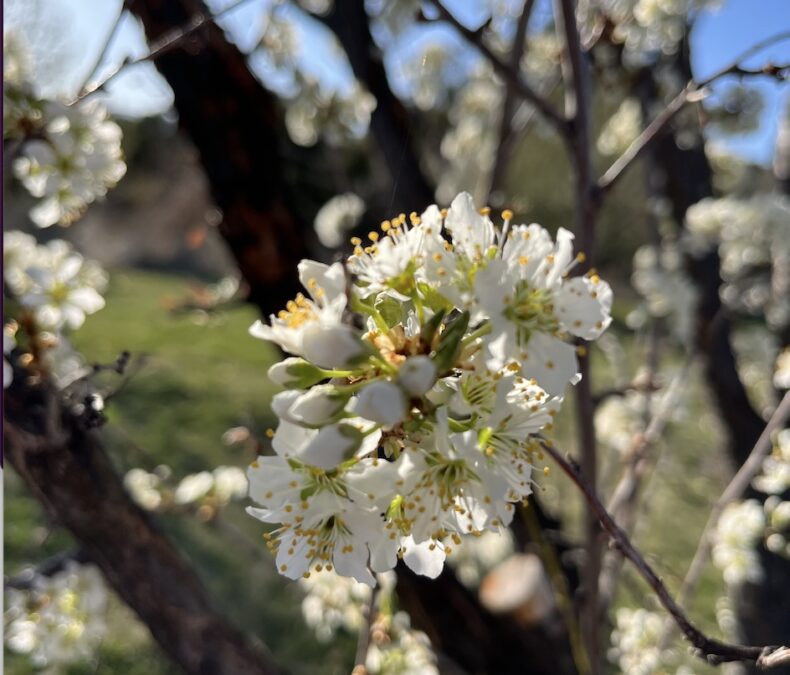
The famous cherry blossoms of Washington will reach peak bloom in the next few days, but in the meantime the non-famous trees of Washington are putting on a show. That apple tree will put out its pretty little flowers soon – I can see the buds from my desk. A neighbor’s dwarf peach (that’s the picture above) is putting on a show already.
I had more trouble than usual figuring out what to write about this month. So much is happening on so many fronts here in Washington these days that it’s hard to get your head around and exhausting, too. Too big to tackle in writing while I’m living through it. So I try to be grateful for moments of good news as I wait for peak bloom.
I always knew flying squirrels lived among us, probably of the southern variety, in the trees at our cabin-in-the-woods in central Virginia. But those buggers are hard to spot. They’re night-owls, first of all, and they’re pretty small. So, I was delighted to see a whole nest of them in our woodshed this winter. (Okay, truth is my husband found them when I wasn’t there one weekend and bragged about his discovery, and I only got to see them by pics and video. Had I been there, I surely would have plucked one out of that nest and kissed it on its little velvety head, so perhaps it’s best I was elsewhere.)
When I saw there were numerous squirrels tucked into the nest together, I assumed they must be pups (also called kits, funnily enough) and thought, huh, why would they have babies during this cold, hungry season? Then I read that the adults commonly come together in the winter to stay warm; nests have been spotted packed with as many as 50 of the things. (This one had eight or ten.)
They don’t actually fly, of course; they have this flap of loose skin on each side of the body attaching fore leg to hind leg, and it creates an airfoil so they can glide in a downward direction (steering with their tail), usually 25 feet or so but sometimes more than 200, or so I’ve read. They have white bellies and pink ears and glorious huge eyes allowing them to see in the dark, all of which makes them extra cute. (Big eyes is one of those traits we humans especially love in other creatures, as it projects innocence and childishness and a request for love and care, in a way.)
Flying squirrels have an impressive repertoire of calls, more than any other type of squirrel, with some utterances out of the human range of hearing. If I’d actually been there with the nest I would have recorded these calls, but I wasn’t, so I couldn’t, so I’ll attach someone else’s recording of their chirps. (Scroll down to “Voice.”)
I’m hoping next time I’m at our cabin the nest is still there, overflowing with little warm bodies. At times like these when the world feels like its imploding, it’s comforting to find wild things living their lives as if nothing is wrong.
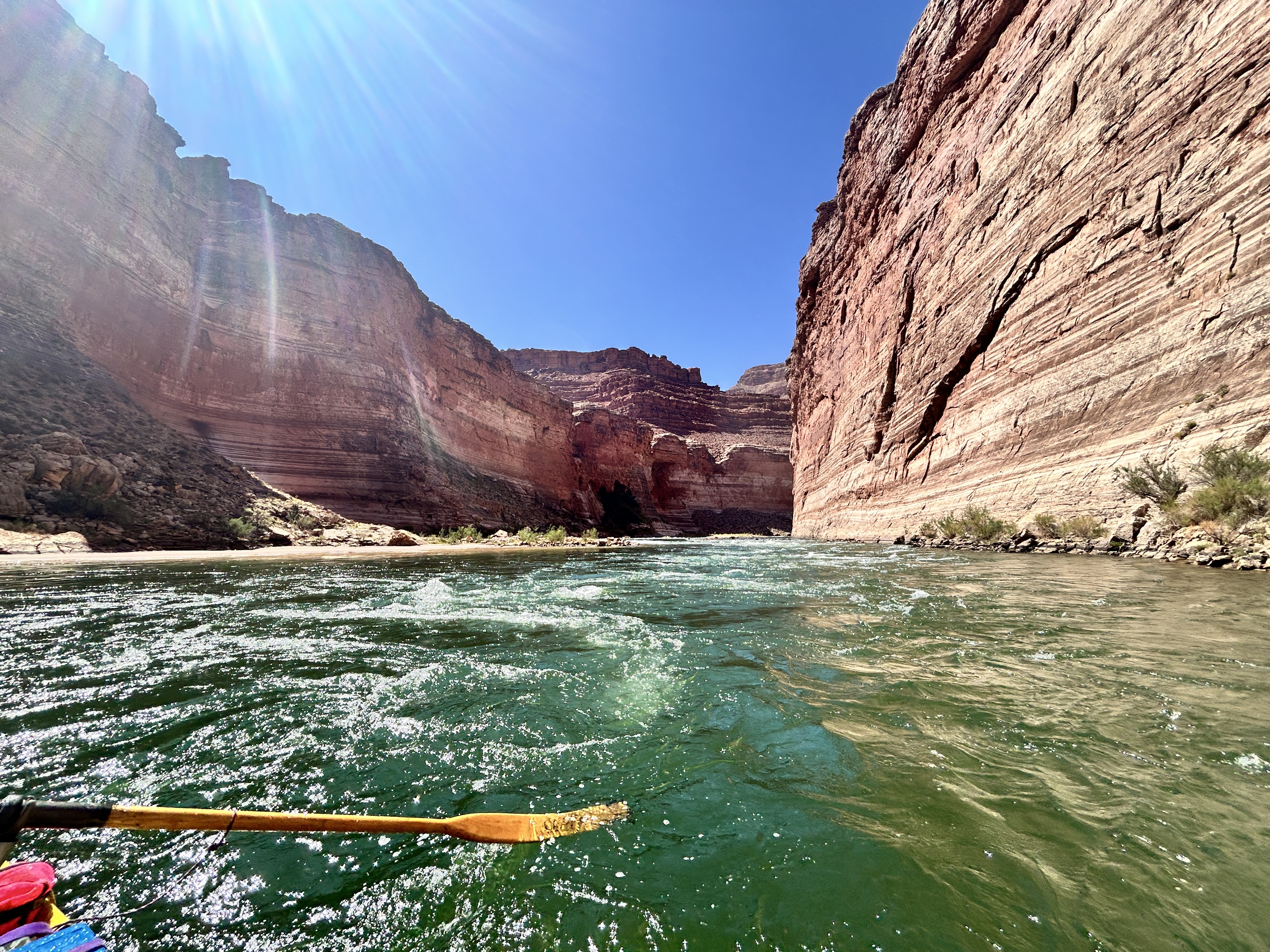
Decades ago when I was hoping to become a scientist, I got a master’s degree dealing with the actions of water in the desert, part of which was studying the hydrology of flash floods on unvegetated bedrock. One term for the result is a “slot canyon.”
When people died in a flash flood in a narrow canyon in Zion years back, NPR brought me on to explain what happened and why. I told listeners that these desert rainstorms touch ground far away and run fast over forty or fifty miles, finding people in a dry, sunlit cathedral dazzled by the convoluted walls around them, perhaps wondering what could have formed such a place. Water and debris arrive in what is called a “flood bore,” either a towering wave or a long, inescapable slope: ankles, knees, and once it’s to your waist you’re ass over teakettle. It keeps rising ten to forty feet or more, a maelstrom of mud, water, and boulders leaving a log jammed between walls sixty feet up in the air. No skill or strength can save you. Everything is up to the flood.
The best chance you have is scrambling to a high ledge when it hits, and hoping it’s high enough.
I interviewed workers on body recoveries, usually Park Service or land agency employees (those now being fired) telling me of a wedding ring being the only thing still on a man, or how three people were all swept together under a ledge miles from where they started as if the water took them in its hand. I was told about a person’s face like a mask, only the face, no bone or anything else. The flood seems to have some kind of agency. Anything in the way enters into the equation.
When civilizations fall into barbarism, the arising culture fetishizes strength. So it has always been. It can feel as if the weak and sensitive have no place and no voice in a time when throwing one’s weight around is the done thing.
This was the world in which Cai Yan, a Chinese noblewoman at the end of the Han Dynasty (around 200 A.D.) found herself when her homeland was thrown into war. She was kidnapped by nomads and taken into the desert as the concubine of a chieftain. She says her captors had the practice of killing the old and weak, while idolizing the young and vigorous. By the time the Han Court negotiated her return, she had borne two sons whom she had to leave behind in the desert, never to see again.
Cai Yan is that rare phenomenon—a voice from the ancient female experience. She tells the story of her life in “18 Verses Sung to a Tatar Reed Whistle“, a lamentation with an interiority that feels ahead of its time. Though she had such little agency in a life dictated by men, there are glimpses in the poem of her power to assert herself in the world. One is her mention of her decision to raise her sons without shame, despite the circumstances of their birth. Another comes from the self-conscious reference to her own art: “As I sing the second stanza I almost break the lute strings / Will broken, heart broken, I sing to myself.”
I can imagine this woman, alone in a world of macho men, singing to herself in the nomad camp. But then I imagine another gentle soul picking up her melody on the wind, taking brief respite (as from the Cellist of Sarajevo). The whole poem feels like an act of resistance, and I find it fitting that her art is so compelling it has lasted for thousands of years while those who subjected her to violence and insults are lost to time. As deflating as it may be to create with posterity alone in mind, know that there may be others listening from neighboring tents, similarly despairing, taking heart from your humanity right now.
There is always one section in our utensil drawer that is emptier than the others. Spoons are useful for so many things, and they seem to have a natural restlessness. They leap away from the confines of the kitchen. They jump into cars and carry-ons. Sometimes the places they go are even stranger. All they need is for some piece of china to whisper “Hey, diddle diddle,” and there they go, sneaking out with the dish again.
In their absence, I have learned more about them. Spoons have, depending on who you ask, between four and seven parts. There is the bowl and the handle—the two parts I know the best, because I hold one part and the other one has the food in it. But there is also the neck, the shoulders, the drop, the tip of the bowl, and the tip of the handle.
Different types of spoons are paired with different purposes. A slotted spoon can strain beans and lentils, a ramen spoon helps you sip the broth and scoop your noodles. When you need a break from eating ramen, the bent tip of the spoon’s handle is like the shepherd’s crook that used to lean against the lifeguard tower, a tool for preventing your spoon from drowning. The name of a ramen spoon is chirirenge, a fallen lotus petal.
Well this story is just a pure delight. In 2017, the Chinese said that by 2030, they were going to be the world champions of AI. So in 2022, the U.S. put export controls on the fancy computer chips, especially Nvidia chips, that AI needed. Then in 2025, the Chinese announced an AI entity called DeepSeek that used, in part, outdated Nvidia chips but mostly inventive software. DeepSeek works as well as or better for AI’s LLMs, the large language models like ChatGPT. It uses 2,048 of those old Nvidia chips, and costs $5.6 million. An LLM built by Meta used 16,000 new Nvidia chips, and cost $60 million.
I’d say — quoting Pappy O’Daniel — the U.S. got its behind kicked. Which as a U.S. citizen, I don’t find delightful. The delight is this: years ago I was interviewing a famous old Cold Warrior, Sid Drell, about the US/USSR Apache standoff over missile defense systems. He said, “What you want to be very careful of, is not the make the fallacy of the last move.”
Mom spreads maps over the dining room table. They’re oldish, not ancient, but the home I see in them is not the home I know. They are all of Colorado—mostly cities at the nexus of Rocky Mountains and High Plains, 40, 50, 60 years ago. The outpost of Ward, a funky old mining town up a sinuous dry canyon, guarded by two guys with broadswords. The hopping university town of Fort Collins, then just a smallish scatter of purple squares along a tidy grid of streets. And there’s Boulder in 1957, my hometown, where I’m visiting my family for the turn of the New Year.
We press the map folds flat with our fingers and lean closer. The city then was a tiny yolk at the core of its current footprint, pressed hard against the mountains. The mesa where my parents live formed its eastward boundary, a new neighborhood then, not yet swallowed and sprawled miles beyond with malls and business parks and subdivisions and natural gas wells, the fingers of the city and its neighbors creeping outward over the plains, grasping each other to form an amoeba of light and noise that pulses with traffic along a vasculature of roads. A place forever swallowing itself. Becoming new and new again, without becoming better.
Every time I come back, I grumble about how much things have changed since I was a kid. For all my sharp words, though, there’s something unchanging here. It rises in me when I see the rolling ponderosa-covered waves of the foothills breaking on the snowy, treeless slopes of the high Rockies to the west, when I see the plains reaching boundlessly east, haloed pink at the days’ two turns, from and towards darkness.
A bird, seeing its parents, learns its identity. Its shape. Its dance and song. The pathways it should migrate. Who and how it should love. This is like that—an imprint, but on the land where I was born, where I first learned the movement of light, the shapes of trees, the way yellowed grass, beneath a storm and slanting sun, becomes lit velvet. In a pigeon, magnetite in the beak is a compass to the Earth’s magnetic fields. Perhaps our bodies contain homing deposits of a kind too, oriented to something deep and indefinite, beyond conscious memory. I imagine my own as a tiny glass vial between my lungs, full of red dust and ponderosa bark and juniper berries and curling petals of moss campion and alpine forget-me-nots and meadowlark and hermit thrush song. A taste a smell a sound. A stirring unexpectedly awake.
It’s a small but substantial talisman I have learned to hold to. This past year, three friends died. This past year, I relearned how fragile is the machinery of my own body. This past year, so many friends have brought new lives into their own. Laying a hand over that spot on my chest—that homing place—I can touch a sense memory that reminds how some things remain steadfast, even as we careen always forward, awfully and beautifully, looking back at what was, looking ahead to the same-and-not-sameness of what is and will be.
The broad, jagged sandstone planes of the Flatirons—an ancient river delta broken skyward by the mountains’ uplift. The hard and sudden winds that stretch wings of cloud over the peaks, throwing garbage cans and picnic tables, snapping trees and power poles, howling around the house, drawing the world into older motion than the heartbeat of our cars back and forth on their diurnal schedules of 9-5, endlessly looping between home and work.
Leaving for the airport at the end of my visit, the Flatirons stand orange with sunrise, motionless despite the bus’s rushing speed. It’s a journey I’ve made dozens of times now. Seeing the lit stone, I think of another time, not so long ago, when the bus passed a coyote loping along the side of the road. She paused, unafraid, her head swiveling to mark our passage–so brief, and gone–before resuming her journey eastward.