This coming Monday is the new moon, which means by tonight we are in the soup. There’s nothing to block the stars but clouds…and us.
Every month has its dark nadir and we’re pretty much there, stars as bright and numerous as they’ll ever be. That’s the thing about a full night sky, it’s as dark and rich now as it would have been 10,00 years ago, if you’re in the right place.
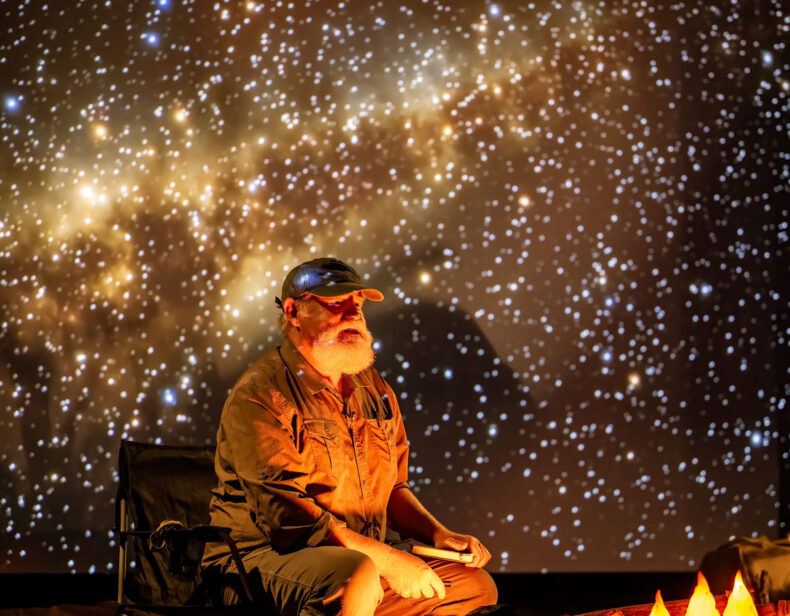
A big moon all bright and milky is one kind of night sky. No moon at all, we see our galaxy from the inside out.
A book of mine came out this week, called “The Wild Dark,” which is about finding dark skies during the most well-lit time in Earth’s history. What I’m looking for I refer to as “old growth dark.” You know the stuff, and it’s disappearing.
A global study among 51,351 citizen scientists using star charts around the world shows a dramatic decline in how much of the night sky we’ve lost between 2011 and 2022. If 200 stars could be seen when the study began, 100 were still visible when it finished. You get the point. It’s going downhill fast. The outcome is not only what this does to our minds and perception, but to our bodies. Cancers and a host of other maladies attend our new era of brilliance, our circadian rhythms derailed, throwing off a litany of physical functions from metabolism to sleep. We are tangibly fucking ourselves up with all this light
When I need to get out of my head, I go to Ellwood. This stretch of bluffs along the coast in western Goleta has trails through open grasslands and small paths that wind down to a wide beach, where you can find driftwood forts and views out to the Channel Islands. At its north end, a eucalyptus grove is home to winter roosts of monarchs. I have happy memories of wandering through the trees with a group of preschoolers in rainboots. When the sun broke through the clouds, dozens of the monarchs and their orange wings descended from the branches and hovered just out of reach. The grove felt, for a moment, touched by magic.
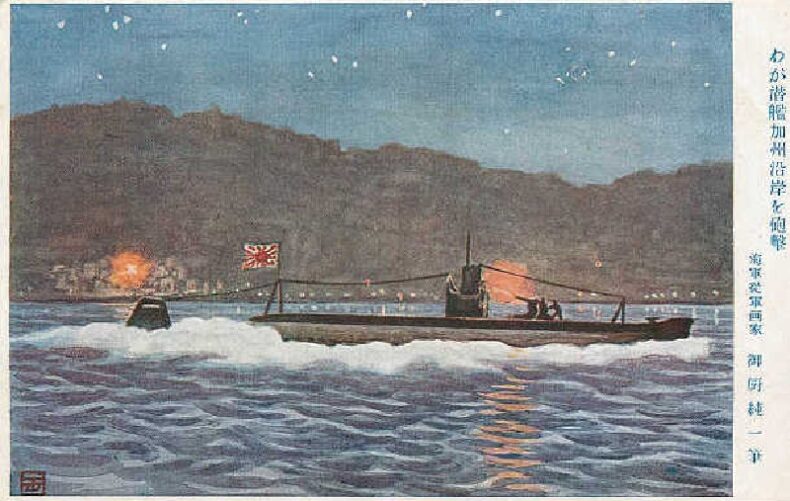
This is one of the things that makes it so hard for me to remember that right here, in 1942, shells from a Japanese submarine were the only thing flying overhead. After the attack, the Japanese Imperial Navy reported that they had “left Santa Barbara in flames.” This was wishful thinking: The damage, at least to the land, was minimal. The target, the Ellwood Oil Field, lost a derrick and a pump house. One of the shells crashed into a nearby pier.
Postcard of a painting of a Japanese submarine shelling the California Coast by Junichi Mikuriya, Wikimedia Commons
But for those who lived on the coast and had just been listening to President Roosevelt’s fireside chat when the shelling started, the fear sparked by the attack was much more devastating.
One concern: Los Padres National Forest, just over the ridge. Many firefighters, along with the equipment they used, had been pulled away from this and other forests to fight in World War II. How could the Forest Service get everyday people more willing to stop the fires they no longer had the ability to fight?
The Ellwood bombardment was the sparkle in the eye from which Smokey Bear was born. Wearing a ranger hat and jeans, he’s urged generations of forest users to take responsibility for preventing fires from posters and advertising spots during Saturday morning cartoons, as a giant balloon during Macy’s Thanksgiving Day Parade.
But after decades of fire suppression—and increasingly devastating fires—some wonder if Smokey’s message could use an update.
Wait for it . . .
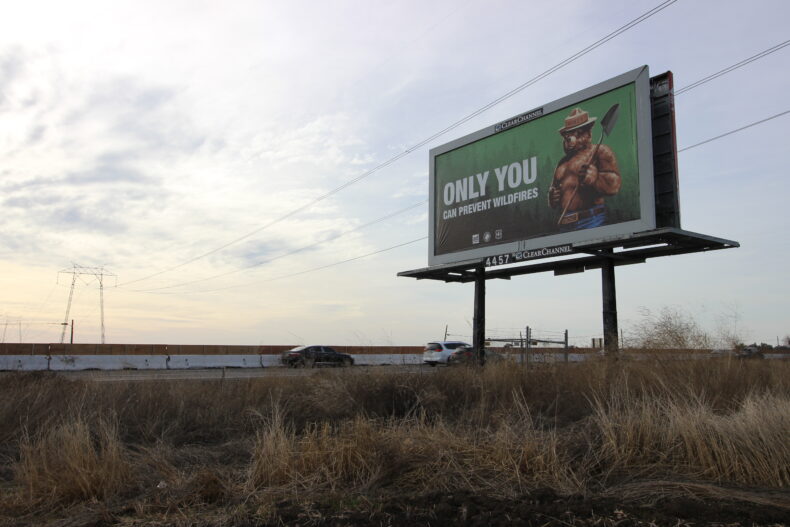
One of these people is Emily Schlickman, a landscape architecture and environmental design professor at UC Davis. Every time she drove out of the mountains and back to the Central Valley, she saw a billboard with Smokey, still protecting the dense stands of forests that cover much of the Sierra Nevada.
Then, on a field visit to Illilouette Creek Basin in Yosemite, Schlickman saw something different. Instead of thick, protected forest or large stands of standing dead wood, the valley teemed with a patchy mix of meadows, grassland, and forests—the result of decades of allowing fire to burn through this area. “People say it’s like a glimpse into the past, like what a lot of the Sierra Nevada forests should look like today,” she says. She remembers turning to a colleague and saying, “What if Smokey had a buddy?”
Richard L. Garwin died this week on Tuesday, May 13, 2025. He was born April 19, 1928, you can do the math. He lived a long time but I still don’t see how he did everything he did. I interviewed him a lot over the years, and stayed in touch even after his health made it harder for him to do the things I interviewed him about. I wrote this post April 11, 2014, after a documentary about him had just come out, and I run the post again, updated, because it says what I have to say about him.
Garwin: the Movie opens with an old, steady, precise hand on a computer keyboard, scrolling through now-declassified documents. Harry Truman and Dwight Eisenhower make announcements, and newspapers flash headlines about our splendid new hydrogen bomb. Then the blossom of a mushroom cloud unfolds; and John F. Kennedy talks about Russian missiles in Cuba; and the same old hand places a pill case near the keyboard, then dumps out his pills. Lyndon Johnson explains the complex problems of Vietnam and soldiers shoot their way through a jungle, and the old hand is tieing up a necktie. Walter Cronkite reports Three-Mile Island, and the old hand pulls on a suit jacket and slings a heavy backpack over his shoulder. The oil wells of Kuwait explode into a fiery smoking darkness, which becomes the smoking darkness of the Twin Towers, which slides into the tsunami slipping in slow motion over the drowning towns of Japan; and the old hand picks up an umbrella, and a heavily-burdened, slightly baggy old guy in a nice suit and tie stumps out onto the sidewalk, gets in a cab, and goes to DC. The film title slowly spells out the name, Garwin. The old guy gets out of the cab, slowly, creakily — he’s 86, after all — and walks past a group of anti-nuke demonstrators, stops and looks at them for a second, then walks on. He’s seen them before. He walks into the Executive Office Building. You know, he says, the president and his national security advisor, aside from their positions, “are really just ordinary people. And they need to make decisions and they don’t have time to learn. So the only thing that really works is education.”
§
Richard L. Garwin, a physicist and inventor, has been educating politicians on the scientific realities, whether they want him to or not, in every administration since Eisenhower’s. He educates them on the physics of nuclear weapons, missile defense, jungle warfare, burning oil wells, terrorist attacks, and of nuclear plant meltdowns. The people who made the movie about him, Richard Breyer and Anand Kamalakar, originally pitched a film on the history of science in America, using Garwin like Zelig or Forrest Gump, they said, because at important moments in history, he always showed up. “But when we got to know him and hung out with him,” Kamalakar said, “it evolved into this other film about a person who built this horrible thing and worked his whole life to dance around it.”
I need your help. I’m trying to find a phrase to describe an important phenomenon and maybe help people recognize it more easily. The phenomenon is this: When we fix a problem, we forget it. I don’t mean you and me in “we” — we, of course, remember. But pop culture forgets, and the mass media forgets, and young people never learn about the problem or how it was solved.
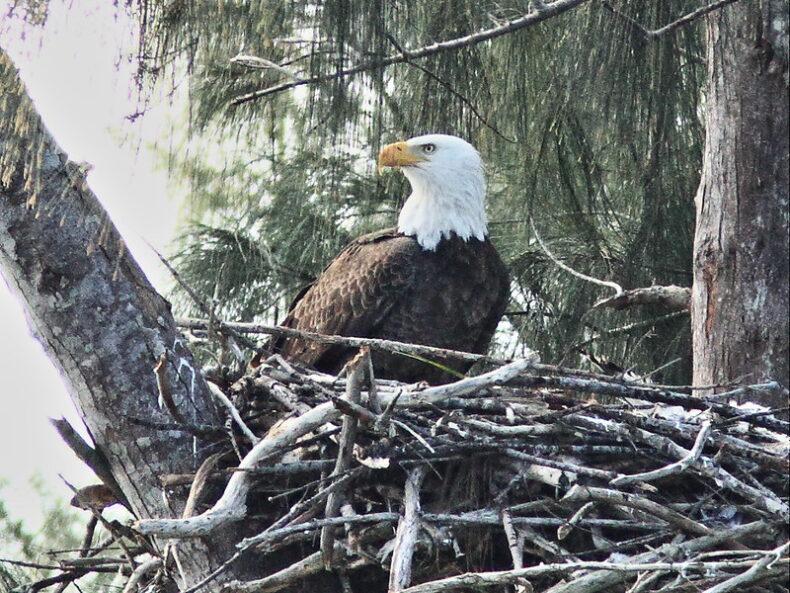
Maybe this will make more sense with examples. Have you ever seen a bald eagle? They almost went extinct! And now they’re everywhere, stealing fish from ospreys (which also almost went extinct) and getting in fights with peregrine falcons (which also almost went extinct). The pesticide DDT caused birds that eat fish that eat bugs to have thin eggshells, and the birds’ nests failed. It took a lot of science and journalism and public outrage, but we banned DDT and the eagles are back.
Do you remember (or have you heard about) the ozone hole? Chlorofluorocarbons were thinning the part of the atmosphere that keeps us from getting sizzled by ultraviolet light. It took a lot of science and journalism and public outrage and global cooperation, but we banned chlorofluorocarbons and the ozone hole is healing.
We fixed acid rain. We took the lead out of gasoline. We prevented catastrophic computer failures from the Y2K bug. These problems dominated news and pop culture for years, but now they’re gone, and we’re left with problems that seem unsolvable. But we can solve problems! We have, and we will.
I am honored to introduce a new Person of LWON, Laura Helmuth, who probably doesn’t need introducing at all, given that she has done everything (editing mostly, but also editing-in-chief and giving encouraging talks and getting a PhD in cognitive neuroscience and winning awards and being on every science writing committee and institution known to humankind) and has been everywhere (Science, Smithsonian, National Geographic, Slate, Washington Post, and Scientific American, that is, a good fraction of the science-related publications known to humankind). She now writes a spritely advice column for Slate for people trying to navigate their workplaces. She remains what she has been ever since I’ve known her: a helper of the young, a quiet community-builder. Her editing inspiration is Charlie Watts, drummer for the Rolling Stones: scroll down to her name in the post on The Open Notebook, not only to see why Charlie is inspiring, but also to see what a splendid writer she is. In fact, she’s just generally splendid all around, everyone who knows her says so. “Oh Laura,” they say, “she’s just splendid.”
__________
Photo of Charlie Watts, playing not with the Rolling Stones but with The ABC&D of Boogie Woogie, by Poiseon Bild & Text, via Wikimedia Creative Commons
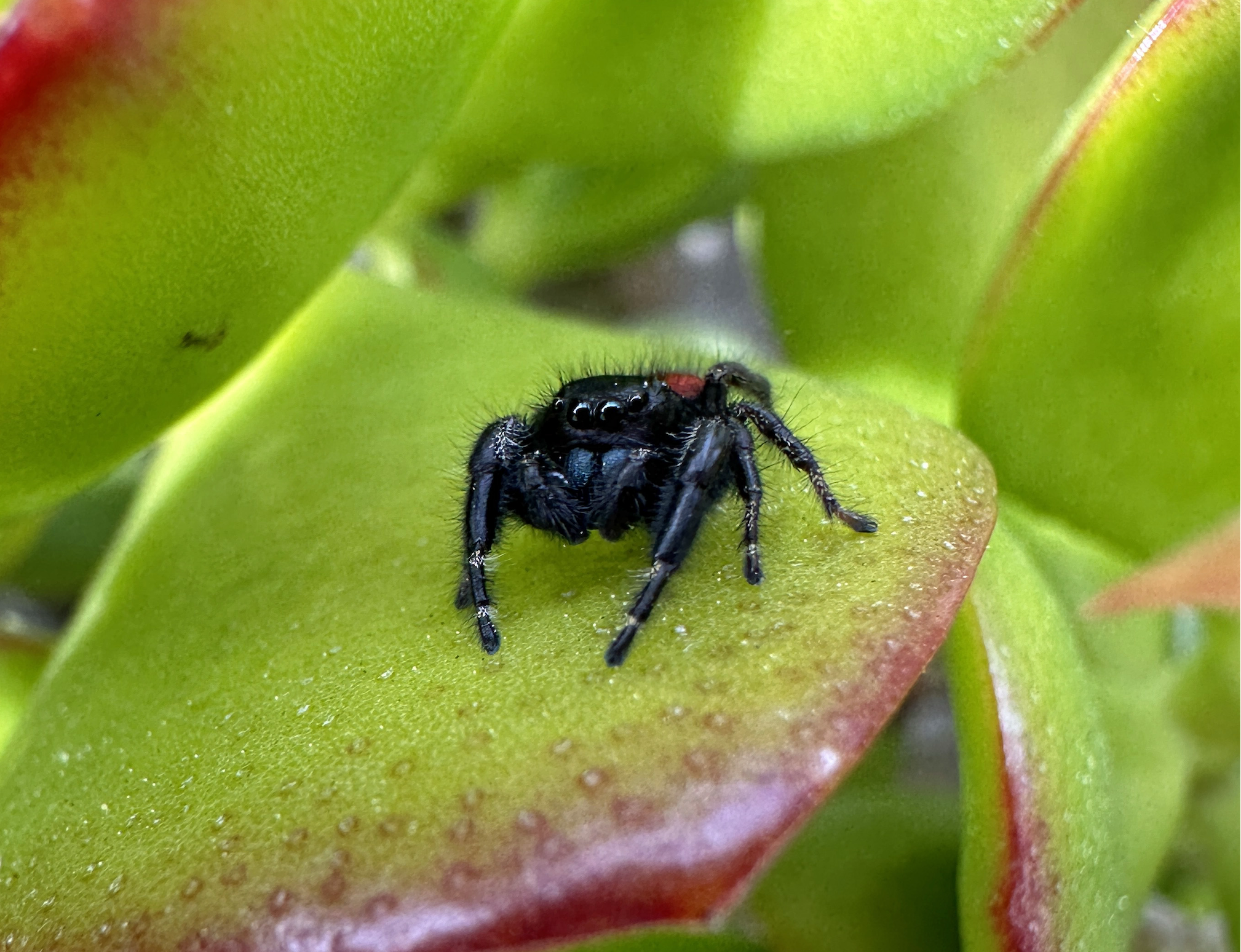
This is Diego. He is a Phidippus johnsoni jumping spider, and he lives on a jade plant in my front yard. There are several spiders of this species that can be found on the jade plant on any given day, but I know when it’s Diego I’ve spotted.
Adult males of this species are around 5 to 7 millimeters long, mostly black with bright red abdomens that often have a black stripe down the center, fuzzy black legs with white stripes, iridescent blue chelicerae (appendage-like mouthparts with fangs at their ends), and adorable little tufts of hair on the tops of their heads. Individual P. johnsoni spiders can vary in appearance quite a bit, but that’s not how I know it’s Diego.
It’s his personality I recognize. Diego is a charming combination of cocky, concerned, and curious. But what really sets him apart is how he reacts to me slowly approaching, phone-first, to take a photo: He waves.
The first time he saw me coming, he quickly backed up to the edge of the jade leaf he was on, ready to disappear to the underside if need be. Once I stopped moving, my phone just inches from him, he hesitantly stepped forward, wiggling his pedipalps (fuzzy little arms that have many uses including cleaning eyes and sensing the environment), trying to assess what he was dealing with. It’s a spider’s way of asking, “What is that?”
Then he came closer, took a good look at the phone, raised up on tiptoes and threw his first pair of legs into the air. That was unexpected! He shuffled sideways back and forth while folding those legs up and down. It’s hard to explain how happy this made me.
It’s my pleasure to welcome Betsy Mason as the newest person of LWON. Betsy is an award-winning freelance science journalist based in the San Francisco Bay Area. She was a senior editor at Wired for many years, and she has won a lot of accolades, including the American Geophysical Union’s David Perlman award for breaking news. She’s also been an Alicia Patterson Foundation fellow and a Knight Science Journalism Fellow at MIT. You can read her full bio here.
I’m not even sure anymore when or where I first met Betsy, it feels like we’ve been friends forever. She is kind and funny and a supremely gifted editor and writer. Betsy wrote a beautiful book about maps (co-authored with Greg Miller), and in addition to freelance editing, she also writes frequently about animals. You can expect a lot of posts about cute critters.
She’s written about problem-solving skills in raccoons, a series of puzzles researchers presented to urban coyotes to study animal cognition and the possibility that spiders dream during their REM-like sleep. She has totally convinced me that jumping spiders are as adorable as dogs and has made me obsessed with trying to befriend my local scrub jays.




.jpg)