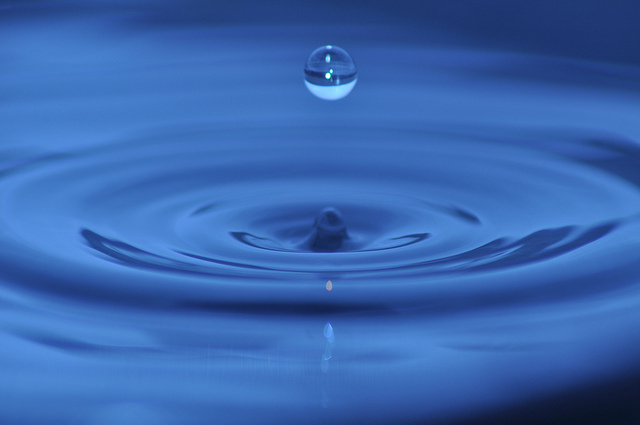
In the Navajo vernacular, this time of year we often get what is called male rain, níłtsą́ bikąʼ. These are drenchers that come on strong and swift, rutting out driveways, turning the river a sudden brown, and they’re usually finished just as fast as they started. This happens when upwellings of heat from the ground collide with cool, moist skies. Other times of the year and in more stable conditions, you get what in Navajo is called female rain, níłtsą́ biʼáád, which falls soft and long, the kind of precipitation that saturates the ground and wets the roots of plants. I’d take either any day, but in the high summer into fall, male rain rules.
Driving a lonely two-lane home from Wyoming, I noticed a silver slash across the highway ahead. Wyoming was just as hot as Colorado, just as hot as about everywhere, and I saw no rain in its scattered clouds. Knife blades of virga reached toward the ground but didn’t make it all the way. As I drove closer to this line across the asphalt, slowing from 70, I could see the air three feet above it misted from exploding raindrops. It wasn’t only rain, it was a fierce rain, and it occupied a space that looked to be fifty feet wide at most, the highway dry to either side. I craned under my windshield and saw a faintest band of gray overhead where a slice of precipitation had fallen out of its cloud. The rain didn’t begin with a drop or two. It came all at once. I sped into a blinding downpour, double-fisted on the steering wheel, eyes dead ahead. My roof and hood sounded like a hail of pea gravel, windshield wipers throwing water everywhere. In another second I broke out the other side trailing a rooster tail of haze. The roar ceased and I kept driving into a dry, sunny day. That was the níłtsą́ bikąʼ, male rain.
I usually like the beginning of the school year, but this year I want a do-over. Lucky for me, there’s a new year starting next week: Water Year 2026! We had a surprise storm this week, complete with purple veins of lightning and raindrops filing our barrel to round out the end of water year 2025. And I’ll use this storm to update the following post: it ran a few years ago, but I’m still thinking about water and time.
*
It’s almost October, the start of a new water year. A water year is one of several ways to measure rainfall. This way, water year 2026 starts now–when we hope the rain will begin–and will end next year on September 30. A rainfall year runs from July to June, a buffer of dry season on either side of when the rain might come. Other places just use a calendar year, from a cross-your-fingers-that-its-rainy January, to summer dryness, then rain again, we hope. We hope.
Different groups use different calendars: The National Weather Service in California used to use the rainfall year, but switched recently to a water year, following suit with the US Geographical Surveys and many other water and weather agencies. Hydrologists often like the rainfall year, because streams and rivers can run dry in October. Others prefer the simplicity of measuring the rain that falls during a standard calendar year, beginning in January.
I’m not sure which way I would choose, if I were doing the choosing. A water year gives you the best odds for good early numbers; then you’re just watching the clock run down unless there are some late-breaking summer storms. The rainfall year eases you in with dryness, then it’s strong in the middle. The calendar year perhaps is when we need a last-minute miracle. It’s probably a good thing I’m not in charge of a water agency, because I’d probably keep changing the system so that the numbers would look good—or at least, not so bad.
I do the same thing with time even when I’m not hoping for rain; I’m always choosing different clocks so that everything turns out the way I want. I don’t really make resolutions at New Year’s, but I do try to shape the year to come. But if that hasn’t gone well, I start again on my birthday, which falls on the spring equinox. Still not happy? I’ll try the fall, when school goes back in session, providing another chance to start over, whether or not I’m the one who’s getting new pencils and following the bell schedule.
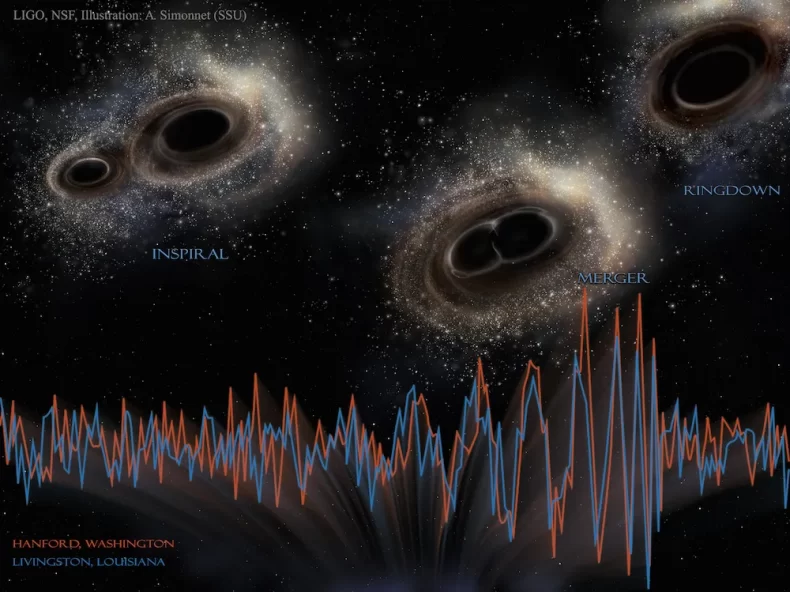
I thought the latest sound clip from two merging black holes was nice but I’d heard this before and I wasn’t stunned. You can hear them spiraling in toward each other and merging — I can’t hear the ringdown which I assume is the merged entity shuddering. The first time I heard one of these clips, though, was the first one (above) recorded, ten years ago, and I was stunned to pieces; I even made it my ring tone. My ring tone clip:
My phone would ring, I’d explain happily to people who heard it that it was the sound equivalent — astronomers call it a chirp — of the gravitational waves caused by two black holes merging. People were generally polite about it.
The translation from gravity to sound by some thoughtful geek was natural: gravitational waves are pressure waves in space/time, just as sound is pressure waves in air. I like my old ring tone clip better than the latest clip — pretty sure the difference is just that the audio was stretched out to play longer, or something — because the inspiral and ringdown were clearer. Inspiral, ringdown, and chirp really are the technical astronomical terms, isn’t that nice, you don’t even need them explained.
Then I got a new phone with a new ring tone and forgot about it all.
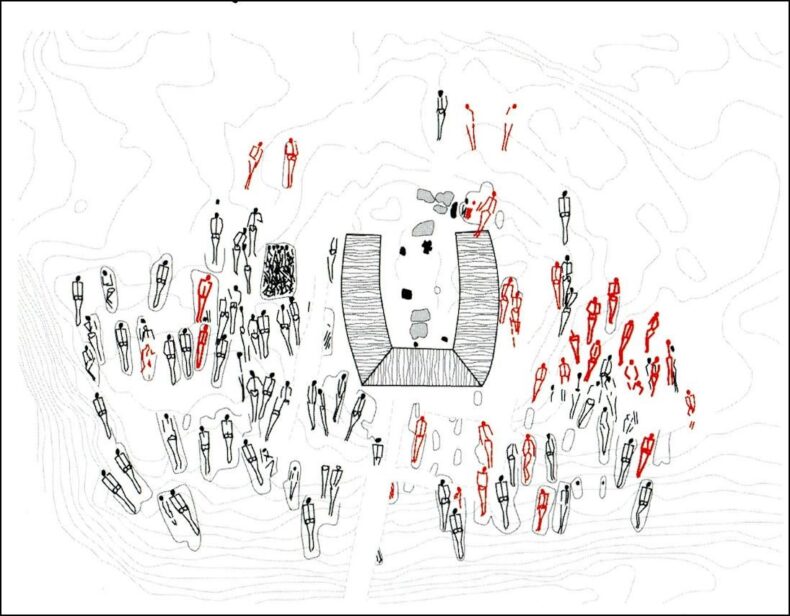
A diagram of medieval burials discovered at a site called Tjoldhilde’s Church, in Qassiarsuk, Greenland.
My tooth aches. I feel it with each plodding step over the stone-stubbled tundra. It’s not so much painful as just there: a sensation of pressure in a left lower molar followed by a jolt of worry for what it might mean. I have not seen a dentist in years.
Teeth are on my mind as I wander across the remains of a medieval Norse farm set on the edge of a fjord in southern Greenland. The burials here, and in other fjords nearby, are not only old but they seem to be disintegrating faster during our time than they did just a few decades earlier. I have heard archeologists describe the human bones they uncover in terms such as “wet biscuit,” and even “peanut butter,” which is to say, spreadable. These are corpses you could smear across toast.
It isn’t clear what’s causing the old skeletons to deteriorate so quickly, though a going theory is—you guessed it—climate change. No direct causal relationship has been established; I can’t simply tell you that rising temperatures are melting bones the same way they’re melting the permafrost, or the glaciers. But some theories make sense long before you prove them, and in any case the bones appear to disappear faster than scientists can get them out of the ground.
This problem immediately raises two questions in my mind.
First, why take them out of the ground in the at all?
Then: what about the teeth?
———
There are 32 teeth in an adult human’s mouth. Children have fewer, about 22, and occasionally someone will have more or less. Generally speaking, though, teeth are fixed equipment. You get what you get: eight incisors, four canines, eight premolars and 12 molars.
Teeth are bones, but unlike tibia or femurs or jawbones, they are coated with mineral-dense layers of enamel. This makes them the hardest, most enduring bones in the body. It doesn’t mean, as we all know, that they’re indestructible. Aside from collisions and falls, teeth can be swiftly corroded by bacteria, which thrive on our sugar-rich modern diets.This is why we’re told—as children, as adults, all the time—to brush brush brush. Even as I write this a voice from childhood—a cartoon character from some television PSA—rises up from memory to shout “Teeth are meant to last a lifetime!”
Very often, they last longer.
I am hiking toward an ancient churchyard that sits on a hill above a river. More and steeper hills rise to the west and beyond them are mountains. Beyond the mountains lies the massive ice sheet that dominates the interior of this enormous island. For nearly 500 years, from the early 980s AD to around 1450, the Norse lived in the fjords below the ice sheet. They raised sheep, goats, cows, and horses. They hunted caribou, seals, and walrus. The built stout stone houses and cathedrals with walls five feet thick. Then, without much warning, they vanished.
The Norse Greenlanders left no documents. They do not speak to us through songs or folk tales of their own creation. The cause of their colony’s collapse remains mysterious, though the going theory is that one of the culprits was—you guessed it—climate change. In the case of the Norse, however, their world got colder.
The old churchyard is among the greenest spots I have ever seen, and it’s striking in this almost-Arctic place. Thick grass, tangled and sweet. Fertilized for centuries from both directions: by Norse sheep leaving their droppings above and Norse Catholics burying their dead down below. In the early 1960s archeologists found 155 skeletons here. All were buried facing east, all were arranged in a loose circle around the remains of what seemed to be a small chapel.
A few decades later a strontium analysis of teeth gathered from this site revealed that many of the skeletons—the people—appeared to have been born in Iceland. Some of the bones were among the oldest Norse remains ever found in Greenland, which suggests they may have been among the original colonists. Their church may also have been the very first ever built in North America.
Below on the fjord blue icebergs drift in an ebbing tide. For some reason I kneel where the old church stood and when my knee hits ground a vibration shudders up through my body to my jaw, where it rumbles through my molar. When the sensation fades I try to do some quick math: all those Norse bodies times all of their teeth. There had been thousands of them, waiting like jewels in the darkness.
———
Many years ago I traveled to the far end of Virginia, to Appalachia, to report on a pop-up health clinic that provided, among other things, free dental care to rural people. I arrived late in the day, and already the empty field beside the high school had filled with cars and trucks. In the morning the clinic would serve patients on a first-come-first served basis, and everyone I spoke to planned to sleep in their vehicle so they might wake up early and get a good spot.
When the clinic opened hundreds of people stumbled out of their cars and tottered through the frost-covered grass. Dentists and dental students in neat bright scrubs patrolled the line, assessing everyone’s teeth and inviting the worst cases to step aside. By worst cases I mean people whose teeth were so rotten they needed to be extracted immediately.
For a few hours I floated through the gymnasium, talking with dentists and patients, stunned at the state of teeth in America. Dentists clutching gleaming steel tools stood on foot ladders and tugged molars from the mouths of stunned mothers, fathers, teenagers. It was hard work. Sweat beaded on the faces of the dentists.
Later, when I asked one of them why people let their teeth get into such bad shape he said, Unfortunately low-income families tend not to prioritize their oral hygiene.
When I asked people standing in line the same question they told me that dentists were simply a luxury they couldn’t afford.
The clinic was held in the autumn of 2008, just before the election of Barack Obama. The season of Yes We Can. I didn’t know it then, but I was a few weeks away from losing my regular job and with it my health and dental insurance.
Walking through the clinic at the end of that long day I noticed, sitting on a table top, a large pickle jar. It was filled with blood-streaked teeth.
———
So far as I can tell, very few studies have focused on dental health in the ancient Norse era. Aside from the work with strontium, which can tell you where a person was born but not, for example, exactly what they ate, only a couple of papers seems to have touched the topic.
Among them is one that examined the teeth of Icelanders who lived around the first millennium AD. Their teeth showed signs of heavy wear and erosion. The wear was attributed to a diet of rough leathery meat and fish. The erosion was apparently caused by the consumption of acid-rich dairy products, including whey and skyr. Generally-speaking, younger people had better teeth and older men had the worst teeth of all.
I sit reading these papers late one night in Nuuk, the capital of Greenland, a few days after my visit to the oldest church in North America. I read about methods, sample sizes, results. I can hear the Appalachian dentist in the back of my mind—Unfortunately low-income Norsemen tended not to prioritize their oral hygiene.
But I can also peer forward, to the moment far from now, when my own teeth are unburied and studied. The ache in my molar has subsided, and I no longer feel it with every footfall or sense it when the morning cold sinks over the crown. Still, because it is late and I haven’t slept much, I worry irrationally about how future scientists will judge me.
Strontium ratios will show I was born on the East Coast. A simple magnifying glass will reveal chipped enamel from falls and collisions. It’s obvious I never wore braces. But there will be no documents to explain exactly how, in one of the largest and richest nations on earth, during an era of unprecedented prosperity, I could not afford to visit a dentist. I suppose that will be easy enough to read in the bone.
“Being a CEO is tough because you’re in a meeting from 9 to 10—internal meeting—this design is wrong. 10:00, there’s a customer. 11:00, there’s an interview. 12:00, there’s an employee quitting that you don’t want to quit that was not on your schedule, and you’re eating while you’re dealing with that, so you better not carry over, “Wow, I saw a bunch of geniuses in that last meeting” or “That was the bozo-est meeting of all time.” If you carry that over to your next meeting, it’s going to really randomize the world.”
That’s Bill Gates talking to Dax Shepard on the Armchair Expert Podcast. It’s not just CEOs that have these bananas schedules that require a lot of context switching, and often executives now go for half-hour or even 15 minute increments. It’s even worse with everything on Zoom because you don’t even get the five minute walk to a different conference room to reset. Each Zoom meeting reliably goes 4 minutes past schedule, despite the ‘hard stop’, and the executive signs off and goes directly into the next one. Coffee and lunch are delivered to their desk.
I’ve been working closely with a handful of these overschedulers in the past few years, and what I’ve noticed is that they can’t retain things properly. Like, at all. What they do retain from meetings, they can’t accurately attribute to the right speaker. This isn’t one overwhelmed person—it’s how the brain works.
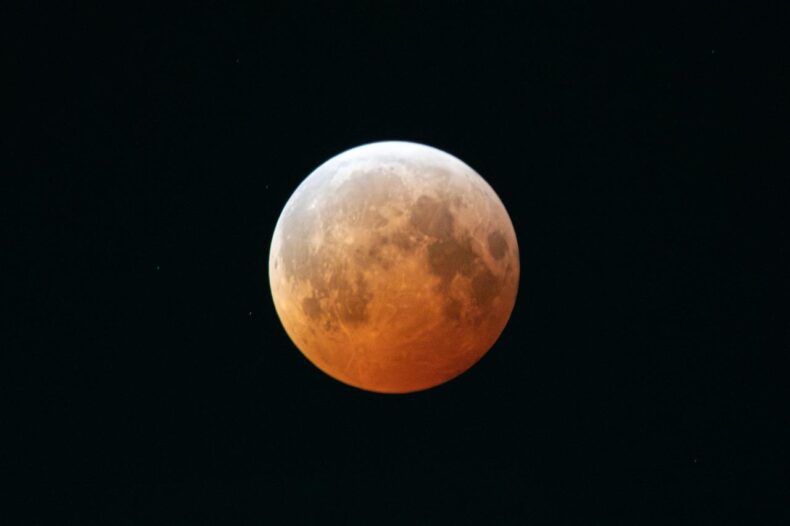
Lunar eclipse on March 14, 2025. Credit: NASA / Jordan Cochran
How have you been sleeping lately? Me, not so great. I do fine during the days, mostly. But then I wake up at 3 or 4 a.m. worried about what’s happening in the world. Here are some strategies I use for distracting myself and getting back to sleep. Maybe they’ll be useful for you?
You have to avoid thinking about certain things if you want to sleep again, in my experience. Death. Dementia. The theocrats on the Supreme Court. Billionaire white supremacists. The sociopathic eugenicist who denies all scientific and medical reality and is preventing our loved ones (and hated ones) from getting life-saving vaccines. That sort of thing.
It’s also best to not think about the science of sleep when you can’t sleep. Like how sleep disruption impairs memory consolidation. I would very much like to remember what happened yesterday! And how sleep disruption raises blood pressure. I would very much like to not have a heart attack tomorrow!
I know what you’re supposed to do to sleep better: Don’t eat or drink anything near bedtime. Exercise. Enjoy absorbing hobbies. No screens or doomscrolling late at night. Read sedate books in bed, not thrillers. Keep your room cool. Nice, fluffy pillows. I do all this stuff.
But still! There’s so much to worry about in the middle of the night. Missing a flight. Bodily aches and annoyances. Propaganda stomping all over facts and humanity. The reckless, narcissistic, belligerent dictator who has control of U.S. nuclear weapon codes.
So I try to wear out my mind like you would do with a cranky toddler. I try counting down from 100 by sevens. Or counting up by orders of two: 2, 4, 8, 16, 32, 64, 128, 256, etc., until I lose my place and briefly worry about that rather than transgender people who are just trying to be their authentic selves but are being denied basic health care by the worst bullies in the world.
Bland, irrelevant, or quirky words can help. I often pick a category of things and then go through the alphabet thinking of examples that start with each letter. So, for animals: aardvark, bonobo, cutthroat trout, etc. FYI for when you get to the hard letters, there is a mammal called a quokka, which is adorable, and a bird called a Xantus’s murrelet, which, same.
If you play Wordle, you can go through the alphabet thinking of good starting words: audio, bayou, cause, delay, etc. Try words that start and end with the same letter: Alaska, blurb, chic, dud, etc. You can list foods: apple pie, borscht, crepes … but beware that it might make you hungry.
The categories have to be cheerful, and sometimes the category I pick is “cheerful words.” Amazing, beautiful, creative, depressing… argh, start over.
I’ve tried breathing exercises but feel like I’m hyperventilating. I’m probably doing it wrong.
Don’t test your memory with world capitals or other facts you used to know, although it may help to read Billy Collins’s wonderful poem Forgetfulness, which begins: “The name of the author is the first to go / followed obediently by the title, the plot, the heartbreaking conclusion…” and describes memories like the capital of Paraguay slipping away. (It’s Asunción.)
I try to think of things that have gotten better in our lifetimes. Bald eagles are nesting all over now! The Cuyahoga doesn’t burn, and Cleveland has a lovely rails-to-trails park network along its river. Scientists just came up with a vaccine for chlamydia in koalas.
But please do think about what we can do about <waves hands> all this. I don’t have great or big answers, just small but hopefully meaningful answers. Check in with people. Support advocacy organizations. Go to protests. Share real information on social media. Subscribe to trustworthy news sources. Support friends, especially ones who are more vulnerable. Volunteer. Mentor. Build stuff. Make bad art or bad music. Go to trivia night with friends, and lose. Tell someone you enjoyed their work. Read mysteries — it’s so satisfying that there is an answer at the end. Read SciFi to get the heck offa this planet. Laugh about how bad it is. Plant things. Cook for people. Thank people, whether you know them well or not. And please take care of yourselves as best you can. We’ve got to outlast these demagogues.
And please share, in comments here or on social media, how you get through the night. I could use some fresh ideas! Thank you, and sweet dreams.
My last post in July was about a court case in New York state where a judge decided a dog who had been killed by a negligent driver could be considered “immediate family” under the law, enabling the family to seek damages beyond the monetary value of the dog.
One of the things I find fascinating about cases like this is you can watch the legal system—which is inflexible by nature—grapple in real time with changing societal norms. And I’m equally fascinated by how we think about and relate to other species, and how and why that has changed over time. So matters of animal law are of particular interest.
If these matters intrigue you as well, here are a few more recent legal cases involving our relationship with other animals.
California Court of Appeal denies the necessity defense on behalf of animals
This case gets at the question of who should decide whether animals matter under the law. In the New York case I wrote about, a judge saw it as his role to answer a legal question about when and how animals matter. The court in a recent California case saw things differently.
The case involves an animal rights activist who was charged in 2019 with trespass during protests at farms in Sonoma County, during which activists took sick chickens and ducks from the farms, got them veterinary care and brought them to live at animal sanctuaries. One of the activists charged was Wayne Hsiung, co-founder of an animal rights group called Direct Action Everywhere that has won similar cases in the past, including one that got a fair amount of press coverage involving two sick piglets rescued from a factory farm in Utah.
Hsiung, who is a lawyer, represented himself at a jury trial and asked to present a “necessity defense,” which is a doctrine excusing the breaking of a law in order to stop or prevent something worse, such as breaking a car window on a hot day to rescue a baby at risk of overheating. Hsiung pointed out that 14 states also allow citizens to break a car window to rescue a dog and argued that in his case, trespassing was necessary in order to prevent the more serious harm of animal cruelty, which represented a “significant evil” under the necessity doctrine.
The judge denied the request, saying that the necessity defense does not apply to harm to animals. The prosecution argued that in order to apply it to animals, the necessity defense would need to be expanded, which is the purview of lawmakers, not courts. In 2023 Hsuing was convicted of two counts of misdemeanor trespass and one count of felony conspiracy to trespass and sentenced to 90 days in jail, of which he served 38. He is currently appealing his conviction in the California Court of Appeals.