Almost every night since late February I’ve slept on our deck, watching the star-scape creep westward month by month. Scorpius recently came out of hiding and now the great space scorpion is standing on its tail in the middle of the southern sky. Jupiter has been sailing toward the evening glory of Venus, Power and Love nearly touching, then passing each other by. This is how I’ve been clocking the intricate movement of days, weeks, and seasons, using the glowing, shifting cosmos as a timepiece.
Two thousand years ago, Polynesians sailed and paddled the Pacific to find a lone fleck of an island by following wave patterns, clouds, winds, fish, birds, dolphins, and mostly stars. At the same time, on the other side of the world, Minoans were crossing the Mediterranean Sea by stars, setting off from the island of Crete fixed on the big guns of Arcturus, Altair, Spica, Aldebaran, Sirius, Rigel, Betelgeuse, and the phosphorescent triad of Orion’s Belt. Each star rose over the position of a trade city 500 miles across open water. The hypothesis has been floated that those distant cities grew to their stature because their rising stars made them easy to locate from Crete, opening them to sea trade.
The fourth brightest star in the night sky, Arcturus, has become the one that tells me how much sleep I’ll get on the deck. This golden-orange pinpoint has been moving over the top of the sky around 11pm, inching farther west by midnight. When I crawl into my sleeping bag and Arcturus is directly overhead, that means it’s early enough I’ll get a full night’s sleep.
Looking up in the daytime, I think of what we see as ‘sky.’ It’s the blue lid that seats down on top of us, sunlight bouncing off the Earth and dazzling the particulates above us, mostly nitrogen and oxygen molecules that scatter the blue end of the spectrum. At night, we’re not seeing sky so much as we are seeing space. The sky has pulled back like a curtain and we are able to see where we are in the big picture.
We’re not the only ones looking up and locating ourselves. Dung beetles have been shown to align themselves with the Milky Way. Migratory birds in the Northern Hemisphere fix on faint Polaris, the North Star, the one star that doesn’t move, which is why our brilliant cities and porch lights standing still at night throw them off.
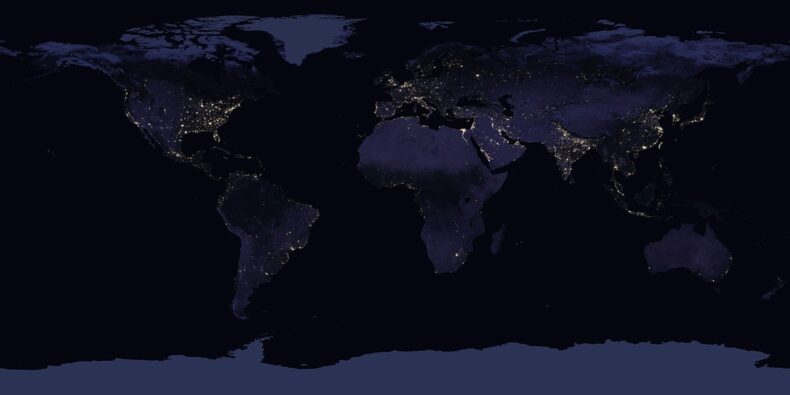
Although human-made light on Earth has gone through the roof over the last few decades, great dark patches remain. I’m fortunate to live in one in rural Colorado, and each night I wake in the wee hours to see the Milky Way crossing my view as if I were passing under a bridge, sharp enough in detail I can see the topography of our galactic disk, and the coal-black blockages of interstellar dust clouds.
I spoke with Dr. Jenny Ouyang, a professor and ecologist out of the University of Nevada in Reno studying the effects of artificial light on birds, and she told me that growing up in the Chinese megacity of Xi’an, she didn’t know stars were real. She sang to me the version of “Twinkle Twinkle Little Star” she learned as a kid, Yi shan yi shan, liang jing jing, and said she thought stars were fairy tale objects, that they weren’t real. At the age of 20, when she was a biology undergrad taking an ecology class at University of California at Irvine, she went with her class to Joshua Tree in the Mojave Desert to camp. As night came on, the transition bewitched her. As stars rolled out, every time she looked in one direction or another, she saw hundred more of them, and a hundred more after that. They filled the sky. Her voice faltered as she recalled seeing the Milky Way for the first time in her life.
“I think I cried,” Ouyang said, then corrected herself. “I know I cried.”
I’m fortunate to live in a dark place, but any night sky will do. Last summer I was in Tokyo and I’d wander between buildings at night until I found a planet or a star in the bright, humid murk, proof of what lies beyond the Earth. I was trying not to forget where we are, easy to grow myopic and ground-centered, when the majority of creation is overhead and not down here.
Sleeping outside is atavistic. We’ve been doing it for a long time. It’s not the sleep that’s so good, but the waking in the middle of the night. Emerging from dreams, I crack my eyelids and see the universe. I try to stay awake, I really do, letting out a gasp before slipping back under.
Photo: NASA

One thought on “Sleeping in Space”
Comments are closed.