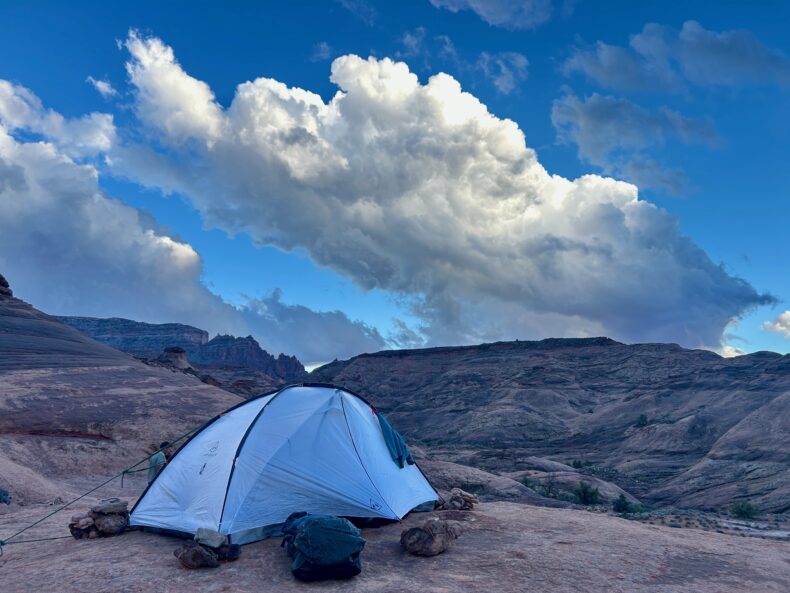
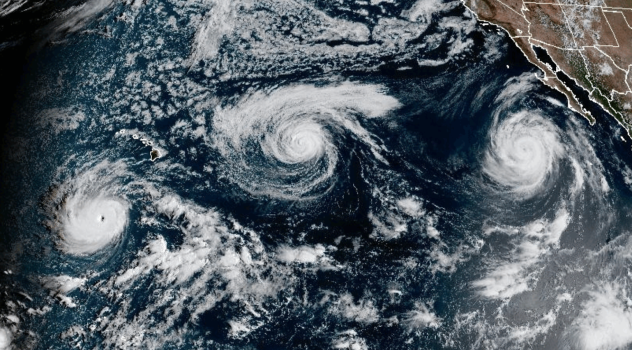
The Pacific hurricane season has ended, leaving the West in the wake of 18 hurricanes and 41 named storms. It’s been a brilliant and devastating couple months, and I had a front row seat for some of the more powerful events. For eleven days last month I was backpacking with four others in far southeast Utah near the Four Corners and we took the fallout of Hurricane Simon with Trudy shortly behind and then Vance. From our perspective these storms were tangled up in an almost seamless raging mass.
We are in an historic El Niño pattern that has topped NOAA’s intensity scale. El Niño is a periodic warming of the eastern and central tropical Pacific Ocean that weakens the normal trade winds and shifts atmospheric circulation. Heat and moisture are redistributed across the planet, altering rainfall, drought, storm tracks, and temperatures far beyond the Pacific. This season it suppressed hurricanes in the Atlantic and drove them to a fever pitch in the Pacific.
When one made landfall in the Southwest as a post-tropical cyclone, we were in a perfect spot. You couldn’t ask for a better view, facing a grand southern horizon of sandstone desert, the direction the storms came from. The sky was a troop of gargantuan octopi with arms and globular heads seething across the troposphere, and the wind and rain they brought hammered us into the ground. I was with a group of mountaineering friends, big summit climbers who’ve been around the world, bivouacked on snow-crest ridges, tents hounded by fearsome blizzards above 20,000 feet, and they were taken aback. This wasn’t how it usually happens in the desert. I rarely carry a tent, relying instead on a tarp and natural overhangs. In our situation, that could have been deadly. We were pinned down for three days and nights. Our spots we picked were high points of bare bedrock knobs where water would drain away from us. Still, the tent I shared with one other began filling like a bathtub, wind wheedling through every seam, and we had to use a trekking pole to tear holes in the bottom to let the water out.
Floods plunged around us day and night, waterfalls streaking down cliffs, rumbling and roaring in narrow canyons below us. We were in a country of cliffs and the excess rainfall loosened boulders and slabs that we heard crashing down, rock collapsing by the ton, low tones of concussions echoing differently than thunder, more solid, stone on stone.
Whenever we could catch a break and crawl out, we discussed how much energy these storms were carrying, their mouths stuffed with lightning and thunder. These weren’t normal thunderstorms we get around here, which can be plenty violent and destructive. These had a different level of power, a weight I’m not used to. Clouds had sharp, interwoven boundaries, like stretched taffy. The claps, cracks, drumrolls, and grumbles of thunder were each an auditory work of art to listen to, echoing with their own percussion depending on where the bolts struck. Storms came in waves. I can still hear distant thunder in my imagination, the next wave arriving, drenched cotton clouds flying past as lightning began ripping the air. We’d retreat to our tents for the next few battering hours.
At night, the black insides of our tents turned a searing white, again and again. Weather came on so hard sometimes I wanted to shout, “Enough, that’s too much!”
We weren’t afraid for our lives, nothing like that. We’d positioned ourselves well. Fifteen-hundred feet below a towering mesa, and a hundred feet above a nest of narrow bedrock canyons choking with runoff, we were neither at the highest nor lowest point, relatively safe from lighting even as we looked out of our tents to watch bolt after bolt striking ground across the desert.
In a day’s gap between storms we hiked out, a last tail of rain and rainbows chasing our eleventh day.
As I drove back home to Colorado with my tent mate, the next spun-off hurricane hit. All across the Navajo Nation, trucks and cars were bogged down in mud off the highway, every dirt road turned to slop. Our rivers were rising to historic levels. When we reached the outskirts of the reservation town of Aneth, CO, the San Juan River was bucking under the bridge, flooding the town, and the bridge was closed. This tributary of the Colorado rose to 39,000 cubic feet per second that day. To put the number in perspective, when I ran the Colorado through the Grand Canyon last spring—one of the biggest, wildest stretches of river on the continent—it was running at 7,000 cfs, five and a half times smaller than its tributary was running today. We backtracked into Arizona and tried another crossing, but minutes ahead of us that bridge closed. We retreated into New Mexico where we finally crossed the San Juan at the town of Shiprock, passing mobile homes and a flea market under brown water.
Footage of houses being carried away and shops drowning flooded the airwaves. I’ve been through almost sixty autumns in the Southwest and this has been the biggest in my memory, water everywhere in such a dry land. As I returned home under peaks bone white with snow, the next wave arrived. Wind kicked up, knocking over the outdoor furniture as we scattered bowls on the floor to catch roof leaks. It’ll be dry again, the desert will resettle, and we will dream of rain.
Photos by me and by NOAA
