What kind of music do you listen to when going to see monarchs? I can’t figure out the answer. It’s before dawn, and I’m fumbling around in the car in the dark, and finally I decide to just let my phone play whatever it’s going to play. I turn my headlights on and pull away from the curb, and just then the song title flashes across the dashboard screen: UP!
That’s what the hope is for the butterflies that I’m going to see. I’m meeting a group of researchers and monarch lovers as part of a butterfly tagging project at Ellwood Mesa, an open space with eucalyptus groves that host overwintering monarch butterflies.
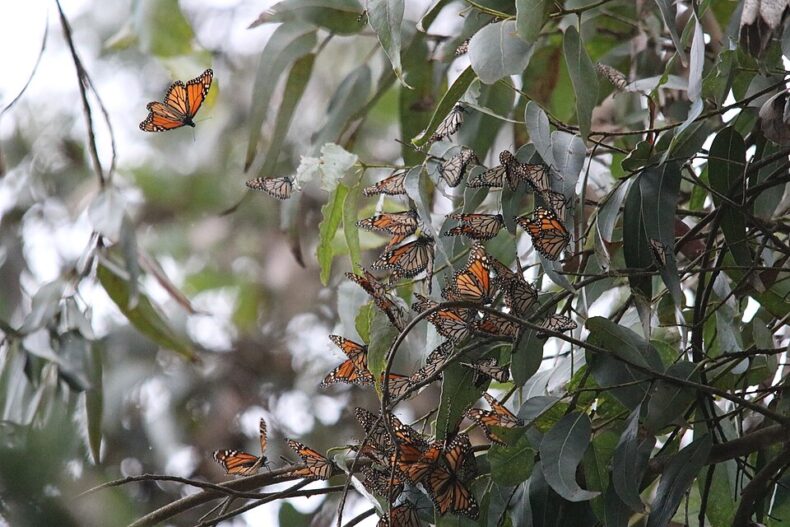
We’re meeting early because it’s easiest to catch butterflies when it’s cool. Once the day warms, they’ll begin fluttering off the eucalyptus branches, where they cluster like grapes.
In the half-light, research biologist Charis van der Heide lashes a butterfly net to the end of a telescoping 28-foot pole and hovers it beneath a small group of butterflies before gently scooping them off. It’s 58 degrees at 6:15 a.m. — already a little too warm, she says, and then recounts an anxiety dream she had the night before, where it was 80 degrees at sunrise — so the rest of us are on scout duty, in case one of the butterflies heats up and drifts away from the group to the ground.
As she counts the butterflies from this harvest, six in all, their wings begin to flutter. “They’re already waking up,” she says.
She’s looking for five males and five females to tag with radio transmitters, so that their movements can be tracked by Project Monarch, a collaboration of organizations across North America. The tags allow researchers to follow monarchs across the year and across the continent, from migration to overwintering, migration to summer breeding.
At Ellwood Mesa, where butterflies spend the winter after migrating from their summer breeding ground in places like Idaho, Nevada, and Arizona, “we want to look at overwintering behavior on an individual basis,” van der Heide says. “When they use a site, how long are they there? How often? Do they leave a site every day? Do they go to specific locations for nectar or water and then come back? How far do they go before they don’t come back?”
What they learn about overwintering monarchs could help them not only understand more about these butterflies’ life cycle and movements, but could also identify areas of habitat that are critical to keep butterfly populations healthy. From the data, researchers could determine how much habitat needs to be protected, whether there are sites that should be enhanced with nectar-rich, winter-flowering plants or milkweed. And they might be able to solve a butterfly mystery: where monarchs go immediately after overwintering. “Knowing where they go is a first step to how can we better conserve their habitat,” she says.
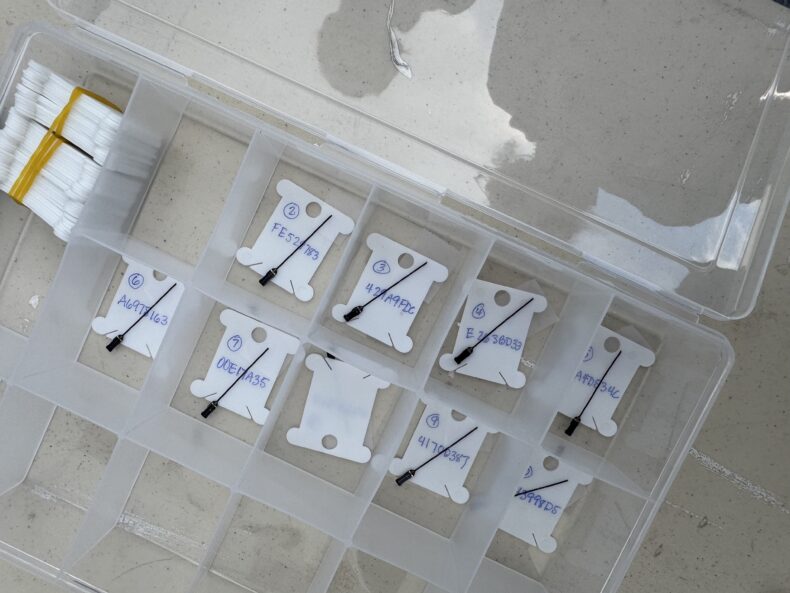
But how do you put a tag on something that small? A monarch butterfly weighs about as much as a pumpkin seed, so the tags are even smaller, less that 18 percent of their body weight. Today, van der Heide and her colleague, Fiona Reidy — they work for the biological and environmental consulting firm Althouse and Meade — will attach these tags to each butterfly’s abdomen. Once the butterflies flutter off, the solar-powered tag will send out signals to radio telemetry towers in the MOTUS and to smartphones through the Project Monarch app, allowing users to pinpoint the butterfly’s location and follow their movements.
I’ve been following other tagged butterflies on Project Monarch’s app for the past week. There’s one named Lulu that flew all the way from southern Idaho to the Central Coast, a journey of 1,000 kilometers.
Eastern monarchs are known for even more extensive migrations, traveling all the way from Canada to Mexico in the winter, and then, over a series of generations, back to Canada in the summer. Lulu, and the butterflies being tagged today, are part of the less-studied western migratory population, which makes understanding their movements even more critical, particularly as the past few winters have brought steep declines in California butterfly populations.
Van der Heide gently captures a few more clusters in her net, each time she separates males and females into two different containers, and releases butterflies that have visible wing damage. Above us, jets from the nearby airport begin to roar overhead, drowning out the bird song as they find their own flight paths.
There are only five females, while the container with males is flecked with monarchs. She reaches for one more cluster in the trees. “I’m feeling good about this one. Very feminine.” But when she looks through her net, the entire group is males, which she releases. “I think we’ve woken up enough of the roosting monarchs and we’ll leave the rest undisturbed,” she says.
We head up the hill to a fenced-off area, where she and Reidy set up a table and scale to measure and weigh the butterflies before they’re tagged, to make sure the tag won’t be too much ballast.
How do you do all this with something as light as a butterfly? Carefully, but not as carefully as you might think. It’s a misunderstanding, van der Heide says, that butterflies are exquisitely fragile. These same wings can carry them 100 miles a day. Storms, high winds, bird beaks — sometimes their wings are tattered, their scales damaged, but many of them fly on.
Van der Heide pins the wings together between two fingers as she measures the wing from abdomen to wingtip, then she holds the abdomen as she examines the wings for damage and the condition of the scales.
Each butterfly also gets a small sample taken from its abdomen with a clear sticker, the kind used to seal envelopes, which then gets pressed against an index card. The researchers are looking for spores of the parasite Ophryocystis elektroscirrha, or OE, which infects monarchs and other butterflies. A caterpillar eats spores of OE, which then release the parasite into the caterpillar’s gut. Once the caterpillar builds itself into its chrysalis, the parasite can damage growing wings and so that the emerging butterfly’s wings are crumpled or undersized. They fly poorly, if they fly at all.
Under a small scope, the spores look like little black dots scattered among the arcs of scales. The researchers are looking for ones with minimal to no infection to tag. Each measured butterfly gets a letter and is put in a glassine bag, the same way they’re stored for butterfly releases. Beneath the table, there’s a cooler packed with butterflies.
Once they’re all measured, the tags go on. It’s a careful process. Each wing of the butterfly goes into a separate, smaller bag for protection, and then the butterfly is set down on a handmade board with a space for its abdomen. Small washers act like weighted blankets, keeping the butterfly calm and still while the tag is attached.
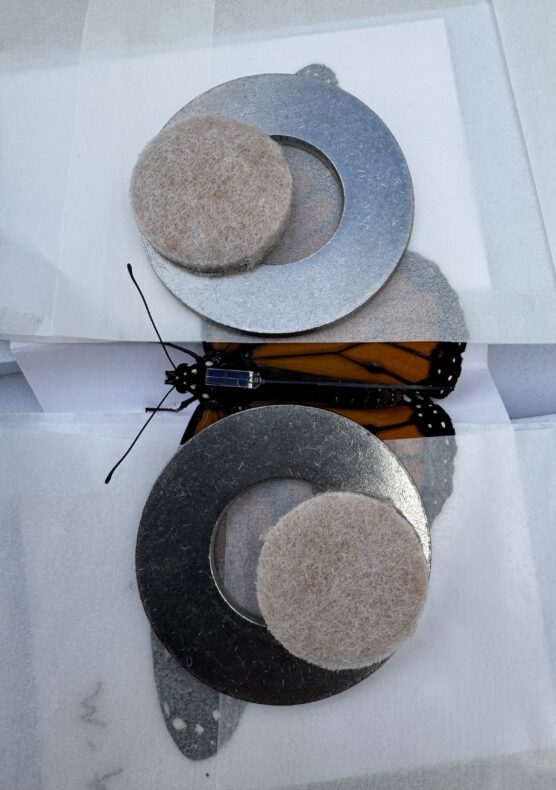
How do you attach a butterfly tag? Eyelash glue. I’ve never worn false eyelashes, but seeing the tubes of glue makes me think, for a moment, I should give it a try. As research.
The real researchers dot glue on the back of the tag, on the thorax of the butterfly, and then press the tag down gently with the tip of a mechanical pencil. I keep writing the word gently in my notes, but I don’t know how else to describe it. Butterflies are strong, and they are also small. People want to take care of them. Another volunteer tells a story of people trying to feed butterflies with crumpled wings, trying to fix broken wings with rubber cement.
The clouds have rolled in as the tagging begins — rain is coming tomorrow, which is why the tagging is being done now, ahead of van der Heide’s original schedule. She wants to give the butterflies time to resettle in the grove before the storm blows in.
Cooler weather means the glue dries slowly, so on-the-fly solutions emerge: lay the butterflies inside a warm car for now, then run to town and get a craft heat gun once the store opens. Test the heat gun on your hand, then test it on the washer to make sure they don’t get too hot. Just then, the sun comes out again, so the heat gun gets tucked away for another time.
By 11 a.m., five male and five female butterflies are tagged and ready to be released. We take them back into the grove and Reidy and van der Heide unzip their carriers. As soon as they fly away, we all pull out our phones to see if we can see where they’ve headed.
What do you name a butterfly? Kids at a nearby school want to call one “Ellie Wood.” A local company offers up its name: Toad. There’s Maxine, and Penny, and the mysterious Fifi LeMoque.
Before I met van der Heide, I thought her first name came from a genus of metalmark butterflies, but when I ask she says it’s Greek, for charisma.
Butterflies seem drawn to her, and people, too. When we encounter a group of schoolkids visiting from Lompoc, about an hour away, in the butterfly grove, they draw near as she talks them through the process of tagging. Then she shows them the Project Monarch app on her phone.
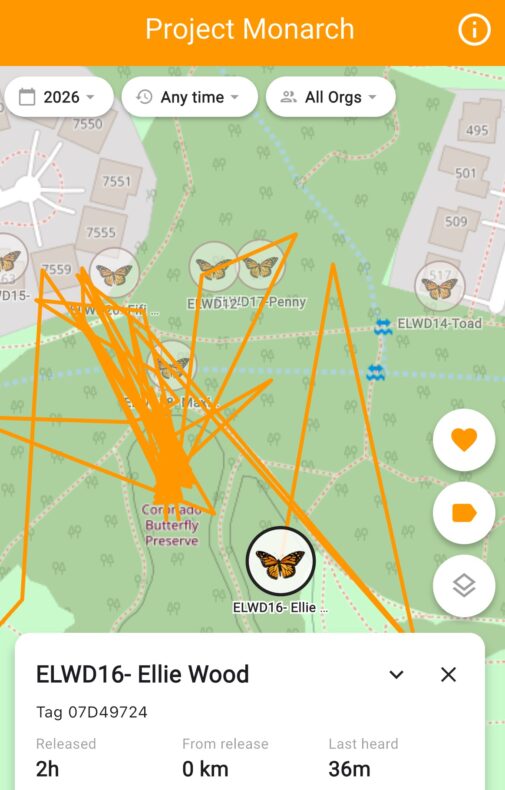
The butterflies’ signals are pinging around the grove. There’s Penny, who flew straight toward the sunlight. There’s Ellie Wood, lingering near ELWD12. And Fifi, who’s winged her way over to someone’s backyard in a nearby neighborhood.
I keep following the butterflies for the rest of the day. As I drive home (still acting of its own accord, my car stereo starts playing a song called GOOD DAY, all caps) my phone pings with monarchs. When I’m parked in my driveway, 15 miles away, I sit and watch the butterflies on the app. I watch them again between each paragraph of this story. Maxine! Penny! ELWD11! Toad! Ellie! Their flight forms orange lines that crisscross the eucalyptus grove, scribbling across the map in the color of autumn.
What do you do when it’s really time to stop looking at where the butterflies are? I close the app and instead look at a video I took of van der Heide as she released the last group of tagged butterflies. Beneath the tree where she’d found the butterflies a few hours before, she unzips the top of the white mesh enclosure. One after another, the butterflies fly out. “Go join your friends,” she says, “Go up, up, up! UP!”
But a few monarchs still linger on the inside, gripping the mesh with the claws on the tips of their legs. She coaxes one out. For a moment, it rests on her index finger. Its wings flap — gently, strongly — until she blows at it like a stubborn birthday candle, and at last, it flies up and away.
*
top photo: Joanna Gilkeson/USFWS
other photos: Cameron Walker

