In job ads for news writers, you’ll often see a reference to the ideal candidate having a “fast news metabolism”. It means: How much information can you cram into your eye holes and how quickly can you digest it all into a compact pellet of 400 words? (I apologise for taking the metaphor to its natural conclusion.)
The question of whether speed should be the primary objective in science news coverage is beyond the scope of this post. (I will offer that, anecdotally, all my own worst “news pellets” were generated in greatest haste.)
However, while I was in the trenches of electrophysiology history research for my book, I found an idea I liked a lot better than metabolism for how I think about my approach to science news: chronaxie.
Even by electrophysiology standards, this term is a deep cut. It was introduced in 1909 by the French physiologist* Louis Lapicque, one of many physicians beguiled by the invention of a new tool known as the galvanometer, and its ability to eavesdrop on electrical activity inside the body. This was already revealing whole new worlds of health and infirmity: the electrocardiogram had recently decoded the secrets of the heart’s various failure modes; Hans Berger was just gathering the first of the electrical brain data that would lead to the invention of the EEG.
But Lapicque wanted to use electrical signals to probe muscle and nerve health more generally. So he introduced the word “chronaxie” as a measure of how well tissue responds to electrical stimulation. It gets quite complicated – it’s the minimum amount of time an electrical current must be applied to trigger a muscle twitch, which also depends on minimum effective current strength (ugh, I know). But to completely oversimplify it, it’s the unit of time that locates the robustness of your nerve-muscle circuit on a spectrum from “knee-jerk” to “half-dead”, effervescent to torpid, Leslie Knope to April Ludgate. This reaction speed and strength is the indicator light for the health of your muscle.
It was used diagnostically. Say someone came to a physiologist with peripheral nerve damage. Maybe they had been shot or stabbed; maybe they had an auto-immune disorder. They wanted to know if their muscle would ever return to its former strength. Stimulating the muscle and then measuring the chronaxie could help answer the question by determining whether the muscle had been cut off from its animating connection to the brain.
This approach spent some time as the gold standard, but bigger problems with Lapicque’s broader theory soon emerged. By the 1960s, chronaxie had been abandoned as a diagnostic tool (before you click, be warned that the link downloads a PDF of an Edgar Adrian lecture in which he reads Lapicque for filth). You can find a mention here or there in a few niche texts, but for the most part, the notion of chronaxie languishes on the dust heap of history.
Which is why I’m comfortable exhuming its corpse and claiming it for myself. For journalism.
Chronaxie, as Lapicque conceived of it, is more than the linear reaction I think metabolism implies; it implies both sensitivity and discrimination. It takes into account the repetition of a stimulus and the exact window of time you wait before you decide the signal is there.
I’ve spent the past three years twiddling with it as a metaphor for how I consider whether something is newsworthy. I’ve used it to diagnose myself as underreactive to news. I’m afraid of being wrong and dumb so I let a lot of stimuli float by, and then watch them turn into news stories I failed to write. It’s an overreaction to having had the opposite problem in the past, writing about something before it had been fully, er, metabolised, leading to results that were watery and loose. In part to escape the relentlessly digestive metaphors that haunt news gathering and coverage, now I have started thinking of my personal goal state as “healthy news chronaxie”.
Luckily, I can do whatever I want with the word, because it’s a relic, an antique! Chronaxie doesn’t mean anything anymore in electrophysiology.
OR DOES IT? [Stay tuned for Part 2, in which after three long years of overthinking the word chronaxie, I may have to give it all up, because maybe this word is being reclaimed in a new corner of electric medicine.]
* Lapicque called himself a physiologist because the word neuroscientist is a modern term that wasn’t around yet in his day. But today you would certainly call him a neuroscientist.
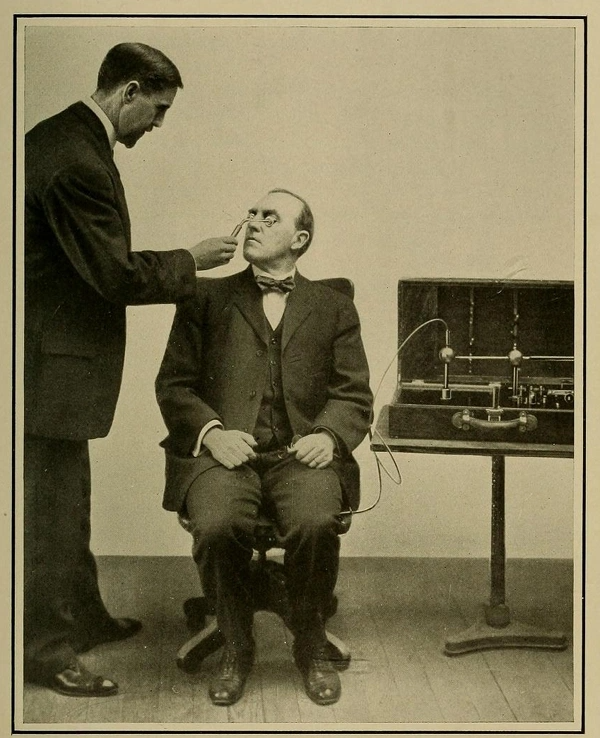
Photo Credit: A still from Samuel Howard Monell’s 1910 book High frequency Electric Currents in Medicine and Dentistry. This image does not illustrate a physician measuring chronaxie, but it would have looked similar enough, and I justify my use of this phot because it involves electricity and medicine. Plus, for the purposes of this post, I like the metaphorical nature of measuring how well your eyes can see that there’s a story to be told. I told you I’ve been overthinking this for years.
