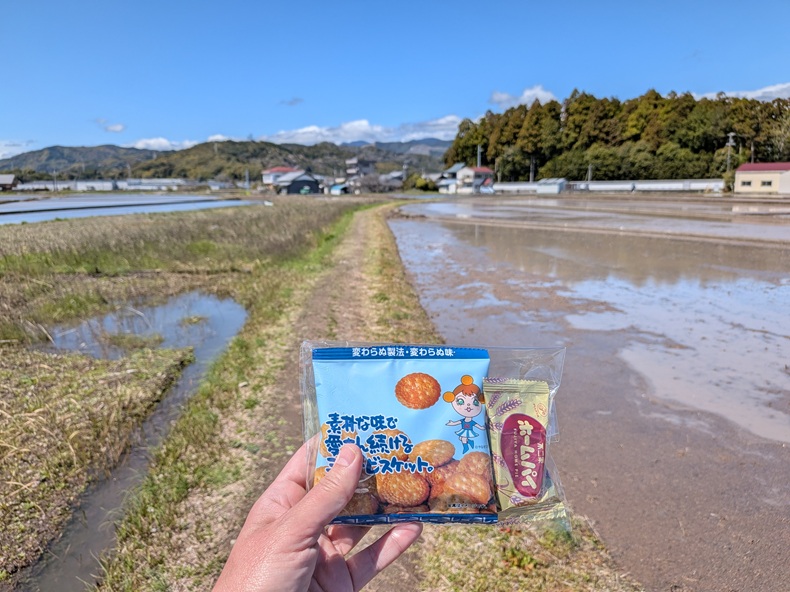
This spring I went on a pilgrimage to 88 temples around the island of Shikoku. There’s a tradition of giving gifts to pilgrims, called “osettai” – an important part of the pilgrimage.
I experienced osettai in many forms. A volunteer on our second day of walking who stopped and offered a ride to the next temple, number 10. (We accepted, gladly.) An inn near temple 44 where the host threw in dinner for free, two nights in a row – she asked us not to mention it in any online reviews, because she might not always be able to do it, and it was delicious. An older man who tapped me on the shoulder as I ate a snack at a convenience store counter and handed me the sports drink he’d just bought me.
The osettai in the picture above came from a woman who was waiting at a wooden shelter along a river in the eastern part of Kochi. A couple of other pilgrims happened to be walking a few hundred feet in front of me, and I saw her go up to them and give them something out of her tote bag. I got to her and it was my turn. She handed me this bag of snacks. I dug in my pocket and pulled out an “osamefuda” – a piece of paper with my name, location, the date, and a prayer that you leave in an offering box at each temple and give to people when they do something nice for you. We thanked each other profusely and I walked on.
The picture reminds me of other things, too. It was late March, and farmers had started to flood, then plant, their rice fields. I didn’t visit those exact mountains in the distance, but I did walk up and down a lot of other mountains. The path behind the snacks is leading to temple 29 – in that stand of gorgeous mature trees.
After the first few weeks, when my partner had to go back home (boo), I was on my own on this pilgrimage. Occasionally I would walk for a mile or two with another pilgrim, but mostly I was alone, whether walking or riding a bus or train. But the culture of osettai made the pilgrimage into a group project. It felt like the whole population of Shikoku was helping me along.
As I understand it, this help isn’t a purely selfless act; by supporting my pilgrimage, the people I met were earning spiritual merit for themselves. The osamefuda were the proof that they’d been involved. Help doesn’t always have to be selfless; if we all get something out of it, that’s nice. How lovely, to spend a few months in a society where people help each other.
Photo: Helen Fields, obviously
