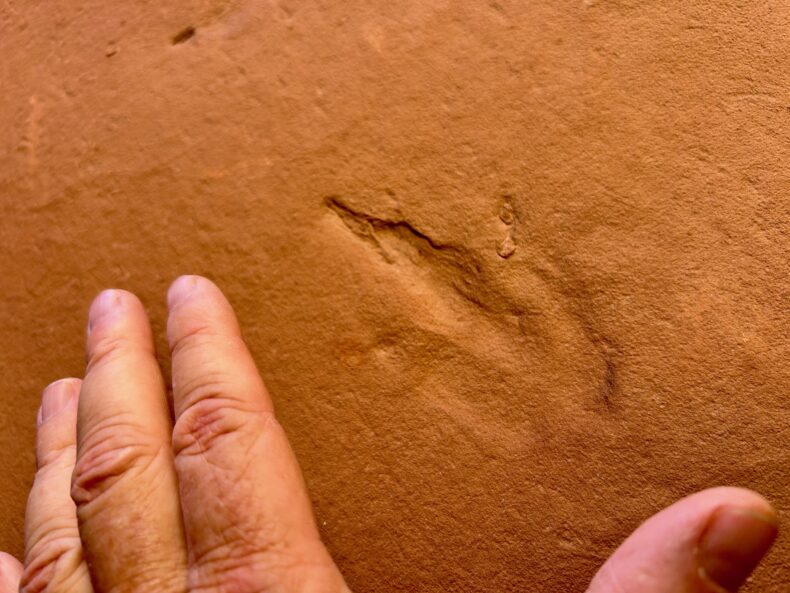
My wife and I were hiking up a pain in the ass desert canyon the other day, hand over hand between bus-sized boulders, no trail to follow, when she said she was done and sat in the shade. She said feel free to poke ahead and when I did, within eyesight of her I found a panel of ancient fossilized ripple marks on a boulder half the size of our house. The way the boulder landed when it fell from surrounding cliffs, what was once flat was like a painting on a wall, 90 degrees to what is currently flat. Set along the face of this late Triassic boulder at the base of Wingate Sandstone, western Colorado, was a trackway of a four-legged dinosaur the size of a hippo.
I started calling back to her, and I’ve got to say it sounded like mansplaining because for good reason she didn’t want to climb the boulder choke that was required to get here and I needed to convey a scene that was unfolding: a four-legged animal had walked across a mudflat leaving four or five impressions around 210 million years ago, maybe a smaller, long-necked predecessor of the sauropods. Looking at each print, you might think it was a bulged concretion or some other geologic oddity (they were convex to the rock, reverse impressions, also known as negative tracks), but when put together the walking pattern was clear to the eye.
Looking up through the crack I had climbed, she could see what I was talking about from fifty feet away, and maybe had a better view of the canvas from a distance, pointing out features I couldn’t see, branch-like impressions as if from vegetation.
After half an hour of back-and-forthing, I said I was going to keep on and see where our route went and I’d be back in half an hour. Where it went was nowhere, the canyon steep and so full of giant geologic debris I understood why there was no trail. Nobody comes up here. My wife and I specialize in places like this, poking into nowhere lands, and we’ve found dinosaur environs before, mostly plant fossils, sometimes the porous patterns of bone sticking out of a rock, and footprints now an then. There’s so much dinosaur-aged rock lying around—cliff walls and ten thousand boulders at a time—that you can’t help recognizing the existence of other ages.
Many years ago I was in a cave in Colorado excavating a Pleistocene deposit with a paleontologist who in the midst of our scratching with trowels in a tight headlamped space, breathing each other’s breath, said that we’re going to leave hardly a layer when we’re gone. He was talking about dinosaur-age gone. He told me there’d be a layer of mobilized carbon as thin as plywood, and the fossil record would show a period of extinction, but human fossils, being as short-lived as we are in the geologic record, probably wouldn’t show up. Coke bottles would look like some odd concretion around little silica masses, interesting and inexplicable. It’s a notion that relieves and captivates me. This is how rich this planet is, burning through life and beauty and complexity like wrapping paper. That we would disappear like that, all of this vividness, blood pumping to our muscles, air moving in and out of us, every moment crisp and impossibly alive, makes it seem all the more beautiful. Nothing sharpens the mind like the gallows.
At the end of my upward climb through this canyon, I noticed a cave-like space formed beneath a boulder that would take out an entire block if it fell in a city. I ducked under, entering a long, steep, and shaded chamber. The roof over my head and collapsed slabs around me were littered with tracks. I had entered a pedestrian thoroughfare. These were three-toed two-leggeds, the tracks turkey like, middle toe clawed and longer than the other two.
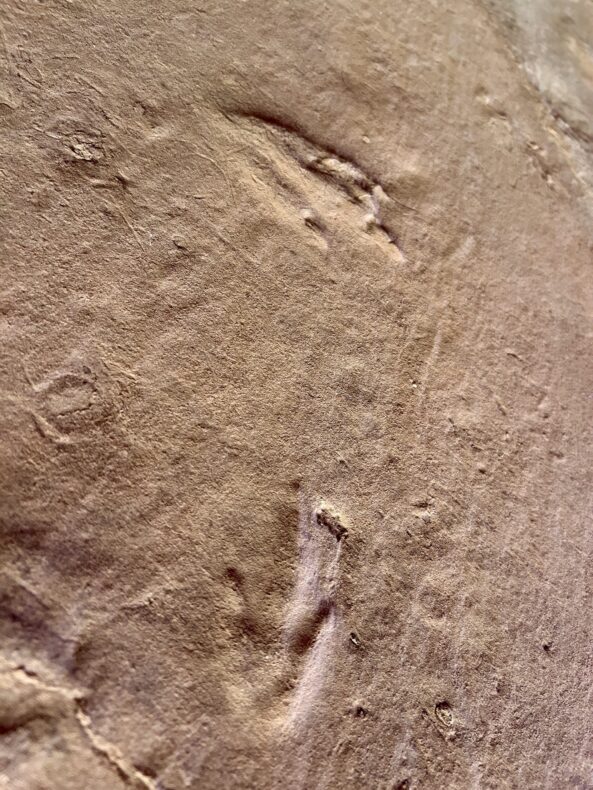
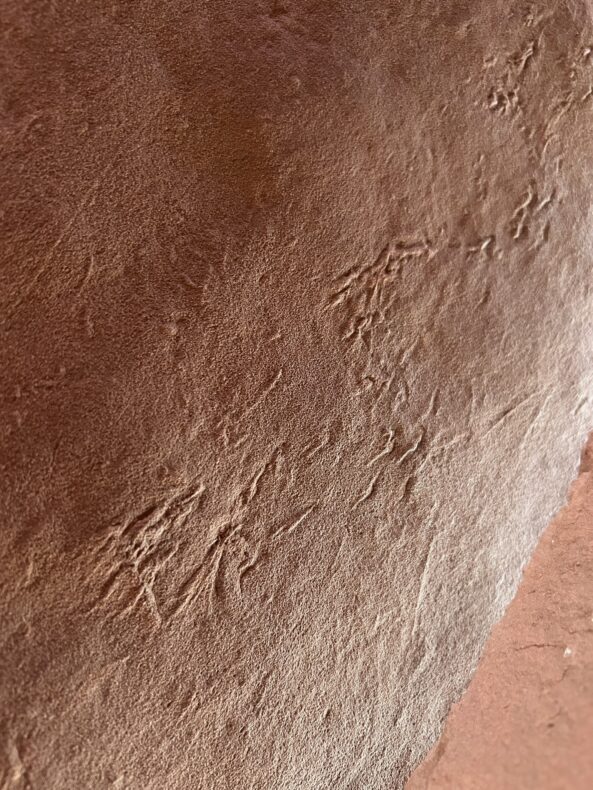
This kind of track is called a grallator, the name for prints left by an ichnogenus, a global bipedal theropod, swift knee-high carnivore. Some of the knuckled, three-prong tracks were reverse impressions and some were marks pressed into the rock the way they would have originally appeared. I was passing through a hall in a museum, finding footing in the dusty debris and fans of woodrat nests, as the ceiling inches above my head revealed more grallators showing where the animals had walked this way and that. The sediment they stepped in was so fine and well preserved that delicate, hair-like impressions stood out, what looked like insect tracks or what I would have thought to be a tiny songbird hopping around in sand. The whole place under this thousand-ton boulder was a display of life and animation.
Some people I’ve heard express despair upon seeing fossils like this, evidence of how gone we already are. Casts of long lost lives speak to inevitability, fate even. All that we have is slated for the same future. For me, I can breathe more easily. We aren’t here alone. This isn’t the pinnacle of all of history. This is a moment, a flash, the light so full of color and brilliance it could blind you.
She’s going to need to see this, I thought, and scrambled back down to tell my love who I found resting in the shade, radiantly alive.
Photos by cc
