Recently, while working through Suleika Jaouad’s The Book of Alchemy with my mom, I encountered a new-to-me poetic form: the sestina.
Jaouad’s book is a collection of creative enticements from writers and artists, musicians and teachers, and we’d come across Ann Patchett’s prompt, “The Mouse Sestina,” in the midst of a particularly hectic time. It was still winter, the radiant heating in my upstairs loft had sprung a leak and flooded the carpet, and I found myself replacing our flooring while my partner was on the other side of the planet. I responded to Patchett’s prompt, “Pick out a poetic form and give it a try,” by writing a haiku and calling it a day. I did not have the bandwidth to engage with a poetic form that she calls “ridiculously complicated.”
A sestina is, indeed, a complicated form—six stanzas of six lines each, where each line ends in one of six words that appear in a bewilderingly specified arrangement. Assign each ending word a number, and the arrangement looks like this:
123456
615243
364125
532614
451362
246531
If you’re feeling particularly adventurous, you can wrap it all up with a concluding stanza—an envoi—of three lines that each contain two of your repeating words in the configuration 2–5, 4–3, 6–1.
But in her prompt, Patchett also calls sestinas “fun,” and by August, the unfinished business of this writing exercise was still rattling about. I decided to give it a try.
Before I continue, there’s something you should know about me: After 13 years of living in the same place, I still sometimes can’t remember my zip code. Numbers are shifty things in my brain, going in as one thing and coming out something else entirely. The week after graduating from my college’s biology department, I cried into a cup of coffee as I told my mom, “I don’t think I’m a scientist.” This particular tendency for numbers to reorder themselves made me realize, finally, that I wasn’t meant for a career built on careful calculations or accurate measurements.
And so, as I wrote my first sestina, I nearly induced a headache focusing on the ordering of the numbered words. But it was kind of fun, and I like a challenge, and so I wrote another. And another.
And finally, I saw it: a pattern free of numbers. The ordering and reordering became like a neatly structured dance, or like a card game. If you had a stack of six cards, each stanza that follows the opening set would be like playing first the bottom card, then the top, then the bottom, and so on until all six are played. Gather them up in their just-played order and begin again.
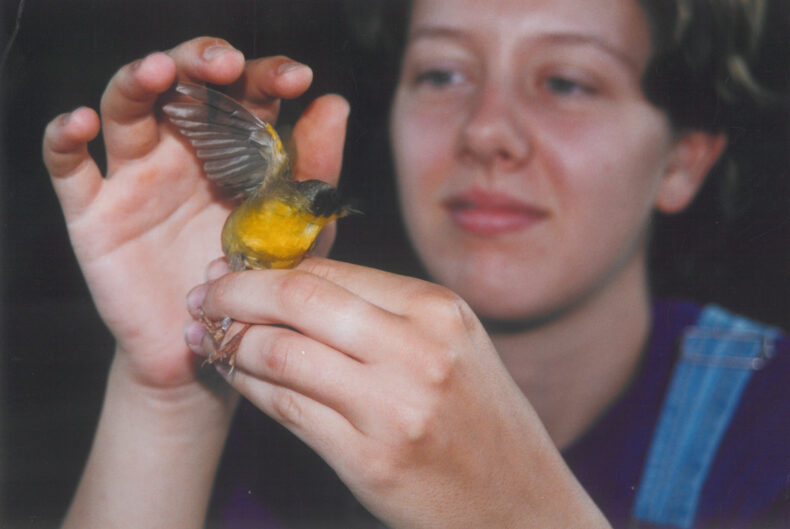
During the summers of my college flirtation with ecological field work, I worked at a 1,500-acre environmental learning center in northern Indiana, where tracks of land are managed for wetland, prairie, and forest ecosystems, providing habitat to an array of wildlife and an opportunity for college students to study their behaviors. On muggy, mosquito-laden mornings, we banded songbirds and shared our data with the nationwide program Monitoring Avian Productivity and Survivorship. Here is a sestina for those birds.
___
We wake before dawn,
head to the edge of the prairie, where songbirds
will begin their morning flights,
start their day with a call, then take to the wing,
flitting from one tree to the next before colliding with our nets,
which are strung where the woods begin, invisible.
//
From a distance, much a bird’s life is hidden, invisible
except their movement and voices at dawn.
We walk a loop in turns, checking the nets,
carefully unravelling gossamer thread from songbirds’
delicate wings,
fragile, yet capable of cross-continental flight.
//
Aluminum ankle bands let us follow the flights,
the numbers and letters etched on the bracelets nearly invisible.
We measure wingspans,
check bellies for featherless brood patches, which, until dawn,
were warming songbird
eggs — young, which might one day also encounter our nets.
//
It was Japanese hunters who inspired these nets;
theirs to capture birds for food, ours to monitor flight.
These datapoints of age and sex and weight of individual songbirds
say little alone, but in aggregate, reveal once-invisible
patterns: population, migration, longevity, their behaviors at dawn.
But what revelation, the flutter against my palm, of a goldfinch wing.
//
Look! See the riot of color interlacing a house sparrow’s brown wings,
but also the long tail feathers dropped in fright, suspended in our nets.
It’s a rude awakening, this passerine dawn,
this interrupted flight.
Is it worth it, this stress, to reveal the invisible
details of the lives of songbirds,
//
as if measuring and weighing and tracking the movement of songbirds
might halt the destruction of their habitats? We’re all just winging
it, hoping this action or that will make some difference, however invisible.
But on the whole, is it a net
benefit to know which birds passed through this prairie on migratory flights?
Still, amid dew-bejeweled spiderwebs at dawn,
//
I am transformed: learning the invisible lives of songbirds
has made my dawns, even still, a search for wings
free of nets, wild in flight.
___
Katie Mast is a science writer in Santa Fe, New Mexico. She manages communications at the Santa Fe Institute, where she writes about our unfolding understanding of the rules that govern complex systems from economies to ecosystems.
Image: the author banding goldfinches in college.
