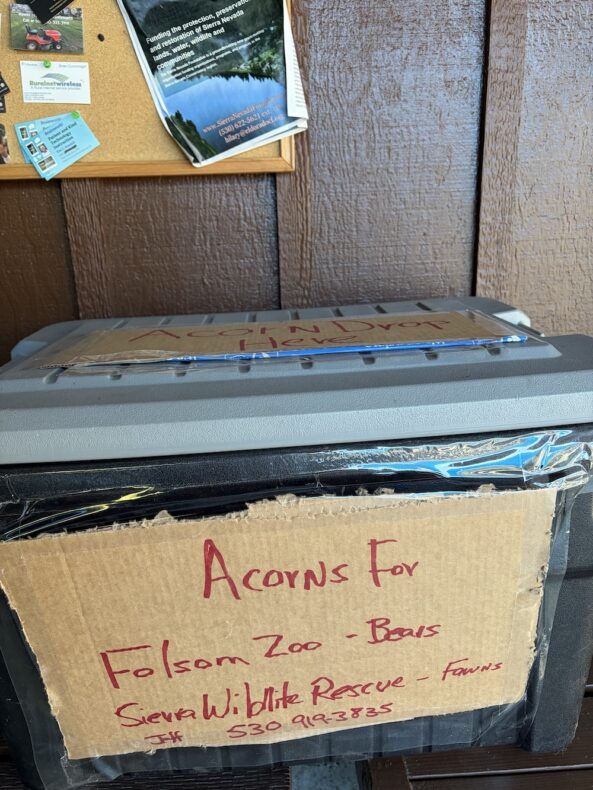
I recently came across this bucket at one of our local coffee shops — a common drop and collection point for free goods, from books and magazines to excess zucchinis and figs. The bucket and its sign reminded me how much I like this dusty little town and its inhabitants, human and wild. So I called Jeff and asked him if I could write a blog post about the acorn collection program. He obliged with an enthusiastic rundown, emphasizing that I should really call the folks at the zoo and rescue. We chatted long enough to discover that, like everyone around here, he knows my dad.
A few weeks later, Jeff posted on our community listserv, passing along an email from Kelly Garner, the fawn program manager at Sierra Wildlife Rescue. She shared photos of fawns feasting on the donated bounty, thanked the community, and reminded us to use only grocery-sized bags or 3-gallon buckets, as “anything larger can be tough for our volunteers to lift.” Kelly recently took over as fawn program manager from Dave Cook — a legend in the wildlife rescue field who, over the past thirty years or so, grew Sierra Wildlife Rescue from an essentially one-man operation into one of the largest fawn rescue operations in California, rehabilitating up to 175 fawns a year.
It was Dave, Kelly told me, who established a relationship with Jeff and Barbara Lee, and got them to help him recruit the community to gather acorns. In addition to leaves and other types of forage, the acorns that shower the ground here in late summer and fall — some dark and shiny as roasted espresso beans, some mahogany or pale yellow — are a staple food source for the convalescing fawns, who also need to eat 10-15% of their body weight in leaves per day.
During fawn season, from mid-May through late July, the wildlife rescue gets hundreds of calls about fawns that appear to be abandoned. Many of these calls are about fawns that have just been left alone for a few hours, but this isn’t usually cause for concern, Kelly said — during the first weeks of its life, a fawn is entirely dependent on its mother and doesn’t move much. Even when it’s tiny and weak, a fawn’s spots camouflage it well from color-blind predators, who see only dappled light against a dappled background. Unlike mature deer, very young fawns also do not emit scent that predators can detect: they have only one scent gland in their tiny hooves, which produces a chemical their mothers can follow.
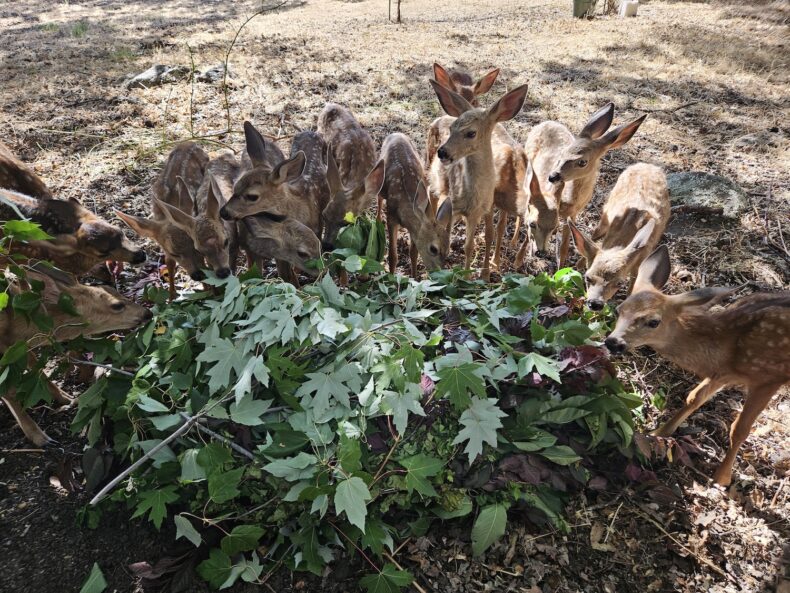
When someone calls in about a quiet, stationary fawn, Kelly and her team ask them to keep an eye on it, often sending a video or two, rather than assume that it needs rescue. Orphaned fawns are more likely to wander and cry out in distress. At the rescue, the youngest of these fawns get bottle-fed formula by a single volunteer, so that they don’t get used to more than one person and lose their fear of humans; the goal is always to get rescued fawns back to the wild, Kelly said.
Kelly went to the same high school I did, we learned as we chatted. We both missed the wildlife here when we lived out of the area. Now, at Sierra Wildlife Rescue, she helps nurse hundreds of fawns back to health each year — working with them in groups of fawns around the same age to try to recreate the natural, matrilineal herds they form in the wild. Although the fawns don’t arrive as a family, the young ones can still form this kind of social structure over time — but that requires keeping the groups together and rehabilitating them for months, which is why they need so many acorns. “It really does take a village to feed the fawns,” she concluded, offering to send me more photos of the fawns munching. Then, after kindly answering all my questions, she signed off to feed some rescued foxes and a ringtail cat.
