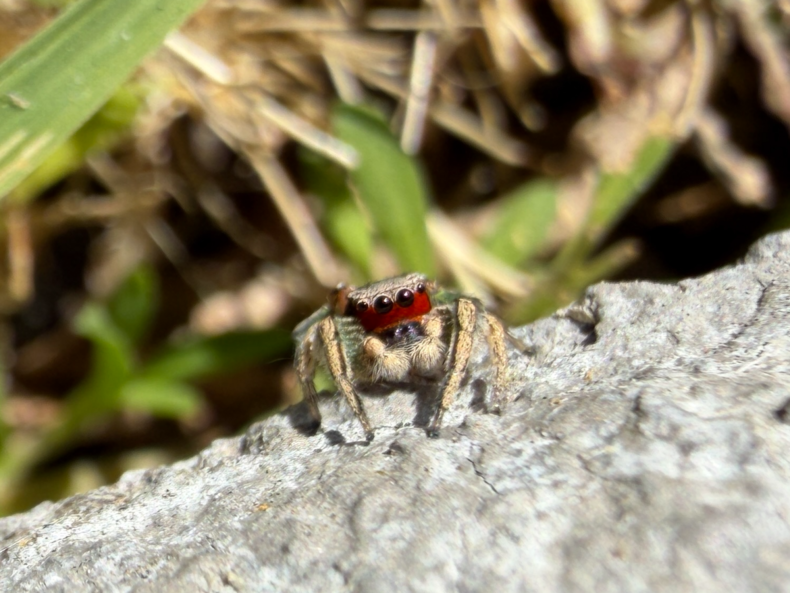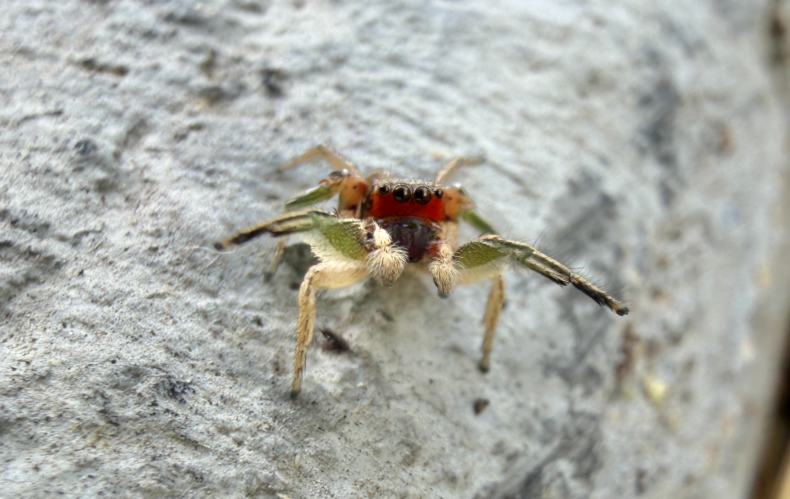
Tomorrow is international jumping spider day, so I’m taking this as an excuse to tell you about one my favorite jumping spiders, Habronattus pyrrhithrix. I was introduced to the species while writing a story about the perceptual world of jumping spiders for Science News. I interviewed visual ecologist Nate Morehouse at the University of Cincinnati. He had discovered that that Habronattus spiders can see the color red using a specialized filter, making them the rare arachnid with trichromatic vision. (In fact, they can see the same range of colors we can, plus UV).
This makes sense given the startlingly bright red faces of male H. pyrrhithrix. They also have lime green front legs and adorable pompoms on their pedipalps. Despite this flashy get up, Morehouse found that it’s the orange knees on the males’ third set of legs that the females are most interested in. (He discovered this using a jumping spider eye tracker, which is exactly as awesome as it sounds.) He also showed me a fantastic video one of his students made of the elaborate courtship dance of the male H. pyrrhithrix (below).
In the video, the male spider periodically pops those orange knees up behind his head, framed by brilliant green front legs sticking straight up like he’s calling a field goal, in a sort of peek-a-boo display. She seems into it at times, but is clearly not convinced and won’t let him mount her when he tries. He keeps at it, not taking the hint until she threatens him. Persistence can pay off for male spiders, but not respecting that “no means no” can be fatal. He wisely takes her seriously at this point, staying put and gently flicking his wrists as she walks away (though I am pretty sure the scientists were ready to intervene with a soft paint brush if things went south).
Imagine how thrilled I was when one of the first jumping spider species I managed to spot in the wild, in my own neighborhood, was H. pyrrhithrix. These spiders are tiny — males are around 5 millimeters long, females measure up to 8millimeters — but once my brain had the right search image, I started seeing them everywhere, even in my own front yard. Now I can even spot baby spiders about the size of a pinhead.
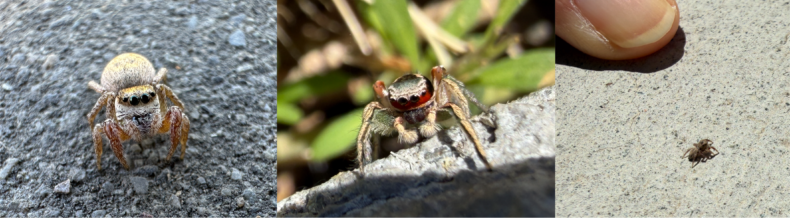
This species likes being on the ground, often in grassy areas. They are easiest to spot when they hang out on the sidewalk at the edge of a lawn, which I think they do to warm up (and to catch flies who also like to warm up on warm concrete). So for the past four years, I’ve been scanning the ground as I walk, everywhere I go. During summer and fall in particular, these guys are all over the neighborhood.
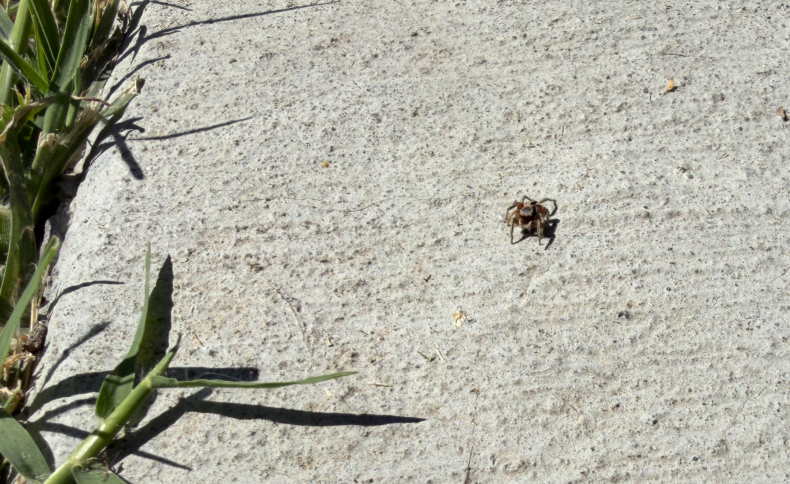
Soon I discovered that the backyard of my parents’ house, about 20 minutes from my own, was home to a very robust population of these little guys. It was there, almost three years ago today, that I saw it: the very same courtship dance from the video, in real life, right in front of me. As I watched the drama unfold, I began to notice other displays happening simultaneously in the sparse grass. These little guys were working so hard, chasing females, trying desperately to get them to watch, waving their arms, flicking their wrists, popping their knees, and vibrating their abdomens to keep the ladies’ attention.
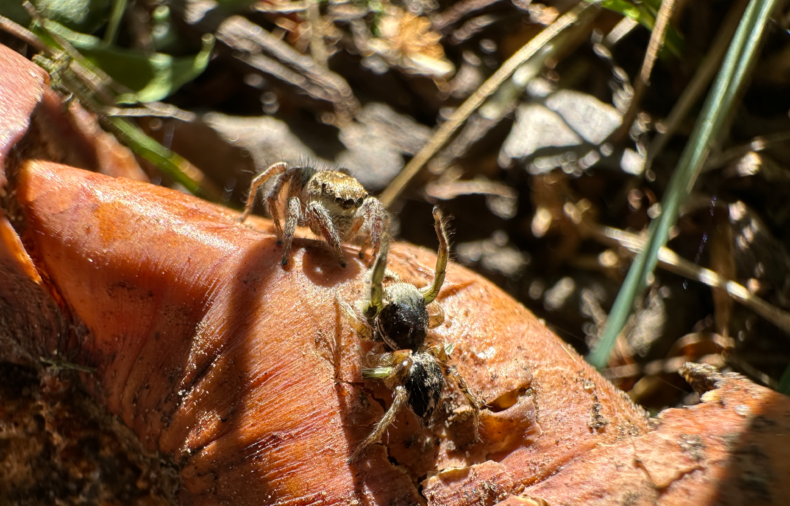
But there’s more to this dance than meets the eye (or even the iPhone macro lens). Another jumping spider researcher I’ve interviewed, Damian Elias at UC Berkeley, studies the vibratory aspect of jumping spider courtship, and it is pretty amazing to hear — like a mini marching band all in one tiny spider. Be sure to turn on the sound wo watch his video (below) of an H. pyrrhithrix display, with the vibrations translated into sound using a laser (watch this bioGraphic video to hear Elias explain how this works, and more courtship videos of other Habronattus species from the Elias lab).
None of the males I watched in my parents’ yard that day were successful. Thankfully, I also didn’t see any of them meet their end, which is a very real possibility for these guys. If she is hungry, or maybe even just annoyed, she might pounce.
In July, I spied another courtship in my own neighborhood, at the edge of a neighbor’s lawn. He had her full attention, and I could see her perk up and track his knees each time they popped up. At one point, she spun around to face away from him, and I thought he might be out of luck, but he managed to reel her back. As his dance was reaching its frantic end, she subtly bowed her head allowing him to climb on and seal the deal, which involved rolling her abdomen to one side and inserting the sperm with his pedipalps.
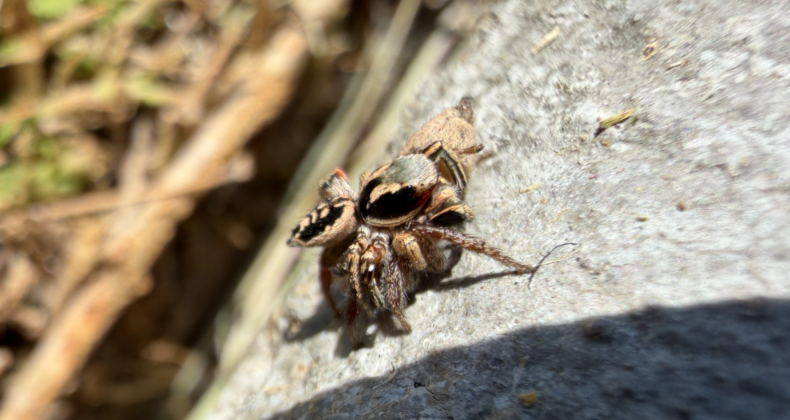
I don’t know how long this part lasts because I began to suspect that she was watching me watch her. I worried that if I made her feel unsafe, her dance partner might pay the price, so I let them be. Hopefully all went well and he lived to show his knees to more females.
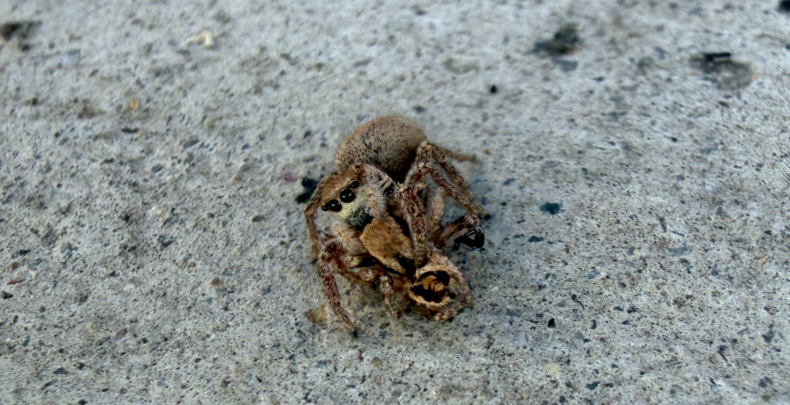
Three days later, however, I came across the aftermath of a courtship gone wrong. This female was pretty plump, so I’m guessing she hadn’t made a meal of her suitor out of hunger. Perhaps she was already pregnant and uninterested in having another go at mating. Or maybe she just didn’t like his dance. Whatever the reason, seeing the much smaller, lifeless male in her clutches was a rare sad moment amid the hours of joy I get from observing these animals. It also made it clear just how risky this whole proposition is for those beautiful, red-masked, orange-kneed little guys.
Now every time I see one of those itsy, bitsy, red-masked spiders, I carefully avoid stepping on them, and then I cheer them on and wish them a safe and successful day.