So there we were, on the deck of a nice restaurant with a view of the mountains and a valley with a river flowing through it, and a menu Google had described as “elevated.”
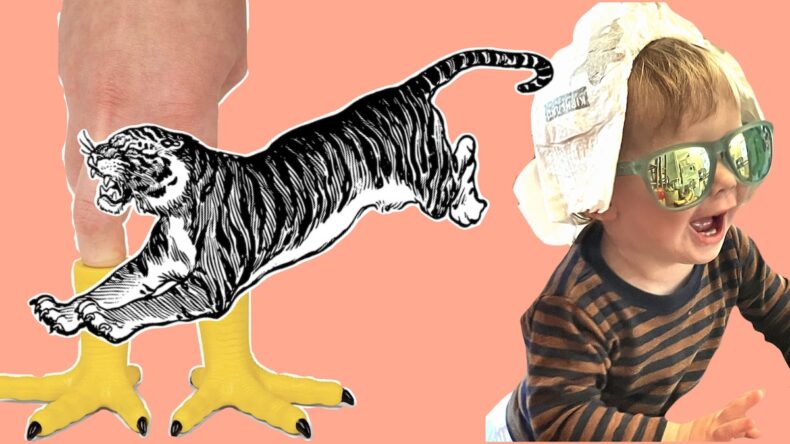
Then, out of nowhere, a tiger appeared. It prowled the deck, brandishing its claws at a bachelorette party sitting next to us. As it stalked the bride, we saw with horror that its jaws were dripping with blood — or was that … ketchup?
No! Will! we cried, scrambling across the deck and attempting to grab the tiger by his ankles.
RAAAAWWWRRRRRRRRRRRRRR! he growled, twisting free and creeping toward the bride-to-be.
Will, stop! I pleaded. He looked back at me, grinning, then sprang forward, coming within inches of mawling her cream-colored dress before I could grab him and football-carry him back to his booster seat.
In comedy this is called escalation — taking an initial premise and making it progressively bigger, weirder, more outrageous. It is also an apt description of parenting a toddler, and the remarkable rate at which humor develops between birth and age four.
The first comprehensive taxonomy of humor in the first four years of life, published in 2022 in Behavior Research Methods, found that jokes of all kinds — from tiger imitations to wearing a salad spinner as a hat — increase sharply from age zero to two, growing increasingly elaborate with age.
That study, drawing on data from more than 800 children, resulted in the Early Humor Survey, a 20-item parent report measure of humor development that includes a rich variety of comedic forms, from “Saying strange things/mixing up concepts/nonsense (e.g., dinosaurs eat the wall; cats have 5 legs, dogs say moo)” to “Referring to gross things, e.g., poo, sneezing, smelly feet, etc.” Here’s a graph of their data:
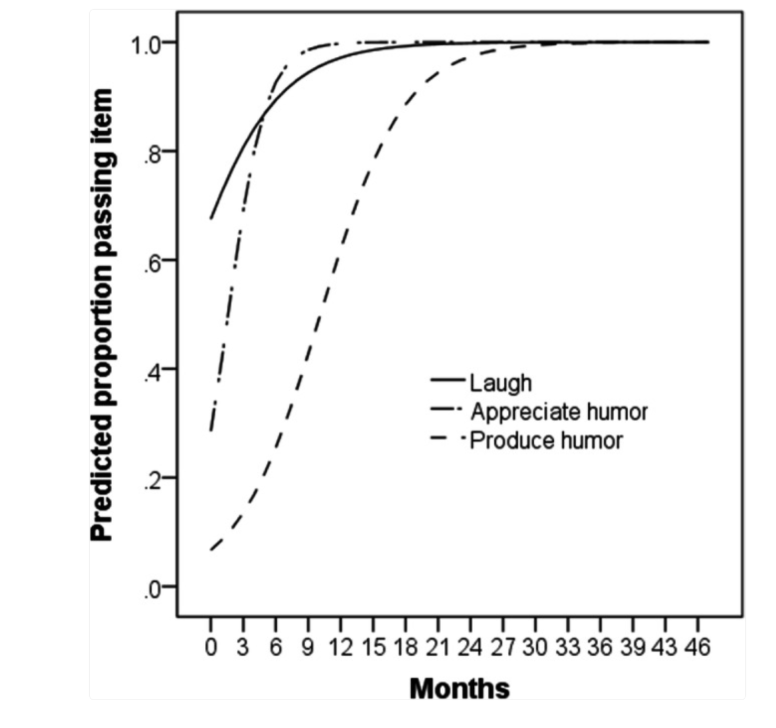
Predicted age curves for laughter, humor appreciation, and humor production
Behav Res Methods. 2021 Nov 18;54(4):1928–1953. doi: 10.3758/s13428-021-01704-4
Will, at 27 months, is right on schedule, having graduated from silly faces, gestures and sounds to parading around the house with a crinkly tube that is by turns an elephant’s nose, a wind instrument, and a bubble blower. According to the EHS, he’s well on his way to irony, which typically shows up around four.
On the way home from our Tahoe dinner, Will worked on his favorite burp joke — fake burp followed by: Mama, I burped! followed by: BIG BURP! HAHAHAH! — for a solid 30 minutes, then moved on to another favorite game: randomly pointing out the window in faux alarm and shouting OCTOPUS!!
I thought about the tiger attack at the restaurant, and how he’d managed to recruit not just me, but Pete, the waiter, and the bachelorette party into his performance — although, unlike the remarkably chill waiter, the bachelorettes had not seemed 100% amused. When Will gets going, we’re not just his audience, I realized. We’re his sidekicks. The inept zookeepers in his circus. His personal improv troupe.
The fact that all toddlers in every society enjoy humor — and basically the same jokes – has long suggested to scientists that it must serve some purpose, from social bonding to developing symbolic thinking and theory of mind. But testing how these milestones contribute to or correlate with cognitive outcomes is difficult, partly because so much of the research is based on parent reports — people like me, watching their kids and filling out surveys.
While the Early Humor Survey was reliable in terms of “parental inter-observability” (translation = two parents took the same survey independently and got similar answers), the researchers also found that “lab experiments do not necessarily capture the everyday humor reported by parents.” Could it be that the scientists in the study were simply not very funny when they delivered the “horse says “neigh” vs. “Quack! Quack Quack!” joke? Yes, they conceded.
Understanding toddler humor can indeed be difficult. For example: when I put a diaper on my head and Will laughs, one scientific interpretation of his glee is that he’s laughing because a) he knows what the diaper is for b) he can infer that I, too, know what a diaper is for c) he knows that I’m doing the “wrong” thing with the diaper on purpose and d) he can tell from my face that I am being silly with the intention of eliciting his giggles. As his mother, I’m inclined to agree with this sophisticated explanation. But since Will can’t yet clearly explain his thinking to me, I can’t really know that it’s true.
My friend, who has a 1-year-old, describes the exact same diaper-on-the-head routine. She initially thought was their own, private joke. But according to the Early Humor Survey, neither her baby nor Will are unusual — the diaper joke is a standard toddler bit, like Will’s tiger attack and his relentless delight in putting his toes on our dining room table. Will’s volume of his mirth is also pretty typical, the 2022 study suggests: When the scientists asked the parents of 671 kids how often their toddlers laughed at something funny, the answer was a median interval of every two hours.
I called my mom the other day when I was waiting for my train — I get lonely on my rides to and from work, missing Will — and we traded stories of all the funny new things he’s done and said lately. Then we talked about a funny viral video she’d sent me, the one of those guys at DCA who bought secret ugly pants for each other. They agreed to trade them and wear them in the terminal — pants with sequins, fringe, ruffles, an elephant’s dangling proboscis — and then they just crack each other up. It feels good, we agreed, to watch that kind of uninhibited silliness in grownup people.
Our conversation turned to her recent visit to the Farallon Islands — how rich those islands were, so alive with rare seabirds and whales and dolphins and endangered seals. That’s how the coast of California used to be, the tour guide had said. Doesn’t it just make you hate people, someone had replied. My mom agreed, at the time, but then watched the ugly pants video in the airport and reconsidered.
No, she didn’t hate people. At least not the ones who made her laugh, she said. And especially not Will.
And suddenly, I felt buoyed by the fact that our private jokes with Will are not private, but universal. I thought of all the laughing toddlers out there — unfettered and life-giving, like the Farallon Islands with their chattering birds and seals. That reminded me of an artesian well I once stumbled on accidentally in Colorado: a free upwelling of pure spring water. And of that time were in line at Target, when Will laughed so uproariously during checkout that everyone stopped and turned towards us, looking for the source of those irrepressible peals.

Thanks for this! I teach college students, and I’ve been thinking a lot lately about the necessity of shared jokes among first year college students, specifically those who have only been on campus a few weeks and have yet to actually feel good about it.
Till the jokes arrive, and for some it takes a long time, college is an awkward business of wanting to be smart but being surrounded by unexpectedly beautiful people or exceptionally athletic people or those who are a cool and smart rather than anxiously earnest as they are.
Sometimes their entire success at this one place they chose for the glossy brochure, some idea they had about the evergreen trees on a campus that is romantic and isolated and darn-hard-to get to, hinges on that one joke that gets repeated and only becomes funnier with every use.
At my alma mater, an all women’s college, there was something called “the third floor voice” and also the useful phrase, “I affirm you,” spoken whenever someone might have overshared a bit. “I affirm you” was borrowed probably from orientation, or some kind of training about how we should support each other, and now purposed to reveal and affirm at the same time, to mock the history of the college itself, it seemed, but also to claim it as our own.
Toddlers are so gleeful and mischevious and they delight because they delight and their delight can seem endless at times. And maybe humor for college students restores them somehow to an earlier self when they created jokes and could get jokes and could manufacture a gag or a bit out of anything. Long before they read and they turn into college students, they do this!
I love that observation, Rachel! And I do wonder and want to understand how and why that early, unselfconscious ability to joke diminishes. On some level, it’s necessary: although I dread it I know I will have to teach Will that some things aren’t always funny (attacking strangers with ketchup for example) or at least to know his audience. But I hope we can keep our little improv group going as long as possible…