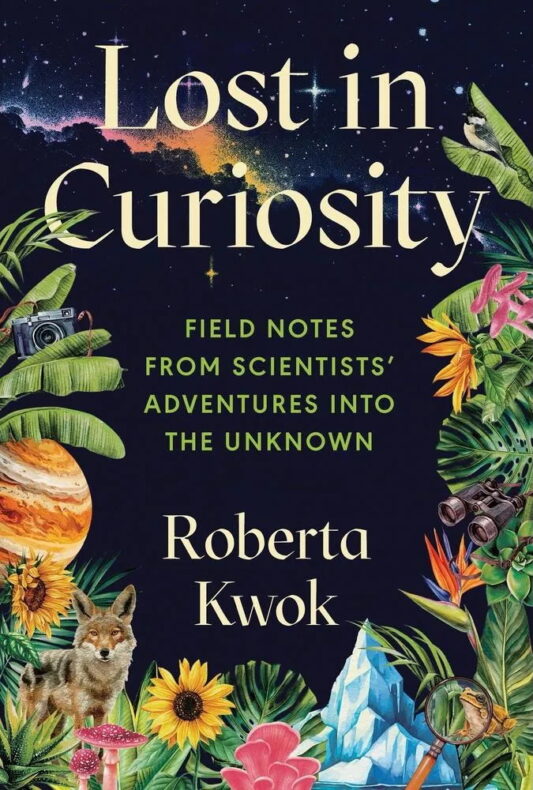
Our Roberta wrote a book!
Roberta Kwok wrote for The Last Word on Nothing for several years — and once a Person of LWON, always a Person of LWON. Her first book, Lost in Curiosity, comes out on July 21. It’s filled with stories of the ups and downs of astronomers, physicists, frog biologists, and more (read on to find out which chapter got its start as an LWON post).
Indie booksellers have already been celebrating Roberta’s writing, and we want to celebrate, too! Here’s an interview with Roberta about her fabulous new book.
*
Cameron: How did the idea for the book come about?
Roberta: It’s hard to believe, but the seed for this book was planted 20 years ago. I was an MFA student in creative writing at Indiana University Bloomington, and I decided to write an essay about a scientist friend, Ben Blackman, who studied sunflowers. As part of the reporting, I followed him on a 20-hour lab experiment collecting leaf samples every few hours. And what struck me was how many things went wrong; most critically, at the 11pm and 3am timepoints, Ben discovered that some lights weren’t configured correctly, and all the samples we’d just laboriously collected might be useless. But he seemed to see this state of affairs as pretty normal and was ready to re-do the entire experiment. (Meanwhile, I was exhausted because I never stayed up this late.)
About 12 years later, I thought that maybe I could write a book exploring that theme — the hidden human struggles, failures, and uncertainty behind scientific discoveries, or the opposite of a Eureka moment. I loved narrative science books like Lab Girl and Owls of the Eastern Ice, where researchers told stories of the obstacles they’d faced and overcome. I wanted to take that idea a step further by following a research project from a different field in each chapter, creating a sort of tapestry of science. The vision was that the book could show science as a massive collective enterprise driven by the tiny steps — forward, and often backward — that individual scientists take.
Cameron: What was reporting this book like? Did the stories of the scientists in the book emerge from reporting that you were already doing, or did you seek out researchers whose projects were especially compelling because of the ups and downs involved in their research?
Roberta: In a few cases, I had written shorter pieces on the researchers before — for instance, a news story about a frog parenting study, a section of a kids feature about an Indigenous chemist studying uranium pollution, and an LWON post about astronomers chasing signals of planets “transiting” across their stars. If I found myself thinking, “Huh, I wonder what happened with that,” I reached back out to the scientist. To find the researchers for other chapters, it was a complete spaghetti-at-the-wall endeavor where I scanned tons of news stories and journal papers for anything that sparked my interest.
Once I started reporting on scientists’ research projects in earnest, it was a little nerve-wracking because I had no idea what was going to happen. I had to commit and follow their journey wherever it led. But science is so inherently filled with twists and turns that, for the most part, it worked to simply trust that a story would emerge.
Credit: Roberta Kwok
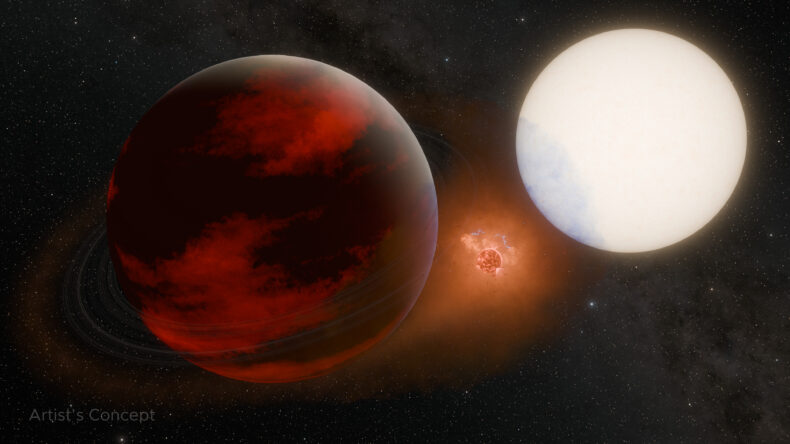
Cameron: In the “Moon on Fire” chapter, which follows researchers searching for exomoons, some of the scientists talk about how emotionally invested they become in their work. How did you see them navigating that, and was that something you had to navigate as well?
Roberta: In that chapter, astronomer David Kipping was very committed to remaining as objective as possible, and his team went to great lengths running batteries of tests to rule out false positives — that is, detecting a moon outside our solar system that wasn’t really there. One quote from Kipping stood out to me; he said, “I don’t want to be emotionally attached to any object I discover.” I found that admirable, but also kind of sad, because it seemed like with that mentality, you might lose some of the joy of science.
I don’t know if all scientists try to be so detached; sometimes the emotional investment is what gives them motivation and meaning. For instance, one chapter is about an evolutionary biologist trying to observe incredibly elusive frogs in the Borneo rainforest, and I’m not sure how she would withstand all the obstacles to her fieldwork without really caring about these frogs.
As for my own attachment, I realized when I listened back to an audio recording of one phone call that I had become emotionally invested. I was standing on a school soccer field with my kid’s telescope one night, talking to another astronomer, Apurva Oza, who was also stargazing. Oza saw a shooting star, and I started yelling that he should wish on the star to see his moon again; I actually sound kind of unhinged. It’s obvious in that moment that I’m on his side and want his team to find the signal they’ve been seeking for so long. So I decided to lean into that and just admit to the reader that I’d lost objectivity.
Credit: NASA/JPL-Caltech
Cameron: Another chapter, “Paper Labyrinth,” looks at research on the physics of paper folding — and I was very excited to learn that one of the physicists also published a paper on how to classify any food as either a soup, salad, or sandwich. This is not really a question, but I love that this was part of the book! My kids talk about this all the time!
Roberta: The physicist, Madelyn Leembruggen, and I discussed this question with great intensity when I visited her. She and her friends got obsessed with the question of whether every dish could be categorized as a soup, salad, or sandwich and created a phase diagram similar to those used for other physical systems. I asked her to classify the peanut butter chocolate chip protein bar that I’d brought, and at first Madelyn definitively said it was a sandwich because you could “pick it up by the carb and eat it.” However, when we realized that the bar was made mostly of non-carb ingredients like pea protein, she decided it was “very close to the sandwich line” but “technically a salad.”
Cameron: Are there stories that didn’t make it into the book that you wish there had been room for?
This isn’t a story, but I had originally wanted to include a song lyric from The Muppets as an epigraph; it turned out that permissions would have been too difficult to get. In “Rainbow Connection,” Kermit the Frog asks why we keep stargazing and wonders what we think we’ll see. (Again, I can’t re-print the exact lyric here but you can hear it in this YouTube video.)
To me, that’s the eternal question. As humans, we keep questioning, we’re always curious, we always want to explore and understand more about our world. That feeling of curiosity is such a human emotion.
Thankfully, we did get permission from Ada Limón to reprint lines from her poem “In Praise of Mystery: A Poem for Europa,” which are even more beautiful.
Cameron: Did writing the book change something about how you saw the process of science?
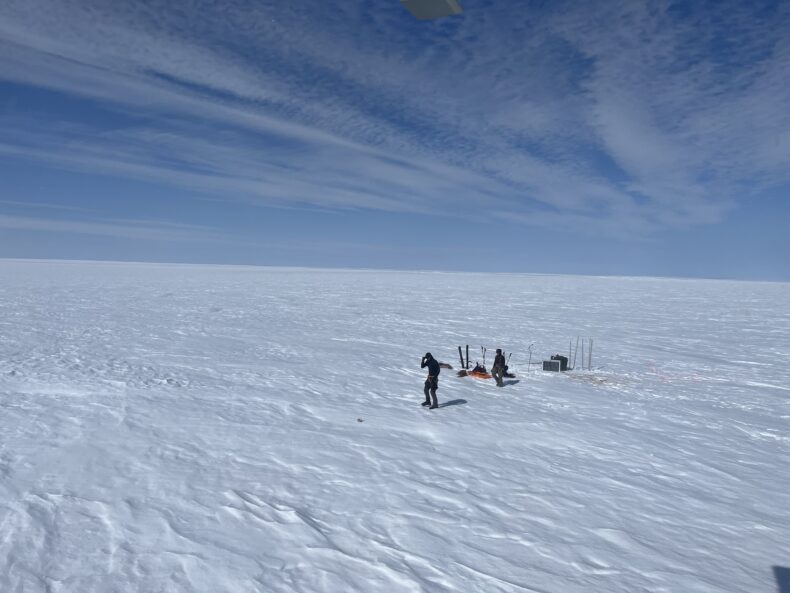
Roberta: I think that writing the book made me feel more grateful to these scientists who continue to hurl themselves at these seemingly unsolvable problems, month after month, year after year. Staying up late to collect sunflower samples with Ben was nothing compared to what some researchers went through, like the geologists in Greenland who were hacking snow off their tents at 3am, getting sick while camping on a remote glacier, and worrying about possible encounters with hungry polar bears.
As part of my reporting, I interviewed philosopher of science Michael Strevens, who wrote in his book The Knowledge Machine about the tremendous amount of labor that goes into gathering scientific data — the “empirical minutiae, so painful to collect, that single out the truth among the plausible falsehoods.” We were talking about scientists’ perseverance, and he said, “I find it kind of marvelous but also puzzling that they’re willing to do it… To go into it wholeheartedly, that seems to me an amazing and good and puzzling thing.” As someone who briefly tried scientific research myself and speedily exited that world, I feel the same way.
At one point, my editor suggested framing the book as “A love letter to science,” which I resisted because of my training to be an objective journalist. But now that I’m looking back at the book… it’s not wrong.
So while I originally wrote this book for the general public, I hope that scientists read it too. Emma Regnier, the biologist/artist who illustrated the book, wrote to me that they were both laughing and tearing up while reading about some of the researchers’ tribulations, and that “as a field biologist myself, I felt so seen.” So if the book makes scientists feel a little more understood during these incredibly troubling and turbulent times, I’ll be glad.
*
Lost in Curiosity cover courtesy of Sourcebooks / Caitlin Sacks
