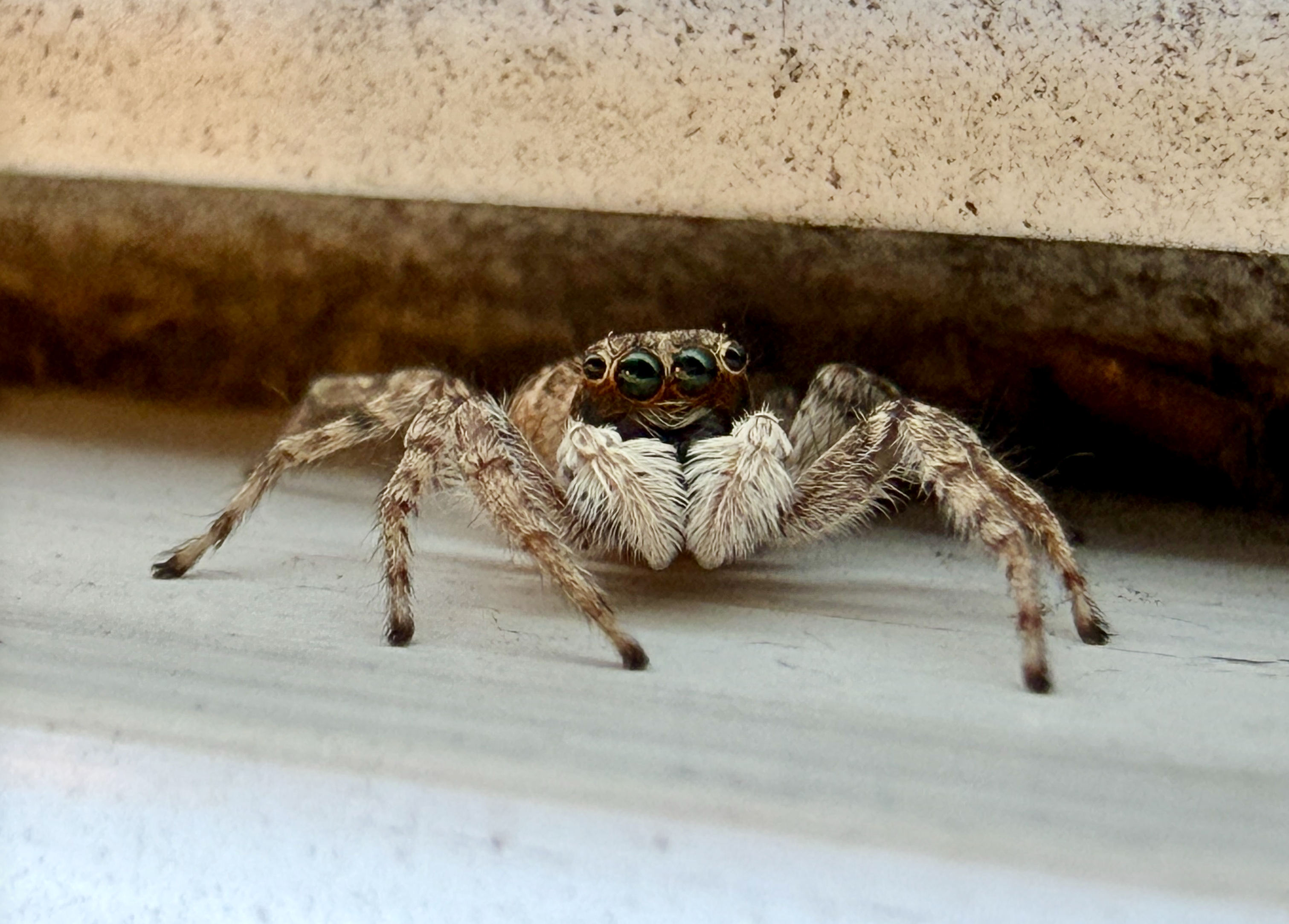
Jumping spiders can see as well as house cats — despite being less than 10mm long in most cases. I find this astounding, but people almost never seem as impressed as I think they should be when I tell them this. Perhaps they don’t believe it could be true.
It is, though. Scientists have measured these spiders’ spatial acuity, and it is on par with cats, pigeons, and elephants. Let that sink in for a moment. Jumping spiders can comfortably fit on your fingernail, while elephants are around 80 times bigger than you are.
As I reported a few years back for Science News, your own visual acuity is only around five or ten times better than a jumping spider’s. “Given that you can fit a lot of spiders in one single human eyeball, that is pretty remarkable,” animal behavior researcher Ximena Nelson, who studies jumping spiders at the University of Canterbury in Christchurch, New Zealand, told me. “In terms of size-for-size, there’s just no comparison whatsoever to the type of spatial acuity that jumping spider eyes can achieve.”
That incredible eyesight evolved for a purpose: hunting. Jumping spiders do not build webs and sit around all night waiting for prey to become ensnared. They are out in the daytime hunting flies and other insects. And this brings us to another way these tiny arachnids are like cats.
The ability of jumping spiders, or salticids, to stalk and pounce on prey has earned them the moniker “big cats of the spider world.” According to a paper (Harland et al, 2012) from the research group of the renowned jumping spider scientist Robert Jackson, the Ming Dynasty–era Chinese word for jumping spider translates to “fly tiger.” (I’d love to hear from any readers who are in a position to confirm or disconfirm this.) The authors argue fly tiger is more fitting than the English jumping spider or the German springspinnen, because what sets them apart from all other spiders isn’t their ability to jump. “It is the making of precision, vision-guided leaps at targets that is unique to salticids.”
It is very rare among arthropods to catch live prey by stalking them the way mammalian carnivores do. But just like cats, jumping spiders “creep toward the prey undetected until the chance of escape is small, and then spring,” Michael Land, the grandfather of jumping spider vision research, wrote in a 1974 paper.
I’ve witnessed this behavior myself many times out in the wilds of my neighborhood. But lately I haven’t even had to leave my living room to watch a hunt. Meet Willa, a half-edged wall jumping spider (Menemerus semilimbatus) who has set up shop in the front window of my house.
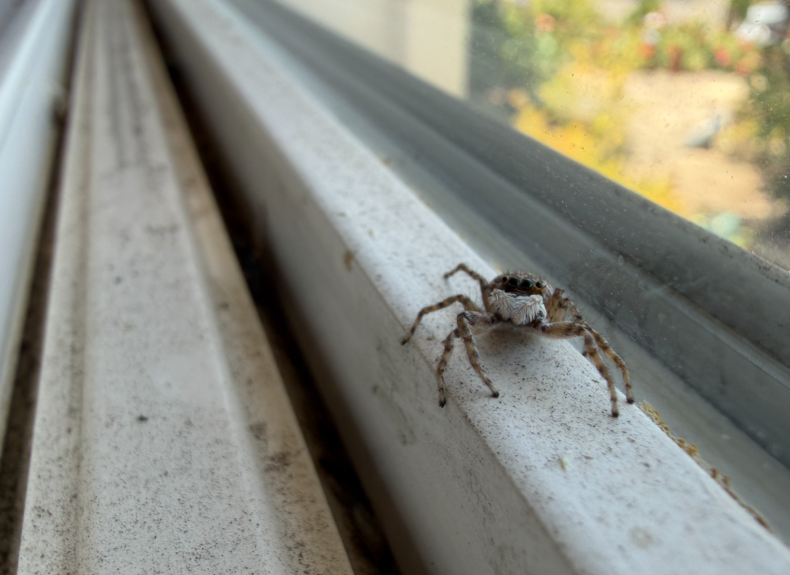
Willa likes to sit on the sill and look out the window (also like a cat!). When she sees something interesting, she pushes up on tip toes to get a better view. It’s pretty adorable.
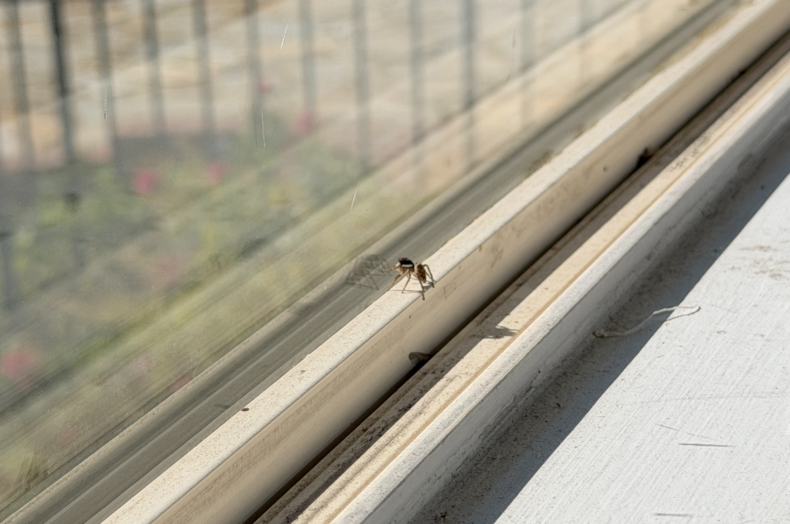
Jumping spiders have secondary eyes on the sides and back of their heads that monitor for motion that warrants a more detailed assessment by their high-acuity, forward-facing primary eyes. This makes it very hard to sneak up on them. In the video below, Willa spins around to look out the window after her secondary eyes spot a passing car.
The first time we noticed Willa, she was on the ceiling at the other end of the living room. But she quickly figured out that the front window is where the house flies like to congregate. Over the month since she took up residence in the window, I’ve watched her successfully stalk and pounce on at least a half dozen flies, often as big or bigger than herself. I’ve seen some misses as well, sometimes because she was too cautious, sometimes because a big fly managed to shake her off.
Every time I watch her hunt I am reminded of a cat. Her very slow, patient approach. The way she freezes any time her quarry looks in her direction. How she stays out of sight if possible as she closes the distance, sneaking careful peeks along the way. You’ll see what I mean in the video below.
Robert Jackson’s research group has observed some jumping spiders in the wild that, much like lions, seem to plan a detour route that allows them to get into an optimal position without being seen before pouncing on their prey. It is certainly easier to ascribe this kind of strategic thinking to lions than to spiders, as they note in the 2012 paper. “However, for the salticid, but not for the lion, we also have experimental evidence that supports the conclusion that the detours were planned ahead of time.” The question is how these tiny spiders with brains no bigger than poppy seeds are able to do so much with so little.
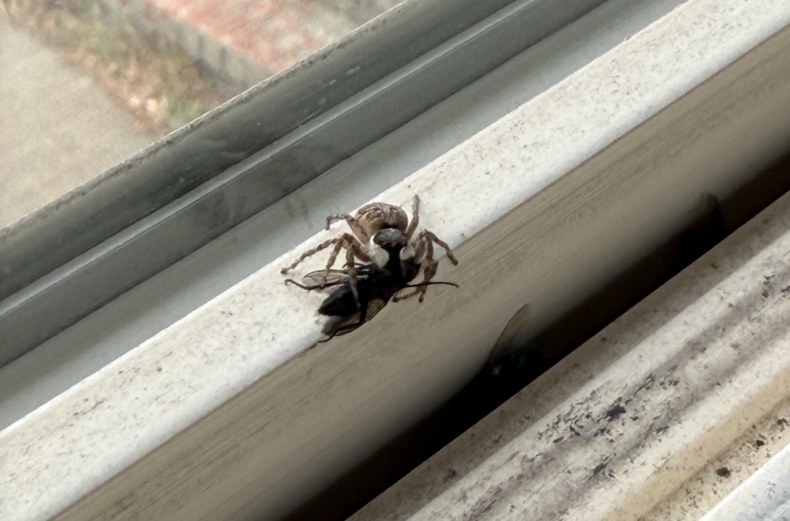
Having a jumping spider for a housemate should, theoretically, be a good way to keep the fly population in your home under control. Unless you feel obliged to keep the doors and windows open most of the day to ensure your fly tiger has enough prey to stalk. In that case, you may end up with more flies than ever. But for me it’s worth it to get to watch some good Willa hunting.

I couldn’t stop smiling after reading “Given that you can fit a lot of spiders in one single human eyeball…”, and then you hit me with Willa staring out the window and the videos of Willa stalking/hunting.
But you did me in with ‘Good Willa hunting’ as a photo caption, and a perfect ending.