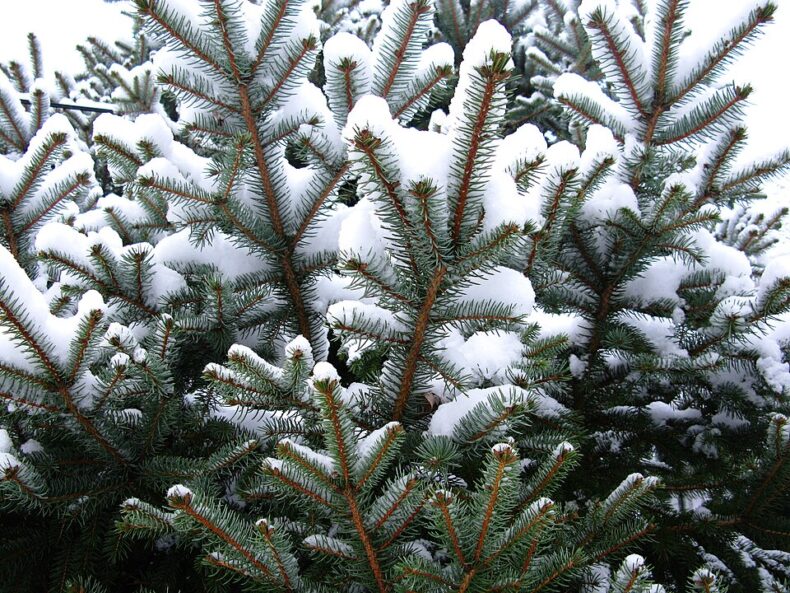
More snow finally came on Tuesday night, two months later than it was supposed to finally come, and it is too late, but it is better than nothing. That’s what everyone is saying. “I’m so grateful for the moisture.” “I hope the flowers I covered will make it.” “I’m happy it snowed, but I do wish it had snowed back in February and March when we really needed it.” “It will be a drought-denter, but not a drought-buster.”
A May snowstorm is not actually all that rare, and most people who live in Colorado are happy about it. The ones who complain or act surprised are usually the Texans who moved here and still talk all the time about Texas. The snow is good — any snow in the mountains is good — and we need it all year, but especially right now, in our absurdly severe megadrought.
Still, even a typical May snowstorm comes at bad timing this year, because the trees and the forest were not ready.
The leaves are on deciduous trees, which happened earlier this year than usual, because it was in the 80s in March during a historic heat wave. I wrote about it in The Atlantic. We lost most of our snow back then, and when more snows came in April, we lost some leafed trees to the weight and the frost. Some farms lost their entire peach crops, the trees having been tricked into thinking it was spring from then on. Others were much more lucky, but famous Colorado peaches are heading for a mixed summer.
In the woods where my house is, the scrub oaks came in a month early and then their buds froze. Now they are in a perpetually liminal state, not-blooming but almost-blooming. Frozen in time and in actual frost.
The blue spruces near me were recently sporting tumescent male pollen cones, and I remarked to my husband that I will have to remember to close my office window, so that my desk won’t be covered in yellow pine dust. What will happen to those cones now? Are they ok?
I looked it up, because I am always worrying about trees, and I learned that blue spruce pollen is shed from April to June, depending on altitude. It was not shedding yet for me, but at 6,700 feet in elevation, I suspect it will be very soon, or would have been. I hope to be sneezing again soon as a sign of the trees’ health.
I also worry about the delicate, but also incredibly hardy mountain plants. In the high mountains, the grasses and the tundra plants were exposed early, and were drying out because the snow was gone two months earlier than usual, at least in some spots. The snow this week is welcome, but it will also bury them, and if they were already out of dormancy, I imagine this is tough for them.
I looked this up, too, and read that cushion plants and sedges can produce buds under the snow, and then awaken for just eight weeks of summer. I hope they were not waking up yet.
Snow at the wrong time can hurt, in a year when everything has been happening out of sync. This snow is too late. But it is better than nothing.
I mean, at least now, the blue spruces and the ponderosas and the tundra grasses will be slightly less likely to burn. Small victories!
—
Photo: Wikimedia Commons because I didn’t want to put a photo of my house on the interweb

Have you seen Ben Noll’s article “Why the odds keep rising for the strongest El Niño in a century” in WaPo? The models are lining up to make it the largest we’ve seen since records began in the 1800s. This could yield both a hotter and wetter summer for Colorado. If so, it makes me wonder what all that out-of-season rain will do to the trees.