Update: I just found out that I’m talking about two different kinds of crows: I was hearing fish crows — which go krokk, then maybe another krokk, then that’s it — and thinking they were American crows which go caw caw caw and never shut up. Never mind because we’re still presented with the mystery of what those close-mouthed fish crows are saying in so few words.
It’s spring, I think it’s spring, yes really, it’s spring, and I have to stop myself from writing about juiced-up kids and hormonal robins and the flourishing minor bulbs, all sproinging all over the place like little fireworks. It’s true that they’re the incarnation of spring but I’ve written and written about them and you don’t need to hear it all again. I was thinking about what else to write about, out on my walk in the morning, and the crows from one patch of trees were crossing the sky to another patch of trees and talking as they went. They weren’t yelling in long sentences the way they usually do; they were talking casually in single words — a quiet krokk, then another one, krokk. They sounded like country people talking over coffee, keeping it short and to the necessities:
“Wet spring.”
“Yes.”
They sounded like my grandmother and her sister playing cards:
(slap a card down) “Do you believe in an afterlife?”
(slap a card down) “No.”
I heard them say this, it was like music: slap, fundamental question, slap, devastating answer, end of conversation. I never forgot it. Anyway I thought I would write about what crows talk about.
I looked it up. Crows are smart and social and civic-minded — LWON has been all over the subject — which means that they have good reason to talk to each other. “There is probably a lot being said,” says one crow scientist, John Marzluff of the University of Washington. “But what they’re actually talking about we really don’t know.” He’s being modest, they know a lot.
Crows have about 20 different calls, which scientists categorize by the sex and age of the crows, and by the “pitch, duration, cadence, and timbre” of the calls. Another crow scientist, Kevin McGowan of the Cornell Laboratory of Ornithology* says crows not only have specific calls for specific messages, like “heads up, hawk,” but by speeding up the same calls, they can say “hawk’s getting closer, scatter.” They warn each other about threats, they argue over territory, they tell each other about food, they arrange meetings. The little ones ask for food, the big ones tell them to stop asking. They make a racket.
So with all my researches into scientists’ researches, I could begin to understand the racket. But I didn’t find anything about those one-word mid-air conversations: krokk (flap flap) krokk. Maybe they’re doing what scientists call counter-cawing: it’s territory-marking, crows in one territory call in a certain way and crows in nearby territories call back in the same way. Or maybe they’re doing what an old 1971 study called duetting: one crow calls, another makes the same call, it might be a way to keep up with where your relatives are. Though to be honest, I was skimming the scientists’ papers and maybe missed what I was looking for.
And surely this is enough of an answer to my question about what crows are talking about. They’re saying all the things you need to say to your relatives to stay alive and find food and take care of the babies and find a place to spend the night and in general watch out for each other. “Did you see the cat down there?” “Guys, did you see that cat?” “Let’s get away from it.” “Everybody get away from that cat.” “Shall we go over here?” “Is there food over there?” “I see food over there.” “Is the cat over there?” “I think the cat went somewhere else.” “How about this patch of trees?” “I like the patch over there better.” “Ok, let’s go over there.” Everybody argues, everybody has an opinion and has to say it, everybody repeats themselves and everybody else.
But what about those single word comments and single word replies, that quiet, spare conversation? Krokk? krokk. Science hasn’t thought of this yet, but maybe that conversation is for the big subjects:
“Do you believe in an afterlife?”
“No.”
__________________
*Surely you know about Cornell’s Merlin app: take your phone outside, fire up the app, lay the phone on the porch table, come back in 15 minutes, and find out who your real neighbors are.
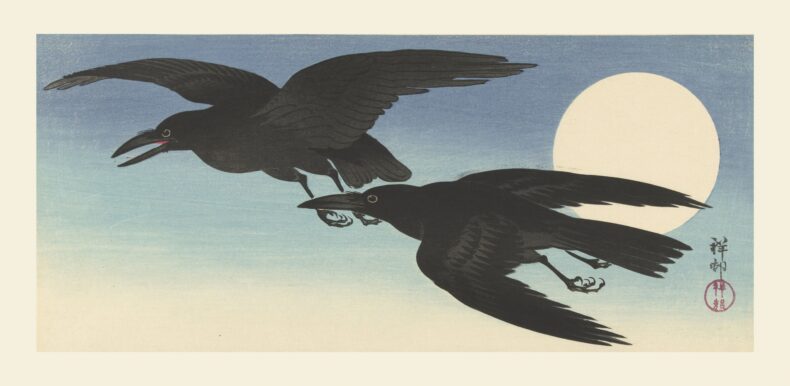
Japanese crows talking: in honor of Helen’s trip all over Japan, on foot and in infinite curiosity.

At my nature center book club last night we chatted about how human beings are likely at the bottom of the proverbial Life hierarchy…next below “Higher Power” is Plants, which may actually support all life and we humans are at the bottom…most dependent. I appreciate how you endeavor to characterize how crows may indeed “talk” about much more than base survival needs. I tend to believe crows…and other animals for that matter…are exceptional scientists capable of understanding chemical reactions and psychology and quantum mechanics and astronomy…in fact these “human” subjects are proverbial “child’s play” for animals. I reckon the crows you heard may have been discussing your physical condition and attitude and dreams and soul movements, all while speculating upon how current human events are fitting into Life years and decades in the future, along with sharing the next meal with other crow-mates while basking in the Sun, and perhaps even laughing about whether 1.d4 d5 2.c4 is a best opening in chess.
I think you are entirely right. And don’t forget squirrels ability to perch on a branch, do advanced aerodynamics calculations including the force of gravity, and jump to a branch of another tree and land as they meant to.
“I tend to believe crows… and other animals for that matter…” Period.
Truly we ARE at the bottom. Thanks to over developing our left brain to the exclusion of our intuitive, kinesetic nature. We know so little about how to really live. Just ask any crow or other animal; they’ll tell you the truth.
I don’t always pay attention to the crows, but last Tuesday I tuned in and one said, “Do you see Finkbeiner?” The other one replied, “Not yet.”