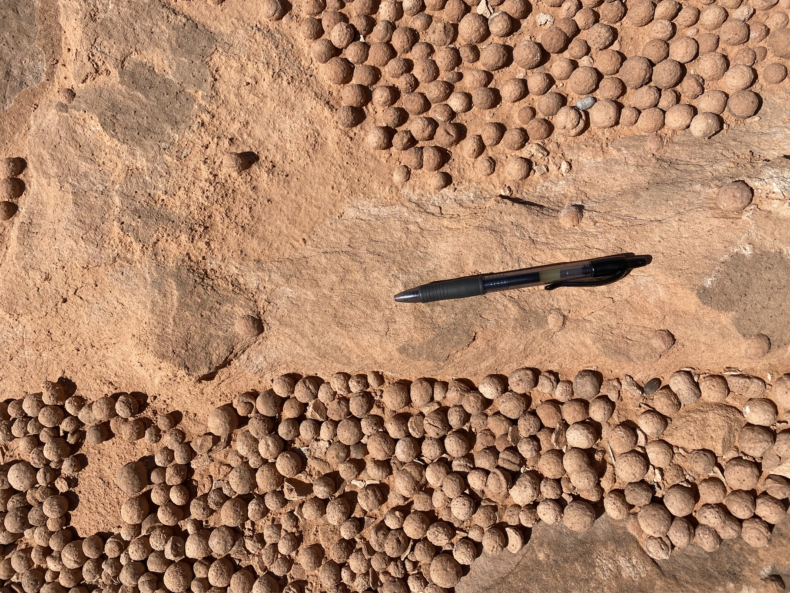
Part of a series of ‘penspective’ posts using a pen for scale
The earth is a producer of oddities. Crystals curl around each other like fiber optics and groundwater stains rock like Van Gogh. Geologic byproducts come out faster than Linnaeus could name off species, lava bombs, pseudomorphs, barites that look like roses, and copper that grows like mushrooms. When you find fields of little geologic eggs, you begin to think Darwin may have been short-sighted focusing only on organic life.
What are these oddities, ball bearings of the desert? You find them all over the Colorado Plateau, iron-rich concretions that erode out of parent rock in the form of spheres. Some are red, some orange, and some so black sunlight gives them a purple sheen. I’ve seen them small as peas or bigger than bowling balls. They can be as hard as musket balls or crumble to the touch. On Mars, they are called blueberries. On Earth, they are known as shaman stones, Moqui balls, or, my favorite from a hibiscusmooncrystal website, shaman balls. To quote the unnamed source on the site: “Shaman balls contain hematite and silicate in their outer shell (the center is sandstone).” Absolutely right. Mostly. Some are iron through and through, squeezed into the sandstone like seeds. When the sandstone wears away, the harder iron concretions remain.
Their origin is hinted at by their age. A shaman ball might be 300,000 years old, but is found in sandstone 250 million years old, dated by the decay of radioactive elements that came to rest when the formation settled. The concretions came well after the sandstone formed, when minerals flowed through groundwater inside the rock and lodged like iron gall stones.
In one case, a layer of marbles from southern Utah was found to have two different ages and distinctly different composition. One group formed around 20 million years ago and the second from the same sandstone was closer to 3 million years old. These two ages represent periods of groundwater flow 17 million years apart. The younger concretions formed about the time the Colorado River began downcutting through the region, and are made of the black crystal, goethite, while the older are mostly red hematite, telling of changes in groundwater composition over time, the influence of a river on the land millions of years ago.
When water percolates through bedrock, filling aquifers between sandstone grains, impurities are filtered out. Stripped and left behind, they oxidize and change. Around cracks or faults, minerals meet and alter their life courses. They oxidize at different rates, uniting or repelling each other, which creates layers of unique chemical reactions, underground fireworks. One theory is that microbes in the groundwater turn iron carbonate into hematite, creating the balls in an organic-mineral exchange.
I mentioned Mars, where they are called blueberries. In 2004, the Opportunity rover investigated a similar field of concretions, finding much the same composition as shaman balls, forms of iron gathered into spheres the same size as those on Earth, and equally weathered out on the surface. If the concretions are formed along with microbes, this could be evidence of some form of life on Mars. If not life, they are at least evidence of persistent groundwater. More recently, this has been called into question. On Mars, they may be metallic spherules that are often found within impact glass at meteorite craters. On Earth, they are made from life and water interacting with minerals.
This is the kind of thing geology gives birth to. Tectonics feeds up mountain ranges and pushes crustal land down to the mantle to be digested and reabsorbed, or twisted into taffy veined with quartz. What blossoms on the surface is like a coral reef of rock and mineral, and one of the species, or maybe a genus, is the marble that rises from sandstone like a pearl.
Photo: Craig Childs

A great blog post on one of the million mysteries the desert holds. (Here and on Mars) Thanks!
Always beaucoup poetry and science to bathe in, in your essays and books. I jump into every one.
Fascinating. Curious if their name ‘Shaman Balls’ was given because the balls evolved from the earth or do Shamans include them in ceremony? Perhaps both?
I have tended not to think of or perceive anything in Nature as odd, as it seems there is a great deal of order in Nature. If anything, I am captivated by and/or notice things for which I am not very familiar. Your piece…the series to date…is an excellent opportunity to challenge my usual perspective and open my eyes and perception to a broader level by which I can notice what has always likely been there in Nature, waiting to reveal itself to me.
“This is the kind of thing geology gives birth to.” Quite the opposite: the geology (vs. the human science of geology) gives birth to our ruminations.
There is a little deposit of these things near Ojo Caliente, NM. These are black, looking so much like the basalt which overlies the area that it threw me at first. Also, they are hollow.
At Moeraki in the South Island of New Zealand, we have rather larger ones – weighing tons – that appear as the cliffs erode. Māori mythology says that they are gourds that washed ashore when the great canoe Araiteuru was wrecked.
https://www.moerakiboulders.com/
I’m fascinated and am trying to wrap my brain around: 300,000 years ago, 20 million years ago, and even 3 million years ago. How is it possible for humans to so arrogantly and ignorantly believe we are so all important?