Last month I wrote about delight—specifically, my inability to access it, at least the way I once did. How impossible it felt to notice the little blessings of an ordinary day.
Then a funny thing happened. Mere minutes after writing that post, I started seeing those little blessings. So I opened a fresh list of delights. I kept it going.
I got sick, and partially recovered, and then got sick again, and stayed sick. Still the delights have not ceased.
It’s no great mystery, really: in writing that post, I gave myself permission to grieve. I let the dam crumble, let the flood of sorrow and anger wash through me, and in so doing loosened the talons of despair. Not entirely. Just a little bit. Enough.
I am still sick, still angry, still grieving, still watching the losses accumulate. But the blessings are still piling up, too.
This post first ran in March 2019. Given the recent though still-dubious claims of sentient AI, it seems like a good time to revisit the brilliant vagaries of AI transcription, which I enjoy lightly (ok sometimes heavily) editing into found poems.
P.S. I’ve somewhat fallen out of love with Otter since writing this piece and welcome recommendations.
Like most journalists, I dread transcribing interviews. I can’t afford to pay other people to do it, so I’ve been experimenting with computer programs that use artificial intelligence to transcribe for me. Last week I tried one of the more advanced transcription programs, Otter, and its performance was nearly flawless.
I felt an odd sense of loss as I watched perfect phrases tumble down my screen at close to the speed of real speech. I wasn’t sad about the hours I’ll save hand-correcting transcripts. Instead, I mourned the bizarre, sometimes profane errors of my older transcription service, Trint.
I am generally more likely to cover the evolution of sponges than a Presidential race or sex scandal. But Trint seems to want me and my interviewees to talk about what everyone else is apparently talking about: politics and sex.
Trint inserts “Trump” and “Melania” into my transcripts seemingly at random, as well as words like “dick.” “There’s a lot of data on this, in terms of being a dick,” read the program’s mis-transcription of one of my recent interviews with a soft-spoken botanist.
I suppose Trint’s proclivities should not surprise me. Like all speech recognition programs, Trint uses statistical algorithms trained on large archives of recorded human speech to predict what is being said. Machine learning technology has a well-documented tendency to reflect the uglier aspects of society, including our racial biases, and Trint, launched in 2016, has been reared on our society’s collective chatter since Trump’s election.
I am tired of spending hours cleaning up my transcripts for the fact-checkers, and eager to find a more accurate program. But I will miss some of Trint’s bizarre word choices and its constant attempts to help me join the crowd. Trint’s errors can also be remarkably creative, like the brilliant AI-generated cookie names published on the blog AI Weirdness: Hand Buttersacks, Apricot Dream Moles, and Walps.
Can artificial intelligence be talented? Does it have anything important to say? I have no idea, but before abandoning Trint I want to celebrate its weirdness with the following poems. I didn’t write these poems, Trint did. It is not my fault that they insult Melania Trump or read like dystopian Radiohead lyrics. I am merely Trint’s transcriptionist. Please share your own AI-generated poems in the comments!
Trint’s mistakes – suggestions? Strokes of genius? – are in bold.
Emily Underbite
Hello, Siberia
It’s Emily Underbite
I’m a relic
I haven’t found a gold star yet
My dream has no leverage
I hurt like imitation
Electoral thinking
What organism has analogous or homologous structures and functions to Melania’s? A slug, a lobster?
People have a lot of trouble with electoral thinking, which is essentially understanding the difference between two sponges.
I mean, what can you expect from a sponge?
The sea of science
I landed in the sea of science
But forgot to control for indifference
I found colonies of people
thinking like the rich
Dr. Dick
Off the record, I should have been a novelist
I should write a book about this
It’s really interesting because he’s a great guy
This field is not nearly as sexist as
These are great guys
I didn’t have beers with them but, they, just, it’s funny
Blindspots
Anyway, we’re getting off topic
Talk about that another time
He’s the one who will make the final decision
about whether to write a story about Dr. Dick
Self Confidence
We have purified a sense of self-confidence
and put it in a dish
We watch it over time under microscopes
We discover that these cells are society
and that they exist now
to receive Google’s censoring
Evil Species
You’re asking for my opinion?
Correct.
The Master of the Universe is a giant cat playing with a ball of yarn. We are the evil species on the planet and the end of species. We have ascended to the point of occupying every inch on the planet that we can identify and to modify the nature of ourselves. This a very defensible biological argument for the termination of multiplicity.
Drafted
I’m hoping to get drafted today
or over the weekend
Then we’ll go through another round of edits
Olé! Olé!
Image info:
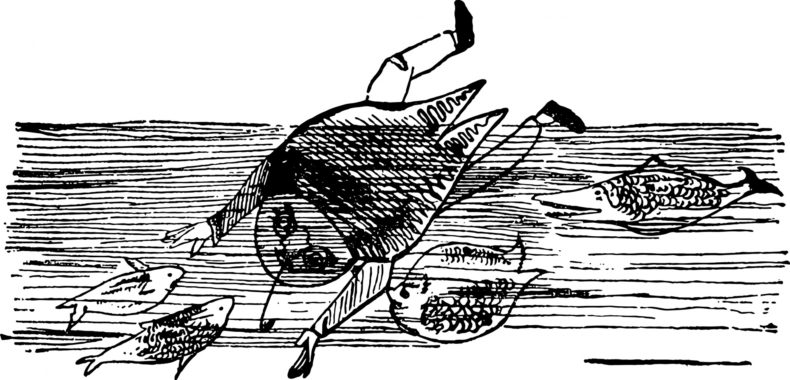
1) Drawing of an early cyborg, Wikipedia
2) Drawing of the Tandonia sowerbyi land slug, Wikipedia
3) Vintage illustration from the Book of Limericks, 1888
4) Kittens and Cats; a Book of Tales, by Eulalie Osgood Grover; 1911; Boston, Houghton Mifflin.
An affirmation for everyone out there who happens to have a uterus: WE BELONG TO OURSELVES. Our bodies are ours, no matter what the law says, even if we have to fight like hell for our inherent human rights.
Parking lot mustard – you can eat that (and I did)
Did you know…that food…comes from plants?
A few weekends ago I went on an edible plant walk led by a local guy who knows his plants. That’s probably what his resume says. “Knows his plants.” Ten or so of us met on a sunny Sunday morning in a school parking lot to learn how to eat plants.
Ok, I’m aware that is how the whole food chain thing works. Plants make things; we eat the things. Apples come from plants. Lettuce is plants. Plants can even come with reminders that they’re part of the food web, like the caterpillars that hitchhike in broccoli sometimes, or the fresh garlic that comes attached to its above-ground parts.
But it feels different when you’re walking along in the suburbs, and the guy stops, and points out a wild garlic plant, and tells you can eat those teensy-weensy cloves growing in a sphere on top. Or when you pull it up and see the garlic clove right there, growing within a few feet of the athletic field like it was nothing. Or when he leans down in a patch of weeds and points out the wood sorrel, with its cute little heart-shaped leaves and its wee yellow flowers. As long as you’re confident that you can tell it apart from clover, which I am, not only can you eat the leaves, you can also eat the cute li’l seedpods and pretend that they are lemon candy.
So we walked, and we ate. Weedy little mustard in the parking lot – spicy! Plantain, an astoundingly common plant growing by the dumpsters – the tiniest leaves taste like mushrooms. Mmmm. Mulberries – delicious, and one of the few local plants I was already eating. Our guide shared a pro tip: If you’re going to harvest mulberries, go around tasting the trees until you find one you like, because they all taste different. Then spread out a tarp and shake the branches, and the ripe berries will drop off and come home with you.
Some of the plants he introduced us to need cooking. Some can make you quite sick if not handled properly – pokeweed, for example, a plant that I have admired before for its beautiful berries. (Fortunately, I had the good sense not to eat those berries.) One of the other women on the walk told me pokeweed was her introduction to foraging, and she had been extremely proud of herself for preparing the leaves safely and eating them, but didn’t plan to do it again. “But did you tell everyone that you’d done it?” I asked her. “Oh, I told everyone.”
We learned the difference between milkweed, which you can eat, and dogbane, which is poisonous. Both have milky sap, but one is very bad for you. He showed us poison ivy – not for eating, but on the principle that when you’re teaching newbies about plants, they should, at a minimum, go home knowing that one.
I brought home a produce bag stuffed with garlic mustard, an invasive plant; a container of mulberries; some wild garlic; and handful of lemon balm leaves. My garlic mustard pesto made a great pizza sauce. My wild garlic is just like garlic, but with annoyingly tiny cloves and I picked it myself. And the other night I drank my lemon balm tea.
I’ve only eaten a few plants out in the wild since then. Most of the places I walk are heavily used by dogs, and I don’t really want to grab a plantain and stick it in my mouth when I don’t know who’s peed there lately. But there’s a healthy patch of wood sorrel in a tall concrete planter a few blocks from here, and every time I walk by it I stop, pick out a sour-lemon seedpod, and relish my new knowledge, eating it in tiny bites.
This is, obviously, how animals work. Someone teaches us a plant is edible, we find it again, we eat it, hopefully we find enough of it to keep ourselves alive. If we’re of a particular species of bipedal ape, we take the edible plant and figure out how to domesticate it and sell it and breed it into tasteless versions of itself that can be shipped around the world in containers. So that’s the stage we’re at now. But it’s nice to know, even here in the near-suburbs, I do have the option of stopping, picking something, and feeding myself with it.
Earlier this week we all piled into the van and went to the Weird Al concert. My inner twelve-year-old was thrilled. Weird Al, well, he rocked.
I was inspired to finally see Weird Al in person after a really lovely story about him appeared in the New York Times magazine early in the pandemic, a moment of joyful weirdness blinking on like a firefly in the darkness of April 2020. The show was everything I’d imagined—energetic, delirious, funny, frenetic, virtuoso, and with an accordion.
Also, it was loud*.
It’s been so long time since I’ve been anywhere that loud! At one point, there was some wild bass that seemed to emerge from the floor, an earthquake of sound, while the usual things—guitar and drums and keyboard and Al’s unexpectedly amazing voice—seemed to halo around the theater’s ceiling. It was a full-body sonic moment. (My kids wore earplugs. My husband wore earplugs. Why did I not wear earplugs?)
When I woke up the next morning, all I could think was that my ears needed something different. Something quiet. Waves or the wind through the trees or even just fresh air. If my ear could pull me by the ear, that’s what it was doing. The dog jumped in the car and we drove—the dog, me, my two ears—to an open space on top of the bluff.
I’m not sure if I’ve ever had the sensation of really being led by my ears. I’ve definitely run out of steam on podcasts and turned them off, or pulled out my earbuds after a while listening to music, but this felt different. Loud noises bend the tiny cells within the ear, the stereocilia, like blades of grass. The vegetation of my ears felt like it had been hit with a hard rain.
I feel like I’ve lucked out: a day later, I can still hear the cricket that just started up outside, and the sound of the walnut tree’s growing leaves in the wind. Thank you, resilient tiny cilia. Still, there was part of me that loved the feeling of having my ears know what they wanted, and following where they led. I’m not sure this is how it actually happens, but this is how I imagine my ears: walking along the bluff, their tiny cochlear hairs (some of them, anyway, the ones that aren’t already toast) beginning to unfurl themselves with the distant sounds of incoming waves. Next time, my friends, I will bring you a small umbrella, shaped like an auditory canal.
——
*I know, I know, if it’s too loud, I’m too old–but my kids said that it was so intense they needed to take a month-long break from Weird Al after the show.
Image of ear mushrooms by Flickr user Rob Oo-offline under Creative Commons license.
Last month I had occasion to spend a couple of days poking around beaver ponds with Joe Wheaton, a castorologist at Utah State University. Joe is a visionary thinker and a profound observer of aquatic ecosystems, and I learn something new whenever I hang out with him. My latest trip to Utah didn’t disappoint, and if you’re at all interested in beaver ingenuity and architecture, I recommend this Twitter thread, in which I attempt to collate some of Joe’s insights and display highlights from our photo safari.
One afternoon, as we hiked up a creek stair-stepped with massive beaver-built terraces, we came upon an especially astonishing sight: a sandhill crane picking her way across the rim of a beaver dam. There are few North American animals that I haven’t seen nosing around a beaver pond, but a sandhill was a new one for me, and for Joe, too. We watched in amazement as the crane wandered behind the lodge and ventured up an aspen-studded slope, hollering that eerie sandhill trill/bugle all the while, the saurian call that Aldo Leopold described as “the trumpet in the orchestra of evolution.” We were baffled — was she lost? What was she trying to communicate? Why had she flown into these mountains, and why was she marching ever higher into the aspens? Another beaver-pond mystery, in a world full of ‘em.
This first ran May 17, 2013. The running kids are grown and going to college or have graduated from it. So they’re not running any more, not in that way that looks like they’re powered by lighter-than-air energy sources. That’s fine, because another generation of littles just ran across the yard, running for no good reason, putting more energy into running than running needs. They are, as were the now-grown kids, astonishingly beautiful. As are the juiced-up robins.
Outside the window, the neighborhood kids are running again. They’re about 12 years old, a boy and a girl and the girl’s little sister, about 8, and they’re racing around the court, up the street, along the alley, through a yard, and back onto the court, altogether maybe a full block, around and around. They’re going flat-out on long skinny legs, hair flying and completely silent. Sometimes they’re playing tag, but mostly they’re just running, they hardly touch earth, they’re all but airborne. What is it about spring?