 I’ve often had the same thought myself. You have too, haven’t you.
 Today, I’m venturing backstage at Last Word on Nothing, a rather frantic place at the best of times. Ann has just published a very cool new book on a group of astronomers who created this beautiful map of the universe, the Sloan Digital Sky Survey. Her book is called A Grand and Bold Thing, and I was curious about Ann’s work on it.
Q: What do you like most about astronomers?
In the first place, I like astronomy itself: you look up in the night sky, and infinity is right there and full of stuff. In the second place, astronomers are devoting their lives and very smart selves to studying all that stuff in infinity and what they study—they don’t like it when I say this—will never conceivably matter or affect us in any way. Aesthetically and spiritually, that’s lovely.
Q: The hero of your book, Jim Gunn, is an amazing and very entertaining character. He says what he thinks, he’s stubborn, opinionated, and he sure as hell gets things done. Tell us about him.
He’d make a good book all by himself. Physically, he looks a little homeless though harmless, and if he walked into my middle-class neighborhood, somebody would ask him if he needed help finding his way back out again. He’s extremely polite and draws you out so kindly that you end up having a good opinion of yourself. That’s unsettling because when you finally get him to talk, you see that while you’ve been vaguely prattling on, he’s been thinking complicated and sharp things which he can explain in the clearest way, and you think to yourself, “why don’t I just shut up now.” And he’s a splendid writer with perfect control of sentence rhythms. And he can write about a thing you’ve haven’t a hope of understanding and somehow you get it. One of his fellow astronomers described Jim’s writing as “clear and simple is the Lord.” Continue reading
The Perseids are reliable, regular shooting stars, a meteor shower that shows up nights in late July every year. I didn’t see the Perseids this year myself because Baltimore’s skies are a rich carnelian haze that hold nothing much and certainly not meteorites. And Heather didn’t see them because, she thinks, of light pollution. To comfort ourselves, we post this video of the Perseid meteor shower, taken against the Milky Way. It must have been done over several nights or from several different angles or something. Nevertheless, astounding. I’m astounded.
Joshua Tree Under the Milky Way from Henry Jun Wah Lee on Vimeo.
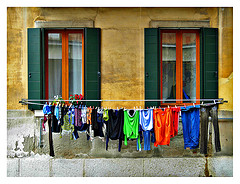
I looked up my parents’ house in London on Google Earth, and was excited to see not just the lush greenery of their garden, but smack in the middle of it, their rotary clothes line. This may not seem so thrilling to the average reader, but outdoor clothes lines are cool these days, and my parents have had one forever. In rainy Olde Englande, that’s quite a feat. It’s also the environmentally friendly thing to do: stuffing the clothes in a dryer generates a walloping 4.4 pounds of carbon dioxide. Line-dried clothes smell garden-fresh and don’t shrink, either, although they may form an occasional target for birds. Alas, some 60 million people in the U.S. live in private communities that forbid line-drying, since many view fluttering underwear as an eyesore that lowers property values.
The times are changing, however: as of 2009, the states of Florida, Colorado, Utah, Hawaii, Maine and Vermont have passed laws forbidding clothes line bans. So I was pleased to read of the Care to Air Design Challenge, aka build a better clothes line. Or, as sponsor Levi Strauss & Co calls it, the search for “the world’s most innovative, covetable, and sustainable air-drying solution for clothing.”

In the early 8th century A.D., the great Maya city state of Tikal reached the zenith of its sophistication and power. Its kings sipped frothy chocolate and smoked elegant cigars in their chambers, listening to the music of trumpeters and drummers. Its painters rendered brilliant court scenes on vases. Its architects designed pyramidal masterpieces that climbed to the sky. Tikal was the Manhattan of its day.
Over the next century and a half, however, the bloom went off the rose in Tikal. Its ambitious building program collapsed and its artists ceased to carve inscriptions on stone. Its divine kings vanished and its population thinned to just 20 percent of its peak. Tikal, moreover, was not the only Maya city state to suffer such a dramatic fall from grace. Elsewhere in the Maya world, dozens of other splendid cities crumbled over a span of 300 years ending around A.D. 1050.
Archaeologists have pointed to many reasons for the fall of the classic Maya civilization. The Maya slashed and burned most of their forests. They mined the fertility of their fields and allowed their populations to soar unchecked, straining food supplies. Then they fought wars over prized resources, terrible wars. When climate change finally arrived in the 8th century, in the form of severe, prolonged droughts, many Maya were singularly ill-equipped to weather it.
Just how did the Maya react to this sudden disastrous change in climate? Continue reading
 This is a photograph — meaning, it’s real — taken from 114 million miles away on the far side of the sun. The brightest little dot in the lower left is the earth. The less bright dot near it is our moon. Click on it: it almost makes you cry. Continue reading
 I thought I’d made the case against parasitic wasps with evidence and eloquence. I thought that would be the end of it. But no: counter-arguments were made (even if insects did evolve first, Josie, I can still feel superior), gauntlets thrown down, aspersions cast (you think I didn’t notice “delicate flower,” Heather?), and lines drawn in the sand. I decided I must defend those of us revolted by the moral tendencies of insects. I began by googling bees. Before I could find anything about killer bees or maybe the horrors of the hive-mind, I got diverted.

