The Little Roller Girl Who Could

May B. Twisted: It's funny 'cause it's true!

I was teetering along the concrete track at about 5 miles per hour, a pathetic speed that nonetheless significantly exceeded my comfort zone. “Baseball slide,” barked a blonde pixie in a tiny pink skirt and massive black TSG kneepads over leopard-print tights. I tensed my core, gingerly lowered my left knee, and on impact, slipped the other leg through like a baseball player sliding into home plate. After an awkward couple of meters, I came to a stop leaning on my left hip and elbow, my right leg stretched up in what could only be called a “cheesecake” pose. “Blow us a kiss!” yelled one of the other newbies.

This is what the London Rollergirls charmingly refer to as “fresh meat,” the intake session for roller derby novices: a grueling four hours of falling and skating, and falling, and skating.

I had wobbled in that morning, 10 years off skates and terrified. I had just attended a bout in which an all-star Roller girl was carted off on a stretcher. What possible hope did I have of walking out of here with my ass in one piece?

But I was set to rights by that little pixie, a veteran roller girl named Emmeline May who goes by the skate name “May B. Twisted.” It turns out that staying in one piece in a violent full-contact sport like roller derby isn’t about defensive plays or speed. It’s about knowing exactly how to hold your body–whether you’re skating, hitting or falling–so that it never gets caught off guard. If Twisted is particularly good at teaching us how to hold our bodies, it’s because in addition to being a top notch trainer and formidable roller girl, she has a chronic illness that puts many of its victims into wheelchairs.
Continue reading →

Indiana Jones and the Neanderthal’s Tooth

Most archaeologists I know have a soft spot for Indiana Jones. They might not admit it. They might grimace at the famous bullwhip and guffaw at all the suspension-bridge antics over crocodile-infested waters. But despite that, or perhaps because of it, Indiana Jones often captures something from a defining moment in their lives. It reminds them—as little else can—of childhood and their Howard Carter/Gertrude Bell dreams of becoming archaeologists, of going it alone, of mastering ancient Egyptian hieroglyphs, of roaming faraway deserts and discovering the golden treasures of ancient kings. Could anything that adults do be more fun?

At the end of this month, Montreal Science Centre is hosting the world premiere of an exhibit entitled Indiana Jones and the Adventure of Archaeology. On display will be props and models from the George Lucas movies as well as some lovely ancient eye candy from the collections of the University of Pennsylvania Museum. The exhibit will surely draw huge crowds, including, I suspect, most archaeologists from the region.

What I find fascinating though is how little this childhood dream matches the very real, very adult pleasure of working in the field. It’s a pleasure that has little to do with adrenaline, and much to do with other kinds of human chemistry.   Continue reading →

Polio: No End in Sight

Since the launch of the Global Polio Eradication Initiative in 1988, intense vaccination campaigns have dramatically reduced the number of cases of polio worldwide. Between 1988 and 2000, the number of polio cases dropped 99 percent — from 350,000 to just 3,000.

But the polio eradication effort appears to have stalled out. Despite an investment of roughly $9 billion and more than two decades of sustained international commitment, polio stubbornly persists. For the past seven years, the number of cases worldwide has hovered between 1,000 and 2,000. The deadline for wiping out the disease has been pushed back again and again. In a New York Times article published in January, Donald McNeil, writes that eliminating the virus is “like trying to squeeze Jell-O to death.” It’s an apt description. “As the vaccination fist closes in one country, the virus bursts out in another,” he continues. Four endemic countries remain—Afghanistan, India, Nigeria, and Pakistan. And the virus has regained a foothold in Angola, Chad, the Democratic Republic of Congo and Sudan.

We have an effective vaccine that provides life-long protection against the virus. So why is this disease so frigging difficult to eradicate? Continue reading →

Guest Post: Limestone, the Civil War’s Great Equalizer

I am a bit of a Civil War nerd. I inherited this interest from my dad. Together we have visited many of the Civil War’s top landmarks (we’ve even paid our respects to Stonewall Jackson’s left arm). But for all of the time I’ve spent on battlefields, I never gave any thought to the landscapes on which the war was waged until I read Tony Horwitz’s Confederates in the Attic.

In the book, Horwitz travels to the former Confederate states to understand how the Civil War still influences Southern culture today. At Shiloh, in Tennessee, he meets the park’s historian, Stacy Allen. Horwitz learns how Allen, a physical anthropologist, had debunked several myths about the Battle of Shiloh – and the war – with some scientific detective work.

As an earth science writer, I wondered: What do geologists have to say about the Civil War?  A lot, it turns out. Continue reading →

Bad Actors + Science Metaphor (cont)

I’ve kept an eye on neutrinos ever since I heard, back in the mid-1980’s, that not enough of them were coming out of the sun; this sounded serious.  It turned out that the sun was behaving itself but the neutrinos weren’t.  On its way out of the sun, any given neutrino was changing into three different neutrinos, depending on when and where you saw it.  Particle physicists call this oscillation.  I call it bad acting. Continue reading →

How the Other Half Lived

Some scientists make great discoveries. Some scientists provide the opportunity for other scientists to make great discoveries. Let us now praise one not-so-famous man.

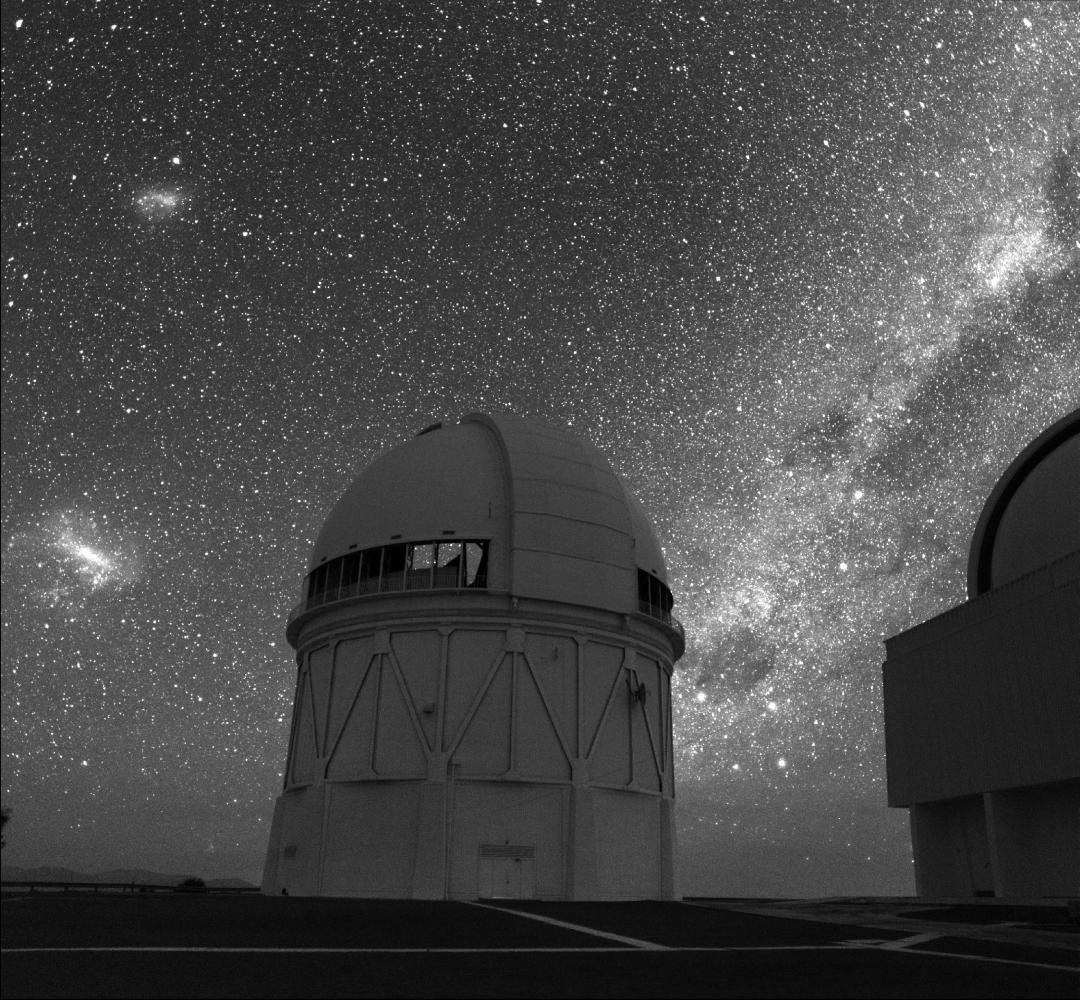
Victor Blanco assumed the directorship of the Cerro Tololo Inter-American Observatory (CTIO) in June 1967, just five months before the observatory opened. CTIO, a collaboration between U.S. and Chile, was an attempt to correct a grievous astronomical oversight: the skies of the Southern Hemisphere. Prior to CTIO, the number of observatories in the Northern Hemisphere was 88, and the number of observatories in the Southern was 10. The disparity in the quality of observing conditions, however, was even more pronounced. The number of Southern Hemisphere observatories with both frequent clear night skies and exceptional “seeing,” as astronomers call atmospheric conditions, was zero.

When surveyors began scouting for a site for CTIO, they already knew that the Atacama desert, in northern Chile, was one of the world’s driest, meaning that astronomical observations would be relatively free of distortions caused by moisture in the atmosphere. But they found that the desert air was unusually stable, too, due to a semi-permanent high pressure system. They settled on Cerro Tololo, a 2200-meter high mountain in the southern part of the desert, about 80 kilometers east of the coastal town of La Serena.

Blanco was born in 1918 in Puerto Rico. As a child, he earned money by raising pigs, which he named after asteroids—Ceres, Vesta, Ganymede. Before he accepted the directorship of CTIO, he had served as an astronomer at the Case Institute of Technology (now Case Western) and the U.S. Naval Observatory. At CTIO, however, he found that he had to be more than an astronomer, even more than an administrator. He needed to be a diplomat.

When the Marxist Salvador Allende won the Chilean presidential election in September 1970, Blanco learned that U.S. sponsors were reluctant to risk further resources on a project operating under an anti-U.S. leadership. So Blanco traveled to Santiago, met with Allende himself, and received promises of the president-elect’s complete support. During the severe economic and political crises that followed, Blanco later wrote, “not a single observing night was lost.”

Continue reading →

Whispers of forgotten history, traced in bacterial filigree

I’ve been thinking a lot about resilience lately, that ineffable quality of being able to withstand trickling insults and outright catastrophe. It characterizes the Japanese ability to remain civil and calm throughout their ongoing weeks of dread, and the ability of some natural systems to bounce back after even the most egregious of impacts.

It also describes the ability of a healthy adult to resist disease or injury, when infants, the elderly or the infirm might succumb.

Resilience, in other words, is wonderful stuff if you can get it.

So what then to make of a pathogen—Mycobacterium tuberculosis, the tuberculosis agent—that is resilient enough to persist a century or more under unfavorable conditions, only to spread again, and rapidly, with devastating effect when conditions are in its favor once again?

Continue reading →

Abstruse Goose: Moment of Clarity 2

If you remember from our last episode,  Abstruse Goose:  Moment of Clarity 1, our plucky hero has had a moment of clarity about quantum mechanics.  The clarity was brief and, sadly, it passed.   He tried again months later and this time, he hung onto his moment long enough to begin fretting about quantum spin.  The phrase, “quantum spin,” would seem to imply that a subatomic particle spins, but since a particle is just as likely to be a wave, and waves don’t spin, “spin” really means — hell, I don’t have a clue what it means.  It’s in the math.  It’s a description of some characteristic or other.  How’s that for clarity?

Physicists really do have this problem with quantum entities not making physical sense.   I am amused but not sympathetic.

http://abstrusegoose.com/342