I’ve never been a small-dog person. I get that they have a touch of cuteness to offer; they are, after all, tiny, furry things with big eyes, and some have silly faces, floppy ears, and goofy antics. But most that I’ve met are just perpetual barkers of the piercing sort, or teeth-bearing growlers, trying to be something they’re not. They’re loyal to one and hateful to the rest of us. And their breath is atrocious.
Me, I’ve had a Golden, a Weimaraner, and two Jindos, among others. Big dogs just seem more like real dogs to me.
A good friend of mine is a little-dog person through and through; I forgive her this misstep and I applaud her willingness to take needy ones, misfit toys if I ever saw them, into her home. I do have limits. Chihuahuas are a nope. One of hers, especially, hated me up until she could no longer see or hear, and even then I got a mean vibe from her; another was tolerant, barely, despite my gentle overtures. Neither struck me as adorable, despite the ears. They only made stronger my big-dog bias.
But recently my friend came home with a wee muppet, genetic tale unknown (but no Chihuahua DNA, methinks), who delights in the world and has been squirming into an empty pocket in my big-dog-packed heart.
She’s so small, only a cat harness will fit her—and she doesn’t need one anyway because when I walk her she trots gleefully by my side, looking up at me every few steps to make sure I’m still there. Her face is ridiculous, her neck recalls a meerkat, and her ear flops and foot taps—especially during her bestest Zoomies—are irresistible. Her fluffy face and naked body/rat tail are a hilarious combo. Most of all, the pup is never in a bad mood. She never stops smiling. Every greeting is a happy dance, tap tap tap, and an immediate request to be held. All she wants is to be in your arms. And mine. (Her breath is indeed a horror show, but we’ll let that go for now.)
Please know that for the most part, nothing has changed. I still gravitate toward the bigger, wolfier canines. Lately I’ve also come to fancy sighthounds, especially those lanky, huge-eared Podencos from Spain. Great Danes, too, have made my wish list.
But now, when I visit my friend, my first act after kicking off my shoes is scooping up that tiny animal, who is already at my feet doing circles and leaps, and cuddling her furry sweetness to my chest. If I stand, she give me a kiss and then rests her head against my shoulder. If I sit, she becomes a warm puddle in my lap. She doesn’t wiggle to get away, and rarely is there a reason to put her down. We’re both happy where she is.
A conversation struck up at a writing workshop a few weeks ago between me and a computational biologist who studies the molecular biology and population genetics of the HIV virus and other virulent diseases including Ebola, Hepatitis, and Covid. She’s what you would call a veteran virus tracker, compiling and interpreting viral genetic sequences and medical alerts from around the world. She’s one of those who raises her finger and says something’s going on here.
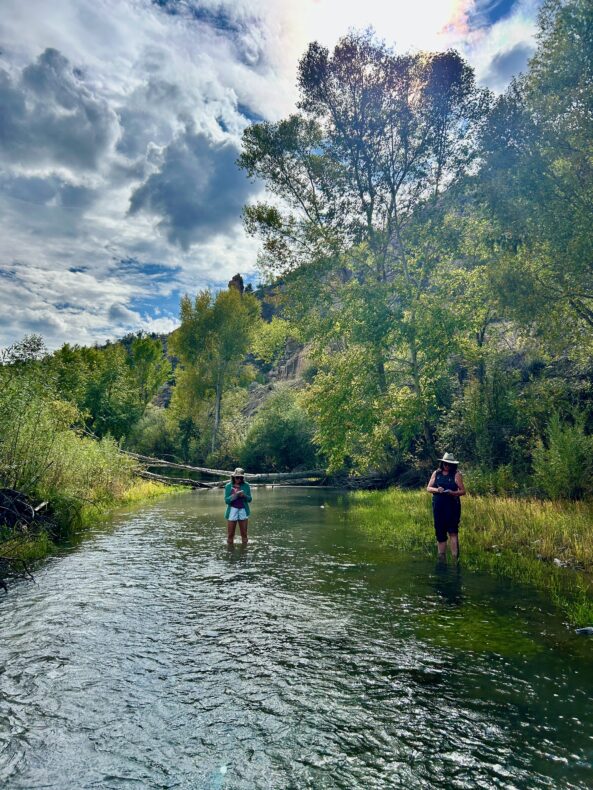
We were eating lunch beneath the copious shade of an alder tree along the Gila River in southern New Mexico. She was talking about her HIV work with studies being halted and USAID shut down during a dismantling of public health architecture. This dismantling, she said, was creating a perfect environment to enable rapid evolution of drug resistant HIV, nothing better for diversifying strains than medication slowing and being misused and underused worldwide. She explained that access suddenly ending means many people with HIV will share what few doses of medication they have left with loved ones, or get inadequate doses, or get ineffective treatments on the black market and this creates the possibility of an evolutionary flashpoint as mutations in medication-avoidant viruses look for hosts. This is how HIV is unleashed back into the wilderness.
I often get scientists in these workshops. They are the ones here to relearn storytelling, the challenging ones, but she was making it easy for me. I was sending her off to write about anything but science. No talk of virulence or pandemics, we instead wrote about the sound of moving water. We climbed a ridge and used boulders for chairs, looking across folds of wild country, furry mountain ranges dropping into canyon after canyon, which we described in our notebooks so someone far away in a different time might see the picture. For days we did this sort of thing. After field class we’d return to an old wood lodge that leans slightly, squeaky wood floors, front porch dressed up with rocking chairs and couches. It was a casual, unguarded atmosphere, and I did ask her permission to write this, especially since she called what she had to say a warning, a red light flashing on the control panel.
I first wrote this post in October 2020, when my kids were much younger and Halloween decorations loomed from every corner.
*
I forget this every year—in October, there are places where it is no longer safe to walk. If we want to go to our friend Peter’s house, we can’t go up the street and around the corner as we usually do. If we need to get to daycare, we have to turn and walk in the exact opposite direction first, before U-turning around the block. And Ezzy’s house? Forget it. That street is riddled with danger.
The Halloween decorations are out again, and some of them are scarier than others. Some houses have cheerful pumpkins. Others have black cats. Then there are the skeletons, the witches hanging from trees, the bloody severed body parts. On Ezzy’s street, there is a demonic baby with red eyes crawling on the rooftop. That’s why we can’t go over to Ezzy’s until November.
Every year, I forget how much terror these decorations create for my children. Sometimes we can protect ourselves by crossing the street. Sometimes they close their eyes and I hold their hands until we pass. Sometimes riding a bike really fast helps. But there are some houses, some days, where we can’t pass by at all.
I love Halloween. Sure, I feel weird about my kids getting a lot of candy, and worry about things that might be even more creepy than the demonic baby. Still, it seems like a generous thing, to make your house look sparkly and spooky, to show a brave face to tiny trick-or-treaters, to come up with creative ways to celebrate, six feet apart. One of our neighbors has dozens—many dozens—of pumpkins, skeletons that are dressed in witch costumes, a giant statue with a pumpkin head, purple and orange lights around their yard. Another creates an elaborate structure—some years a castle, others a dungeon, and hangs dummies from the trees. (I confess that this part makes me nervous—I’m worried someone will get in a car accident, thinking that there is actually a person hanging in the elms.) And there’s a family near the elementary school that every day in October—every day!—re-positions a pair of skeletons into a new scene.
My kids love those skeletons. They love seeing the creative things that the family comes up with. It’s a gift to the neighborhood, all the decorations, even the scary ones.
It’s a gift to me, too, because it reminds me that even during the rest of the year, there are houses I cross the street to avoid, places that bring back memories, whether they be skeletons or something more like a blow-up candy corn. Sometimes there’s a specific reason—the man there had once shouted at you to get out of a tree, or there is a large, unfriendly dog. Other times it’s just a feeling: do not linger here. Other times, houses give off a friendly vibe, whether or not you know who lives within.
Neighborhoods are maps of these feelings, and the longer you’re there, the more they layer over each other. There was that couple who lived in the house with the wisteria and bougainvillea since it was built in the 50s, the large family of caretakers that moved in to help them, and now, the retired officer who had to re-pour the foundation to make everything level again. There’s the other house that was blue, and then was a pale brown, and now is white clapboard with succulents in front. With each iteration, the houses draw me in, push me away, invite me to step a little closer to the fence. There is the sadness of friends’ houses that are now filled with strangers. And then there is the welcome of houses that used to look like empty haunts, homes that are now filled with friends.
*
Top image by Flickr user Vivian D Nguyen under Creative Commons license
I remain mildly obsessed (a nice state to live in) with the mission patches published by the National Reconnaissance Office, which if you’re obsessed enough you can figure out what satellites the NRO just launched. Some of those satellites are, you know, secret. Like this one: it’s for recently-launched constellations (a ton of linked satellites) that are a secret version of the Starlinks. They’re called Starshield. This post first ran March 5, 2021.My mild obsessions are long-running.
We begin, as we so often do, with a tweet.
Jonathan McDowell @planet4589: Interesting that the NROL-44 patch description makes explicit reference to FVEY, the ‘Five Eyes’ spy alliance of US/UK/Aus/Can/NZ.
Brief explainer: Jonathan McDowell is a certified Harvard x-ray astronomer who also keeps an eye on satellites in space. NROL stands for National Reconnaissance Office Launch. NRO sits somewhere in the murky middle space between the defense department and the intelligence community. Its job is to launch spy satellites. The spy satellites are secret and the NRO doesn’t especially acknowledge them. But the satellites are launched on rockets and rocket launches aren’t subtle and come with warnings to pilots, so NRO acknowledges the launches with a statement and a mission patch. For launch #44, the patch was this wolf. An annotated version of this patch says that those five wolves (note the four lurking in the back) “shows the solidarity across the FVEY community.” (FVEY is jargon for Five Eyes, 5 countries that cooperate on spying.) The annotation continues: the wolf is howling into space where the satellite is, and the howl is a warning to the wolf pack of signs of trouble.
Well then. Well-a-then. My my my. I have questions, I do.
Me: Jonathan, I saw your tweet about the NRO patch. I have a tiny obsession about these patches because they are so weird and because they give away information. Why do you think they issue the patches?
Jonathan: It’s a tradition, it promotes team bonding which is a big thing in the military. They’ve been told lots of times not to give things away with the patches but after a while it starts happening again.
Indeed it does. A lovely old example, the patch for launch #11:
In 2000 the NRO launched a satellite it wouldn’t describe but issued a patch. One of my beloved, brilliant amateur satellite watchers (they prefer to be called “hobbyists,” and as one scientist told me, she’d stopped thinking of them as amateurs long ago) saw the patch soon after launch and given his long years of watching, thought it belonged to a family of radar imaging satellites. The four little arrow-things were satellites in the same family, he thought, the clue being that one was black because it had de-orbited (dropped out of the sky) since. Based on the arrows’ paths in the patch, he predicted NROL #11’s eventual orbit. The mesh outlining the owl’s eyes looked like the kind of antenna the satellite’s signals used. And “We Own the Night,” though immodest, was obvious.
People have been studying these patches maybe since 1977, and notice certain repeated images – dragons, eagles, owls – and figured out what the images mean. The number of stars in the patch, for instance, is usually the number of satellites in that family. And in fact, they have long articles and books postulating the iconography of these patches. To be honest, I find postulating iconographies tiring in the same way, as a young English major, I found searching for symbols in poems tiring.
Me: So the next question is, do you have any idea whatsoever that could account for the aesthetic in these patches? Why this combination of comics and fantasy? I associate that combination with basement boys, but surely the guys doing the patches are long since out of the basement if they were ever in it?
And are the patches actually sewed on to anything? are they just collected?
Jonathan: I think the crews in mission control probably wear them.
For the Chandra [an orbiting x-ray telescope] mission, we scientists for the most part didn’t wear patches on our clothes, but we for sure had the sticker versions on our backpacks/briefcases and office doors…
And I think a lot of the engineers in the space program are scifi/fantasy fans
so they are into it
oh, and I admit I have several t-shirts with the STS-93 Chandra patches featured on them
Me: Just googled the STS-93 Chandra patch and realized I have a t-shirt from an astro conference called something like Observing the Dark Ages [the time before the universe universally lit up], and on it is a knight on horseback. Ok. I’m getting it now — a club of people interested in what interests me, my people, and see? I belong.
I have to say though, STS-93 Chandra patch looks pretty normal.
Jonathan: Well Chandra isn’t secret so we didn’t have to be coy
Me: It’s not the coynessthat’s weird. It’s all the octopi and ravening eagles and stalwart avengers and ferrety-looking spies, not to mention the ladies whose clothes either start low or end high.
Jonathan: Yeah, I think a lot of comic book fans in DoD
Me: Not reassuring, is it. Alternate realities in the DoD. That would be a good title for an article.
Jonathan: Hah
Hah indeed. Some of my best friends, or rather some children of some best friends, love that comic-book imagery and who’s to gainsay them? But something about the combination of bulging muscles and boobs, and secret surveillances make me itch. I think of people in the intelligence business as living in a reality that if I but knew, would scare me. I think of them as unrelentingly aware that their knowledge of this reality comes accompanied by responsibility. I think that because of this, they are socially reserved, in fact, flat-out bad at friendly conversation. Surely under that responsible reserve isn’t the soul of a pale but ruthless fantasist with whirling eyes? Surely not?
I’m thinking about fresh scents again, which brings me back to this essay from a few years ago. For the record, I’m still wearing those perfumes!
God damn it, advertising can be powerful. I mean, not that I would ever buy some stupid crap because I saw it advertised on TikTok, of all platforms…that place is rife with over-hyped junk and over-painted hawkers (the term “influencer” makes my toes curl, no joke) and I’m not pathetic enough to fall for their BS.
Until I was. What got me: It was the yummy sounding scents that mean spring and sunshine and a breeze up your skirt. It was the arty images of grasses waving and glitter on the water and dandelion seeds in her hair. Damn it if a company that makes earthy perfumes didn’t grab me and hold me down and whisper sweet nothings against my forehead while I typed my credit card number into their website.
God damn it if in a frenzy of spring fever, I didn’t buy a sampler of 10 wee bottles so I can “find my signature scent” –the one that will make heads turn and noses flare and passers-by wonder who I am (clearly someone special) and wish they’d been to whatever sun-kissed spot on the map I’d just visited. (I’m not a winter person, as you may have guessed.)
Was this just me jumping on a popular thing on a popular platform, to feel a part of the youth culture of today? In economics there’s a phenomenon known as FOMO, or “fear of missing out”—it’s an emotional response that often drives people to buy a stock that’s skyrocketing; as the price reaches all-time highs, people take the leap regardless of what math and investing sense and even past experience might say about its future trajectory.
That’s what happens on these social media marketplaces. There are many trends, but some of them zoom to the moon and innocent scrollers see them rising and want to grab a seat, not be left behind watching vapor trails dissipate in the sky. Even knowing a trend’s star will be short lived, one wants to nab it and, to continue abusing metaphors, bask in its twinkle.
Me, I thumbed by the wide-legged jumpsuits, the crochet kits, the eyelash serums, the hand-knit Sherpa hoods, even the dog products—nope, nope, nope, nope. I flew through the stupid giant sippy cup for grownups (WTF people?) and every makeup product promising to shave off 10+ years. I saw beyond the crisscross shapewear and European hair clips and that spinning toilet brush.
But the idea of the smells of nature in a bottle, that stopped me. I remember well classics like Chanel No. 5 or, more vivid, whatever affordable perfume I bought from JCPenny in the mid-80s that’s still in my closet, 1/3 used. (I DID get beyond Love’s Baby Soft, finally.) I’ve evolved since, now taken in by nature’s notes. Today’s advertisers crept into my soul with words like sage and bergamot and cedar, grapefruit zest and fresh pine and whatever vetiver root is. Desert wind, sandalwood, aquatic notes, lily rain, black amber. Who wouldn’t want to wrap themselves in the blankets of these words, especially in miserable February, and as a bonus emit deliciousness with every step?
Scent is such a provocateur. It tells stories, it conjures memories. It worms its way deep. An exciting scent can send you traveling. A familiar scent can carry you home.
Speaking of home, an aside that I probably shouldn’t admit here: As a kid I found a floral-smelling spray in my mom’s closet that I’d spritz on my wrists and behind my ears before school, feeling very sweet and sophisticated. I didn’t know what “feminine deodorant spray” meant, apparently.
Actual scents aside, the words, the ones you can smell or taste, seem to have the most power over me. They, like the scents themselves, conjure an image that’s hard to resist. Youth, ease, fresh faces, no worries, endless possibility. You’d think I’d be immune, as I know the strength of language and employ it myself to influence others. You’d think. And yet, deep in the winter blues, shivering at my desk, the mirror telling me things I’d rather not know, those words are a breeze slipping among meadow flowers or that first deep breath one takes by the sea, and I’m powerless. I don’t think its FOMO that got me. It’s the ahhhhhhh of magical thinking and of seasons to come.
Caribou of Alaska’s Western Arctic Herd travel the shore of the Kobuk River. Author video. —
Most of the time, caribou are conservative. They tend not to try new things unless they really have to. They don’t like to wander far from their preferred migration routes, except in preiods of unusual weather, or extreme duress. While they often take serious risks—crossing just-frozen lakes, swimming rough rivers, wandering through the territories of hungry bears, wolves, and people—these hazards have been baked into their existence in such a way, and for so long, that you could say they’re grandfathered in. They’re part of the game. And caribou don’t like it when the game changes. I don’t mean to say they’re totally incurious or inflexible. They just spook easily.
This was why I worried for them.
But, as you might expect from a certain kind of conservative, caribou also tend to be very steady. Reliable. Punctual. For a very long time indeed, many thousands of years, you could set a seasonal clock by their migrations. This is uniquely true of the subspecies known as—you guessed it—migratory caribou, which spend their lives in motion and each year travel hundreds of miles between their winter grounds in the boreal forest and their spring and summer range on the Arctic tundra.
Even in our era, with upheavals caused by climate change, you can still expect nearly all of them, hundreds of thousands of animals spread from western Alaska to eastern Canada, to begin their spring peregrinations at almost exactly the same time. This phenomenon is as bewildering as it is inspiring. And yet their synchrony seems so finely-tuned that you cannot help but consider its fragility. As with any finely-tuned thing built of many moving parts—watches, automobile engines, acrobatic teams—caribou migrations are at once impressive and tense, for in their precision you sense that a slight deviation, a misstep, a series of unfortunate events, could fuck the whole thing up.
This, too, was why I worried for them.
——
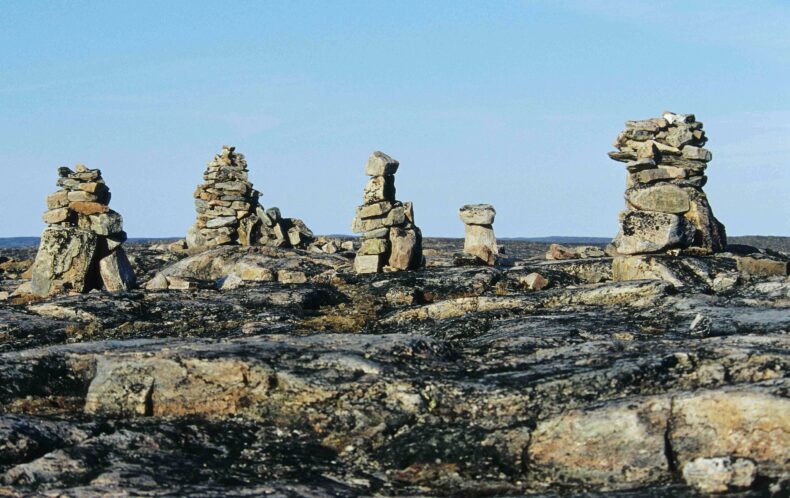
In the deep past Indigenous hunters learned to take advantage of these caribou qualities in ingenious ways. Because they are punctual, Arctic hunters knew where and when to meet them on the landscape. Because they spook easily and don’t like surprises, hunters developed various kinds of herding structures to influence their movement. Often these were built of stone: rock piles arranged at regular intervals along the landscape, sometimes made to look vaguely like a person with their arms stretched out. In Canada, the Inuit call these figures inuksuit, which means, roughly, things that act in the capacity of a person.
In the caribou’s eyes, the stones were people, and upon spotting them the animals would recoil and veer away. This, of course, was just what the hunters wanted. They used inuksuit to steer caribou toward hunting blinds, or lakes, or other places where they could be more easily killed with lances and arrows. While I’ve encountered ancient inuksuk (the singular form of inuksuit) in my travels through the Arctic, I’ve never met more than one or two at a time. I have seen drawings, though, made by hunters in Alaska, of how they were used long ago. In those renderings, the stone figures, shown in great numbers, look like literal fences—lines drawn across the map. At some point I also realized the lines of inuksuit also looked like a lot like roads.
And I worried about roads, for a while.
Inuksuit at Foxe Peninsula, Baffin Island, Canada. Source: Wikipedia. —
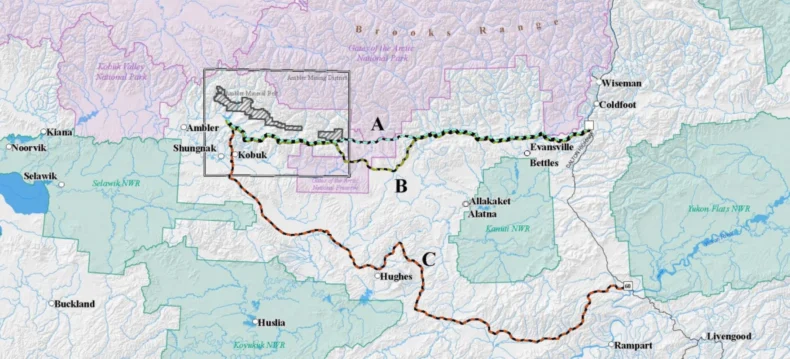
On October 6, the Trump Administration resurrected the so-called Ambler Road project. This is a proposed 211-mile long industrial road that will shoot through a currently roadless, uninhabited portion of Arctic Alaskan wilderness, including the southern hem of the Gates of the Arctic National Park and Preserve. Ambler Road will service a mine, or mines, that like the road haven’t been built yet, but Trump seems dead set on getting it done, and he convened a press conference in the Oval Office to talk about it.
In that meeting Trump did what you might expect from a man who views that natural world variously as an ATM or an enemy. He talked about how “America” needs the minerals the mine will provide. He talked about how mining and road building will create jobs and wealth. He did not mention that it will be a private road, meaning the general public will not be able to use it, and that the wealth created will go almost entirely to foreign-owned companies.
He did not mention any of the things that road building usually brings, including pollution of both the physical variety—trash, chemical spills, runoff, and traffic—and less visible (but no less harmful) kinds, such as dust, noise, greenhouse gases, and illegal hunting. He also did not talk about how the road will impact caribou.
Map of the proposed Ambler Road Project, including potential mine sites. The purple shaded area to the north is the Gates of the Arctic National Park and Preserve. Source: BLM —
If Ambler Road is built, it’ll cut through the home range of the Western Arctic Herd, which is one of the state’s most storied and important herds. The Western, as they’re often called, were formerly Alaska’s largest herd, and at their peak in the early 2000s numbered some half a million animals. But the Western has been in decline for many years, and by 2023, their population had dropped to about 150,000.
This vanishing trend is not limited to the Western. All across the top of the continent migratory caribou populations are falling, some precipitously. And while no one knows why this is happening, two culprits are almost certainly to blame. First is human-caused climate change, which is unraveling the old, relatively reliable world the caribou once knew. The second is human industrial activity, including mining and especially road building.
You probably see by now where my worry was headed.
——
In the late spring of 2022, a biologist in Alaska showed me a digital animation that combined roads and caribou. The caribou, which were wearing satellite tracking collars, appeared as black dots moving across a map. The road—a mining road in the northern part of the state—appeared as a line on the screen. When the black dots hit the line, many, if not most of them, rebounded. Because I am a child of the 80s, I instantly thought of the video game Pong. It was like that: balls bouncing off a paddle.
The biologist had been touring the state, appearing at meetings about the potential effects of the Ambler Road project. At the time, the Biden Administration was mulling the whole thing over, reviewing its permits and purpose. Eventually Biden would kill it, but that hadn’t happened yet and many Alaskas, particularly Indigenous ones who rely on caribou for spiritual well-being as well as physical sustenance, were profoundly concerned about what the road and its attached mine or mines might do to caribou.
The biologist told me he’d show his animation and people in the meetings would sometimes gasp. For the most part, caribou lives unfold far out of our sight. Their challenges, their sufferings and triumphs, lives and deaths, are largely invisible to us, even if we live in caribou country. For many in the audiences, the Pong animation revealed an aspect of caribou-human relations that they had never seen before but recognized right away from their familiarity with the animals, and with old stories about hunting fences.
For a long time mining and oil companies have insisted that their roads, along with their helipads and pipelines and other infrastructure, have hardly any effect on caribou at all. But the satellites were telling a different story. They were showing how human lines scored into earth—not for hunting, but for extraction, for “wealth-generation”—could disrupt caribou movements, possibly throw off their migrations, frighten them into new, unsteady and unreliable behaviors.
“The mine folks didn’t like it much when I showed that animation,” the biologist said.
——
Later, in 2024, he sighed in relief when the Biden Administration scuttled the Ambler Road project. But then Trump resurrected it. Earlier this week I wrote to the biologist to ask how he feels and though I haven’t yet heard back I’m sure I know what he’s going to say. He’s going to tell me he’s worried.
He’ll say what most of us can probably guess: a 211-mile long industrial road, surfaced with gravel and busy with trucks that are feeding the wealth of foreigners will be no friend to the conservative, dwindling caribou of the Western Arctic Herd.
There is still hope that a court might stop the road, or that some other hurdle will block Trump’s plan. No death-cult lasts forever, after all. And if there is a silver lining here for me it may be that I’m not worried anymore. Now I’m angry, and this is good. You can’t do much, I’ve learned, with worry. But anger is, they say, is fuel.
I haven’t heard the foxes for a good year now. The woods are still there but the owners sold it to a buyer who promised to cut down only the middle of it, you know how buyers promise things. No trees have been cut down yet but a lot of people have been tramping through the woods, measuring and discussing. Maybe the foxes got tired of the people, maybe they know what’s coming; but in any case, they probably got up and left. Not everything ends well.
I wrote that paragraph on August 7, 2019, and since then (YES!) things ended well. Only the middle of the woods was indeed cut, and the foxes are back. They sashay across lawns and up the sidewalks. They look neither right nor left, they own the whole neighborhood, but I swear they know every movement everywhere. The 2019 post was a re-run from September 8, 2016. It strikes me that I’ve been doing this for a long time.
*
Across the street are two houses with two small yards, connected so they look like one, shaded by trees, one of which has a rope looped in it. The little kids come out of both houses, run through the shade into the dapple-spots of sunlight, disappear back into the shade, grab the rope and swing, climb up into the tree and perch like little panthers. Sometimes they sing. And one twilight, running into and out of the light, what they sang was “What does the fox say?”
The song was popular a few years ago but I’d never listened to it. I went inside and googled it. It’s an unsettlingly weird song by a Norwegian — what is it with those far northerners and their pale skins and light eyes and strange stories? The song is about a guy who knows that dogs say woof and elephants say toot but doesn’t know what the fox says; so a bunch of people dressed in animal costumes dancing in a woods tell him what the fox says, which is, among other things, Ring-ding-ding-ding-dingeringeding! Wa-pa-pa-pa-pa-pa-pow! Joff-tchoff-tchoffo-tchoffo-tchoff! You get the idea, they’re making it up, they don’t know what the fox says either. These sounds, coming out of the dark from kids in trees across the street, Fraka-kaka-kaka-kaka-kow!, were also unsettlingly weird.
I didn’t used to know what the fox said either. And that’s odd because I grew up on a small farm set in fields, backing on to woods. That’s prime fox territory. We kept chickens, and foxes would get into the chicken house and kill them. I knew it was foxes because my mother said so. But I never heard a fox.
So decades later, hundreds of miles away, in a city, I woke up one night hearing an unholy scream. It didn’t sound human, it didn’t even sound animal. I looked out the window and saw a large fox, long tail held out behind, walking slowly down the street, stopping every now and then to lift its head and scream. You have to hear that sound to believe it. It sounded like it came from a time before animals.
That was years ago; the fox lived in a woods behind the houses across the street. I now recognize the sound — it’s been called a vixen scream and every Brit TV show featuring stately country mansions in the night has vixen screams in the background. Foxes live maybe five years, says Google, so that any foxes I hear now are probably its children. The neighbors keep track of them; on summer mornings they say, “Did you hear the fox last night?” For weeks they talked about one large one that limped; I never saw it. After a while no one saw a limping fox again so either the fox died or it stopped limping.
One night this summer, a neighbor and I were sitting on the porch as it got dark, talking about this and that. I was in the middle of saying something when she froze and nodded toward the street. There, walking down the middle, through the pools of street lights, was a fox and two cubs, maybe adolescents, all three sticking together. They might be heading toward the creek at the bottom of the street. They walked out of the dark and into the street lights, appearing, disappearing, reappearing, the way the little kids across the street moved in and out of the light. They slipped under cars, walked back into the street. Then they walked off into the dark, not saying a word, not saying any of the things that foxes say.
Every rock you pick up at the Mount Stephen Trilobite Beds has a trilobite on it.
Science vacations are the best vacations. I’ve been ridiculously fortunate to visit some great science-related destinations, and I’m trying to figure out which ones to visit next. I’ll share some of my recommendations here, in no particular order. I hope you’ll share your favorites with me and the rest of the Last Word on Nothing community.
A science vacation, for me, means anywhere with interesting wildlife, plants, fossils, rock formations, caves, mountains, museums, reefs, astronomical observatories, engineering marvels, science history sites, etc. Any destination can be a science destination if you look at it right.
Going to the Galápagos is like a pilgrimage for non-believers. (Believers are welcome, too.) I had studied plenty of evolutionary biology—you probably have, too—but when you go there and see the finches and the tortoises and tree-like cacti and the fearless mockingbirds and how they interact and co-evolve on different islands, it just makes all of Earth’s living history make sense. You can swim with marine iguanas, see penguins and flamingos on the same coast, visit HMS Beagle landing sites, and laugh at boobies dancing and frigatebirds puffing out their throat pouches.
Mount St. Helens erupted 45 years ago (I know, I know, I had to double-check the math) and you can still see the devastation it caused—and the ecosystem’s recovery. Any volcanic park makes for a great science trip, as long as it’s inactive or you’re at a safe distance. Lassen Volcanic National Park in California, Haleakalā in Hawaii, and Mount Rainier in Washington are all relatively young, accessible, ridiculously dramatic volcanoes. Devil’s Tower in Wyoming (the one in Close Encounters) is the core of an ancient volcano. You can walk through lava tubes at Craters of the Moon in Idaho (bring a headlamp).