It’s been said and often quoted that 10,000 hours of doing anything will make you a master. Never mind the squishy definition of mastery that makes it apocryphal, I believe it.
When the term mastery is used, I figure it’s not that you’ve risen flawlessly to becoming a great chef or engineer, but that you’ve managed to corral dysfunctions enough to let your functional side shine through. This might lead to becoming that great chef or engineer. You’ve mastered crawling out of the trash compactor of life and made something of it. Congratulations.
One of the finest editors I’ve ever known has died, and I’m heartbroken.
David Corcoran was my first editor at the New York Times, but over the 12 years that I knew him he also became an advocate and a friend.
David was kind and supportive like a good dad. His tenor let me know that he trusted my judgement, and his confidence spilled over to me as I set out to report a story. His edits were always gentle and affirming. He never failed to leave a story better than it was before, and he always worked in service of the story, not his own ego. I’ve never met an editor with a more adept touch. I can’t ever recall getting an edit back from him that didn’t make me happy. Ask any writer — that’s a very rare thing!
I recently bought a camera that prints pictures immediately upon exposing them. Remember those? It’s pretty fun, and it’s nice if, like me, you take a lot of pictures and then save them in your iCloud and forget to look at them. Or at least forget until your phone sends you an automated “memory,” and then they cause a catch in your throat when you realize that was two years ago? How?
Anyway I got it on Amazon, where I get too many things (I think I need an intervention) and that meant it was a good deal, and that it came with a whole kit of extras. There were stickers and cheap plastic frames and tiny clothespins on a string and a little photo album. The instructions were in badly translated Japanese (it’s a Fujifilm). But the album is what got my attention.
Tim Ryan–a mostly forgettable startled-looking white man candidate for the Democratic nomination for president–just debuted a new hashtag and some accompanying merch: #YouDontHaveToYell
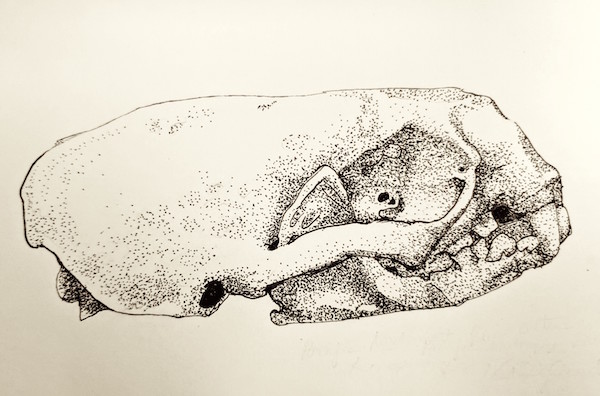
Skull of a North American river otter (Lontra canadensis)
In 2015, Sarah Grimes picked up this river otter’s carcass on
a rugged beach covered in tumbled sea glass. She removed its skin and flesh and
soaked its bones first in warm water, then Borax. She kept each section of the
skeleton — legs, paws, spine – in a separate mesh bag so the bones wouldn’t
get mixed up. Then she cleaned the bones and put the skeleton back together, a
process called rearticulation.
Grimes is the Marine Mammal Stranding Coordinator for the Noyo Center for Marine
Science in Fort Bragg, California. She is trained and permitted to pick up
dead sea mammals and judge how they died. This river otter looked thin, and
probably starved to death – its displaced hip joint would have made it
difficult to swim. “Poor little nugget,” she said, showing me where the otter’s
leg once attached to the rest of the skeleton.
Six years ago in July I was in London for a week, and one day a bee was banging itself against the skylight at my friend’s house, over the desk where I was working. After being annoyed by it for a while—c’mon, bug, the skylight is open—it occurred to me that this wasn’t a very bee-like thing to do. Bees don’t get stuck inside, then bang themselves against windows. Bees bumble. Even the ones that aren’t bumblebees bumble.
This animal was definitely banging, and from somewhere in the depths of my mind I pulled the fact that there are flies that look like bees. If I set aside its stripes, I could tell that it was acting like a fly, it sounded like a fly and, if you could get past the coloration, it looked like a fly—huge eyes, fly-shaped wings.
Here are some facts about hoverflies that I had to check on the internet:
A hoverfly really is a fly, not some other kind of thing masquerading as a fly. Like the other flies, it only has two wings. (Bees, like most flying bugs, have four.)
You can call them hover flies if you prefer. In fact, neither of the paper dictionaries I checked at home even list “hoverfly” as one word. “Flower flies” is also good. Or “syrphids,” which seems like it ought to be poetic but actually comes from the Greek for “gnat.”
Like bees, many of them are pollinators.
Unlike bees, many of them eat aphids. (That’s when they’re maggots; when they grow up, they feed on nectar or pollen.)
Looking like bees probably helps protect them from predators.
This summer I was hiking in Rocky Mountain National Park. At some point in the last six years I became used to the existence of these hoverflies, and now, when I see something buzzing around a flower, I don’t immediately think “bee.”
This time the hoverflies particularly stuck out. As I approached the treeline, the altitude where trees give up and the landscape turns to stubby little plants that can make it through the harsh winter, it seemed like I saw hoverflies everywhere. They were buzzing and darting around the flowers, moving just like flies.
Like so many things we ignore, hoverflies are incredibly diverse; there are thousands of species, going about their business without the average person paying much attention. (Or am I wrong about the average person? Probably. When I think of my reader, I think of a middle-class, college-educated city dweller; probably the true, global average person instantly catches on when something is behaving unlike a bee.)
It comes to me again and again how important classification is for seeing. I knew what lichens were, but it wasn’t until I realized how to look for them that I saw them everywhere. Same with the hoverfly. Out there, hatching, eating aphids, then growing up and pollinating flowers, just one of many neighbors doing its job while I do mine.
Confession time: I used to be a peach hater. What was wrong with me? It’s a question I often find myself asking, too.
Part of it was the pit. When I first saw a peach cut open, I
was a kid. It was summer, and I was at a swimming pool. The pit looked like a
tiny withered brain. A brain that left bloody marks on the peach flesh all
around it, a brain that came out smeared with yellow slime.
A friend told me that the pit was poisonous. In my mind, the
poison infused the whole peach, becoming a deadly pink-yellow time bomb, my own
forbidden fruit. (It’s true that a peach pit contains amygdalin, which turns
into hydrogen cyanide once you eat the pit—so don’t eat peach pits!—but you’d likely
have to eat a lot of them to have real problems. This woman
ate as many as 40 apricot pits and survived.)
Last year, my husband and I set off on a camping adventure in Montana. We canoed to a remote site on Cliff Lake, an expanse of water that formed atop a geologic fault. The sun shone. The water was an impossible shade of aquamarine. Eagles perched atop dead trees. It was pretty damn perfect.
That evening, after we pitched our tent, we took the canoe out for an evening paddle. Not fifty feet from our site, I spied something in the water. Something brown. Something furry. Something mammalian. It took my brain two more oar strokes to ID the animals. Otters! Three of them. Playing in the water near a large rock. I had never seen otters in the wild. Even spotting otters at the zoo had proven surprisingly challenging. Yet, here we were, gazing upon otters in their native habitat.
I was awestruck. My husband and I aren’t the kind of people who hold hands, but had we not been at opposite ends of the canoe, we might have clutched our palms together and gazed meaningfully into each other’s eyes.