Work is a lot of work. Most of us have to work for about half of our waking hours for about half of our lives. And they’re mostly not easy hours. Work can be full of conflicts, confusion, drama, trauma, and awkwardness. I started writing a work advice column a year ago for Slate to help advice seekers think through their work dilemmas, and to help readers solve their own work problems by reading about other people’s. I’d like to share a few of the themes that have come up, in case they’re useful to you or yours.
Advice columns have been around since at least 1690, and they’re immensely popular. Carolyn Hax’s advice column is always among the most-read articles on the Washington Post, and many readers who are furious about the publication’s owner, editorial page, and layoffs are keeping their subscriptions only because of Hax. I’ve been reading advice columns since I was a kid and think they’ve helped me avoid a lot of mistakes and be a more considerate and thoughtful person. Fundamentally, they’re lessons in perspective-taking, problem solving, and empathy.
Each letter to the column—which the editors named “Good Job,” isn’t that great?—describes a specific problem, with plenty of context and details that make the problem tricky. (If it were a simple problem, the person probably wouldn’t be writing in to an advice column.) I try to address the specifics but also extract general principles that might apply to other people’s work questions. A lot of these principles are basic primate stuff about power, communication, and alliances, since we’re just great apes in glasses.
Tell people what you want them to know. Many work problems are communication problems. One person was disappointed that her colleagues didn’t notice her engagement ring, another wanted her husband to stop spending so much time with his boss. (Most of these links go to full columns, which have three questions each and are behind a metered paywall. Some go to Slate Plus content, for subscribers only. Apologies if you can’t access something.) Even people we spend most of our time with don’t notice big or little things we’d like them to; they’re no Sherlocks. Even when you do tell someone something, you may have to tell them again and again. This is especially common in the workplace, which is full of distractions and corporate-speak and mixed messages.
I think about jumping spiders a lot. If you have had a conversation with me in the last several years that lasted more than 5 minutes, you already know this. But what are the spiders thinking?
A friend once bought me a mug with a spider on it that reads “Sometimes I wonder if jumping spiders are thinking about me too.” The spider has a little thought bubble that says “Betsy.” I literally wonder this very thing, nearly every day. I may never know for sure, but I recently got a little closer to the answer, thanks to a clever new study.
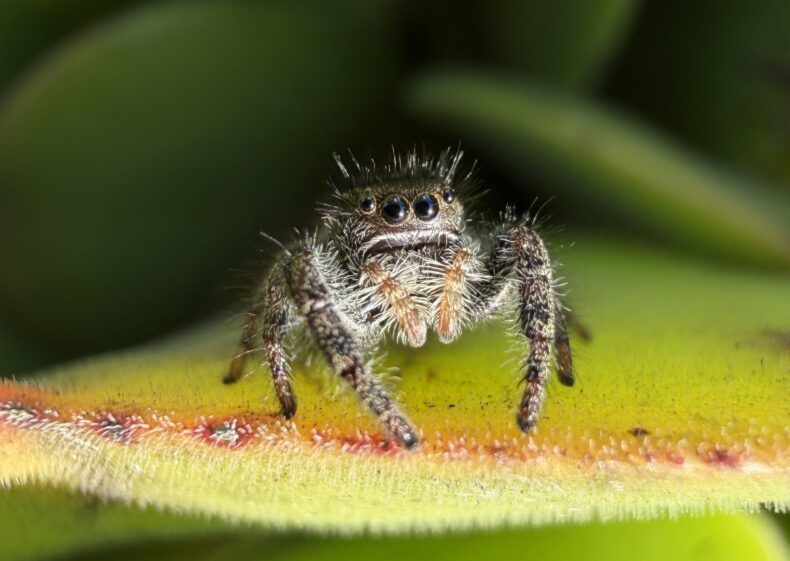
As I wrote in a previous post, I recognize individual jumping spiders in my neighborhood based on where they hang out, how they look, and most importantly, how they behave. On my daily dog walks, I’ll often see the same spider on the same succulent for days and even weeks.
Some are consistently curious and will let me get very close and take lots of photos. Some like to jump on my phone or my hand if I offer a slightly higher perch. (Before they jump, they stretch their front two legs out toward their destination for a second or two, like a toddler asking to be picked up. It’s adorable.) Other spiders are quite timid, ducking behind a leaf the moment they see me coming and remaining hidden as long as I’m there.
A lot of jumping spiders will let me approach if I am careful, but hide if I move too quickly, or get too close, or stick around too long. It’s as if they are curious, but lose their nerve. It’s these spiders who make me wonder if they might eventually recognize me like I recognize them. There’s one such spider currently living on an aeonium around the corner from my house, a young Phiddipus johnsoni I call Frieda. Could she come to know I’m not a threat? Could we become friends?
I took this picture the other day, and it’s a trick. For half a second, I thought I’d made some impossible discovery, the track of what looks to be a giant cat in ancient sandstone.
With all the prehistoric tracks appearing lately — Ice Age humans in Utah, sloths in New Mexico, dinosaurs in Texas — I’ve had my eye to the ground. The picture I took is of Jurassic sandstone. It resembles a cat track, the size of a Pleistocene species, a 500-700 pound feline. Rounded pads, no claw marks, that’s what I’d call it. But felines are Oligocene in origin, 25 million years ago, certainly not Jurassic, which would have been of dinosaur age. So, what is it?
My wife and I have an ongoing debate about whether I take too many photos. Or, more to the point, whether I keep too many of the photos I take. The matter has come to a head lately because our photo account just filled to 89% capacity. We get warnings all the time now. I tentatively offered that we could simply pay a little bit more to double our storage, but she rejected that on principle, arguing it was too much in keeping with a general ethic of endless, heedless expansion. “How many f—–g pictures of the same thing do you need?” she said. “Before we even think about getting more storage, you should go through and really decide what’s worth keeping.”
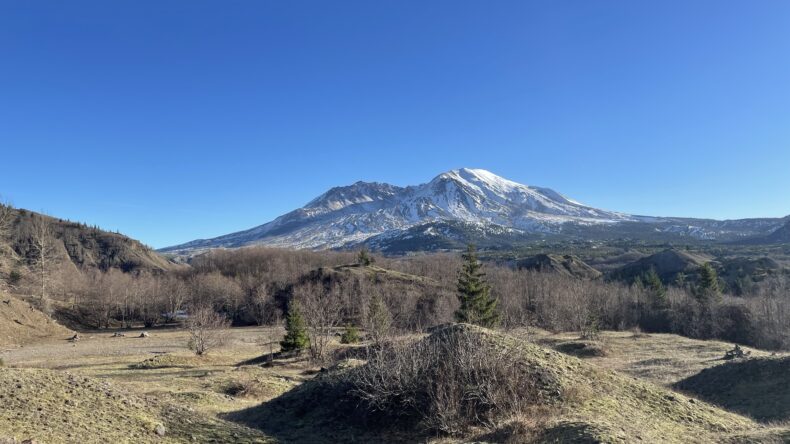
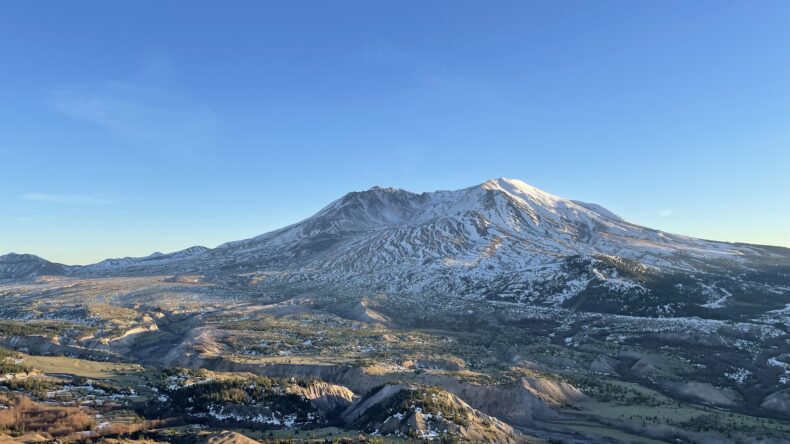
Our debate was on my mind a couple of weeks ago as my daughter B. and I set out on the Hummocks trail near Mount St. Helens. My wife was out of town visiting friends for the holiday weekend, and I had thought it would be a good time for B. and me to do a little winter camping. B., as might be expected, wasn’t terribly enthused at the prospect, but she came gamely along. Not that I gave her much choice.
This first ran in February 18, 2019, back when we thought colds came and went, big deal. Since then, covid has brought us to Jesus and back again, and people are having colds again, not exactly a big deal, not exactly not. And lest this post about our bodies’ resilience be taken as support for not getting vaccines, it’s not, it’s decidedly not. If I hadn’t had a that year’s shot, I’d have been a lot sicker for a lot longer.Anyway, I present this with sympathy for all today’s people with colds: you’re not alone.
I’m writing this to be the voice of all the people who have had this winter’s ratty cold and have not written blog posts about it. I’ve had it twice now, so aside from worrying about what that says about my fundamentals, I feel qualified to testify. I testified once before here but this time I’m serious.
Day 1: Scratchy sore throat, I had this three months ago, I am instantly on guard. I take no chances. I decline an invitation to come over for drinks. I take a pre-emptive antihistamine,
Day 2: Scratchier sore throat, possible increase in fatigue. I would decline drinks again but receive no invitations. I take another pre-emptive antihistamine, add an anti-inflammatory nasal spray, sleep badly.
Day 3: Continued as before, wondering whether a cold that takes this long to kick in means I’m beating it or it’s going to be a bitch. I bundle up and go the farmers’ market for the week’s food. Sleep interrupted by coughing and nose blowing.
Day 4. Scratchy sore throat turns vicious, coughing painful. A cold virus, I think. I remember my husband telling me about a long-ago relative whose doctor told her she had a virus and viruses can’t be cured, so she went home, told her family she had an incurable virus, and took to her bed for seven years. I think the story was true.
Day 5: Swallowing feels like knives in my throat. I sit on the couch under a fuzzy blanket, humidifier going. Antihistamines now accompannied by NSAIDs, nasal spray regimine changes to the real thing, antihistamines. Reflect that, in spite of the antihistamines, the histamines are still winning. Reflect further that I don’t know what histamines are.
I google. All I can figure out is what I think is happening: Somewhere around a week ago, a rhinovirus and all its friends got up my nose, where they latched on to epithelial cells which became all alarmed and disrupted and leaky and broadcast immune system signals which resulted in everything getting inflamed. Somehow the result of all this was poison mucus (I’m flatout making up the poison) (but surely something has to be irritating the hell out of everything, maybe that’s the histamines?). Somehow the inflaming mucal process moved into my sinuses (“Gwaltney et al reported that the intranasal pressure created by nose blowing, sneezing, and coughing is great enough to propel nasal secretions into the sinuses.”) (Lord, have mercy). And then the secretions moved gravitationally back out my nose and down my throat and into my bronchiae and lungs. The reason for coughing seems intuitively obvious (Bronchiae: “Get it outa here and now!”) but apparently is not: “Unfortunately, the mechanism of infectious cough brought on by . . . human rhinovirus, during colds, remains elusive despite the extensive work that has been undertaken.” I still don’t know what histamines are but I no longer care.
Day 6: Alarmed by the throat knives getting worse, and by Cassie’s social media post that her sore throat turned out to be not viral but strep, and by the Capital Weather Gang getting torqued up about a snowstorm followed by extreme cold (meaning that the usual Baltimore approach to snow, letting it melt, won’t work), I go to the ER. The ER is kind but bored: not strep, not the flu, here’s some nice anti-coughing meds and a nice over-the-counter palliative, go home and take plenty of fluid. The ER adds the word “acute” to the diagnosis of “upper respiratory infection” which makes me feel important until I remember that to doctors, “acute” means only “not chronic.” The ER says in parting that the cold is about to get better on its own. I go home to my couch, surrounded now by cups of honeyed tea, pharmaceuticals, and used kleenex.
Day 6: The snow turned out to be slight and the sun strong enough that the usual Baltimore snow removal strategy is indeed working. Under the influence of pharmaceuticals, I’ve had 10 hours of sleep. Knives drastically dulled, coughing decreased, far fewer kleenexes. Sunlight is pouring through the windows and puddling up on the floor. It’s all I can do to not lie down in one of those puddles, but my stern midwestern breeding disallows such indulgence and I’m back on the couch, watching the sun outline the clouds of humidifier vapor and backlight the tips of the used kleenex. I’m about to be cured, I think.
Then I think what that doctor should have told my husband’s relative: doctors can’t cure viruses, but bodies can. That’s not quite true about doctors any more: antivirals are excellent against hepatitis, herpes, HIV. But the common-cold is caused by a rhinovirus, and less frequently by a list of evil-sounding viruses, a couple of which are only recently discovered, and all of which cause similar symptoms, can occasionally get serious, and are cured only by bodies.
Day 7: I’m still on my couch, throat nearly normal, still hacking, tire easily. But I’m getting cured! I have an incurable virus but my body is curing it!
Day 8: I figure out what this post is really about: not just whining about the common cold, but the enormous number of things, physical and mental, that break in the body that the body can’t fix. I’m not listing them because we all know them already, these things for which no medical or psychological measures work. But when the body doesn’t even need the doctors and scientists and therapists, when it just goes about doing what it knows how to do, its little cells and enzymes and proteins trudging dutifully through their routines, and WHAM! curing happens, then honest to God, I turn my face gratefully to the glow of a miracle.
Dr D says:EditAwesome post. Just ending my first week with honest-to-god Influenza. Thankfully I had the flu shot so it’s attenuated. That means I only felt like I was dying for a few days instead of the full week. And now, thanks to the flu’s beatdown on my immune system, I have picked up that damn throat thing you describe here. Sigh. C’mon body. Hurry up and heal. The weather is fine outside and I’m missing it!
Man Flu says:EditCheered me up no end (I’m at day three!), here’s to day eight and onwards, there is an end! I don’t think I have the wherewithal currently to document it daily as my mind is like a proverbial London pea-souper at the moment. Thanks for letting me know whats coming and when it going to be going.
Kaleberg says:EditWow! That was a quick cold. It’s usually two weeks coming, two weeks with me and two weeks going. That is, unless it’s worse. Right now on day 32 of whatever kind of cold I have.
Ann Finkbeiner says:EditI ended the post with the day I knew I was going to live. But yes, I’m still dealing with it and I don’t even know how long it’s been.
Last year, for the first time, food consumption went down, reported the Financial Times, making 2025 “the first year on record where the volume of food consumed in America has decreased.” The weight loss drugs are taking their pound of flesh: not just from their own delighted customers, but from the food industry too.
Meanwhile, this week I have a story in the New York Times about the way intermittent fasting has been oversold the past decade. One researcher reckons that part of the reason people are finally starting to acknowledge the gap between the big claims for it and the meagre scientific evidence is because of the staggering success of those GLP-1 weight-loss drugs. Against their blindingly undeniable successes, all diets pale.
Most diets don’t work for most people long-term, but there’s a good reason they have been particularly ineffective the past three decades. When you’re up against a food environment that has been engineered to make you helpless to resist, diets don’t stand a chance. Unless they have help, which they now do.
It’s becoming increasingly apparent that the benefits of Wegovy, Ozempic, Mounjaro, and the rest won’t just accrue to the people who take them. If the drugs cause major changes to the food landscape, even those of us who don’t take them will probably become healthier.
In May of 2025, I went to Mountainfilm in Telluride with my BFF Rosemerry Wahtola Trommer. We watched numerous amazing films, but there’s one that continues to haunt me, eight months later.
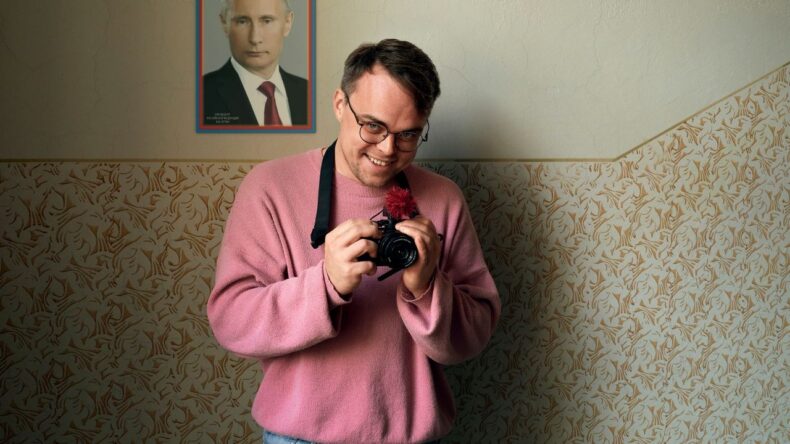
Pasha is a beloved teacher and event organizer at a small Russian school. In ordinary times, he is a mentor, prankster and nonconformist, known for hanging up democracy posters and offering his office as a safe haven for students who feel left out. However, after the 2022 invasion of Ukraine began, his responsibilities began to include facilitating daily state-sponsored propaganda events. Under the guise of his actual role as the school’s videographer, he documents footage inside classrooms, chronicling an institution abruptly transformed by new regressive laws, militarization, violence and oppression.
At the time we watched the film, we were only four months into this current administration and it felt like the world was crashing down. Rosemerry and I were similarly terrified and heartbroken by the destruction we were witnessing in our country, but we had polar opposite responses to the film. She was energized by it. I was left feeling even more despondent.
A few days later, I called her to talk about the film.
My mother died at the end of June 2024, a few months after my father. They lived the last 39 years of their lives in a tidy but full house, surrounded by books, photos, treasures, and memories of travels.
It took a year and a half to transform the house from a cozy den of treasures to the white walls and bare wood I handed over to the new owners last week, and I had a lot of help. Before my parents died, I often wondered how this would go, and worried about it. I was going to want their entire five-bedroom-house’s worth of stuff, and it wasn’t going to fit in my one-bedroom apartment.
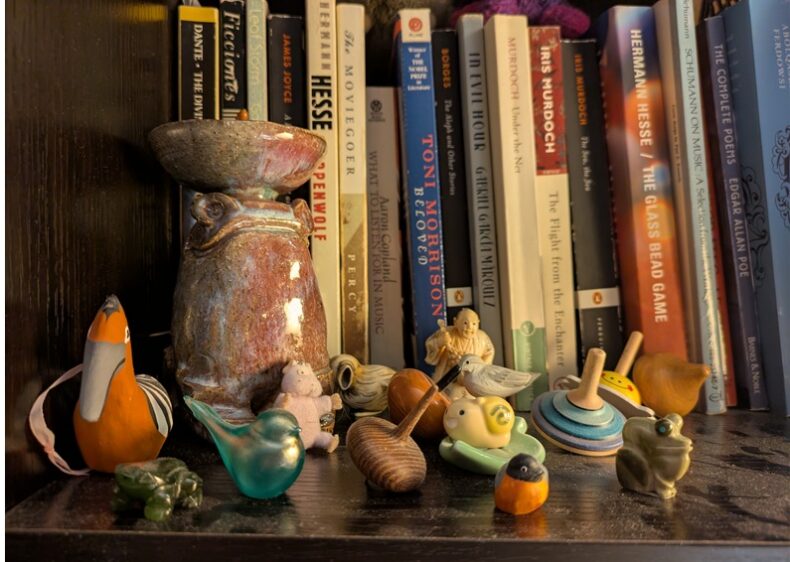
Some of it is here. (Now it’s a two-bedroom house, but it’s not much bigger than the one-bedroom apartment, and it has two people’s stuff in it.) Just above my laptop screen, on a shelf at eye level, are these items from my parents’ house:
A glass bird
A ceramic hoopoe ornament, like the hoopoe my mom and I saw in Turkey in 1998
A tiny bullfinch from Norway
Two frogs, carved of stone – my dad loved Zuni fetishes, tiny carvings by Zuni artists (one has the artist’s name on a sticker on the bottom)
A purple fuzzy critter from a Japanese animated film
A carved wooden sanderling from a craft fair in Maryland
Six of the dozens, maybe hundreds, of spinning tops that my dad collected
Two netsuke, one of a bird and one of a man holding a basket, that my parents must have bought in Japan in the 1970s
A chopstick rest with an adorable cartoonish snail
Nearby shelves hold more of their things: a round Tibetan box studded with coral and turquoise, two hand-carved wooden trolls from Norway, a seated wooden Buddha, a cuddly Welsh dragon. My dog is asleep next to me on a fuzzy blanket on a wooden armchair with a Tibetan-rug-turned-cushion – all from my parents’ house.
My parents liked stuff. I like stuff. Their stuff is here, with me. They are not.
I sometimes feel bad about liking stuff, and am very sensitive to other people’s judgment that I have too much stuff. All the talk about “clutter.” One person’s clutter is another person’s precious memory, made solid.
This shelf of tiny treasures all came home soon after my mom died. I’d hold one and remember its place in the house and feel a bit of love for the people who chose it, and bring it home.
In the year and a half that I was visiting a few times a week, looking at stuff, and leaving again, my feelings eventually started to change.
Sometimes I’d look at something again and find that it was just a thing. Time seemed to wear away some of the meaning. I’ve now looked at so very many treasures that every single one does not carry the same level of meaning. That glass bird in front of me, for example. I don’t know where it came from. I might even consider giving it away.
My feelings shifted in the kitchen, too. Right after my mom died, I couldn’t have dreamed of getting rid of any of her wooden spoons. Every now and then, I’d bring one home and add it to my own collection. A month or so ago, with my deadline closing in, I was able to pick up each remaining spoon, one by one, and decide its fate.
Two weeks ago, I sat on the floor in my parents’ empty box of a bedroom, held a tiny green and yellow ceramic turtle, thought, “I love this!” and happily packed it to go to the thrift store and find a new family.
On a shelf in my bedroom is a book by Richard Todd, a writer who died in 2019, called The Thing Itself: On the Search for Authenticity. He wrote brilliantly about stuff and our relationship with it, how it’s gotten so cheap and available in the era of free trade, the feelings and memories it carries. I went digging through that book tonight for some wisdom to apply to my feelings about my parents’ stuff, and found this:
People interviewed on television after a natural tragedy ravages their world—flood or fire or landslide—say, ‘It’s only things, and things can be replaced. Thank God everyone is safe.’ And you admire them for this, as they expect you to, and their response is indeed right and good. But sometimes, hearing these ritualistic lines, I get an unworthy, even cold-hearted feeling. I want the things to be mourned. Many things, after all, survive us, and some deserve to, in part because they contain us.
Things contain us, he says. I know that having the carved stone frog in my life is not the same as having my dad. My dad is not his belongings. He lives in my memories and imagination, in what he wrote, and in the stories people tell. But I know how carefully he considered every decision in his life. I can picture him holding a tiny stone frog, setting it on the store’s glass counter, and bending over to examine it from all angles before deciding to take it home. The frog isn’t him, no. But if I didn’t have it, would I ever have imagined that scene?




 Dr D says:
 Man Flu says:
 Kaleberg says:
 Ann Finkbeiner says: