I had an ephiphany about why cats are the way they are. But before I can explain the epiphany, I should explain the way that cats are. Granted, I don’t have a cat, but I was raised with them. I lived on a small farm and farms have cats to keep the mice and rats down. The cats themselves lived in a kind of roving population, the females and babies staying pretty close to the outbuildings, the males wandering around doing what they do, and in short a farm can have several litters of babies a year who you won’t know about before you fall over them in the barn. The net numbers of cats were generally controlled by the wandering males and by the likes of my mother, and I’m not going to talk about their methods.
Never mind. The point is, I have many data points about cats so I can generalize. Cats are not your friends. They not only don’t listen to you, they don’t care what you say. They love you while they’re with you and when they want something, but honest? they don’t love you at all. The relationship is not even transactional, they’re all take and no give, it is all on their terms. They go about their own lives and business without regard for you or for the social good, and that is the reason Rudyard Kipling titled his story The Cat That Walked By Himself. They are so focused on themselves as to be psychopaths. They switch easily between friendly and feral and thus survive easily without us. They’re killers, not killers-in-groups, but killers all by themselves and they don’t necessarily kill to eat.
For further data, I also called upon my neighbors who have had many cats over many years. It’s true that a lot of their data points are irrelevant to my epiphany (which I haven’t yet explained). However, their data mainly suggest that cats like to sit in or on things. They offer many photos, 1700 in fact. I include some of those photos here in case they’re relevant after all. For instance, one possibility is that cats sit in or on things as practice for lurking invisibly before seizing upon their prey. Some photos back this possibility, some do not.
Autumn always makes the woods feel empty Though I know strictly speaking This isn’t true
Bears prowl orchards Chuff through oak groves Stuff themselves before a slumber That grows shorter every year Deer, too, are bolder now and dumber Haunting the edges of highways Running to or from the rut Even many insects remain Hidden in soil or bark Unnamed under leaves Or within the spongy corpses Of bug-killed trees
And yet still the woods seem empty Something many things are missing Now running water rings clearer A cold mineral sound While the squirrels get louder In their rooting and hoarding They rustle in the duff like monks Turning pages in a library
I’ve heard squirrels lose Most of their buried acorns Just forget where they put them Like me with the keys the phone The summer Where did it go All that heat and light Wasted
The difference between us is Squirrels by forgetting seed the future While I accomplish nothing Lose entire seasons Can’t remember year to year That if the woods are empty Autumn isn’t the problem
“I put my pants on just like the rest of you—one leg at a time. Except, once my pants are on, I make gold records.”
Christopher Walken as The Bruce Dickinson, SNL “More Cowbell” sketch
Margaret Atwood (Peggy in her personal life) resisted writing her memoirs because she thought her life was not interesting. She was right. Like most great writers, the vast majority of Atwood’s adult life has been spent at a desk. Like most ultra-successful careerpersons, she calls herself a workaholic.
Of course, now that she has bowed to the pressure to write her memoirs in her late 80s, joking that it gave her a chance to get back at her enemies, they are a pleasure to read. I would read an Atwood book about electrical wiring and enjoy it. The audiobook version narrated by the author adds a deadpan delivery that sparks delight.
But if a biography (whether auto- or allo-) recounts the life and times of its subject, the times are more riveting here than the life. Wartime backwoods Canada is just close enough to my own family’s experience that I catch most of her references, but they are certainly a throwback. The way of life in which you must can your own food and sew your own clothes has few comparables now. Even without Atwood’s frequent signposting, it’s not hard to see this girl as the mother of the offbeat, principled, fearlessly frank woman.
These wild turkeys are thankful their population is growing. (Photo by Susan Ruggles / Flickr)
Gratitude is supposed to be good for you. In study after study (enough to suggest the finding replicates), people who practiced simple acts of gratitude, like just listing stuff they’re thankful for, became less stressed, more optimistic, and more satisfied with their lives. That’s nice!
But let’s talk instead about how gratitude can help other people feel better. Giving someone sincere and thoughtful thanks can help them feel understood, appreciated, connected, inspired, empowered. (Okay, sometimes also embarrassed.) Thanking people well is a skill that gets better with practice. So let’s practice.
The first thing to do is make time to thank people. If you’re busy (and we’re all busy), you can schedule a weekly “thank people” appointment on your calendar. If you keep a To Do list, stick thank yous on there. If you have a checklist of steps for a work project, add a thanks item. Send a bunch of messages around Thanksgiving telling people why you’re thankful for them.
I’ve been an editor for a lot of different publications, and writers say they like to work with me. (I realize some of them might have been angling for an assignment.) One reason, I think, is that I thank them throughout the editing process: Thanks for this idea, for this pitch, for this update, for including such interesting and varied sources, for your insight, for turning this around so quickly, for this clarifying metaphor, for making me laugh, for (sniff!) making me cry.
Shortly after I started a job at the Washington Post, one of the reporters said, in mock indignation: “Laura, what are you doing? Nobody says thank you here!” And you know what? The Post, and most newsrooms, and most organizations in general, would be much better workplaces if leadership had more gratitude and less attitude.
Thank someone for their intent. This one is tricky because you don’t want to be presumptuous and claim to know their motivations. But you can express gratitude for the intent as you perceive it: Thank you for your kindness, your generosity, your willingness to consider a weird idea.
Thank someone for their impact. Thank you for writing this article. I was sick and miserable when I read it, and it made me laugh. Thank you for bringing the conversation back to Mia’s idea when Brad spoke over her at the meeting. I think you built up her confidence and helped us decide on a better plan. Thank you for inviting me to your lovely and delicious party. It reminded me that there are so many interesting people in our orbit and inspired me to host a party after the holidays. I hope you can come.
Thank someone to manipulate them (in a good way). If you thank a colleague for mentoring an intern, especially if you’re a manager, they’ll be more enthusiastic about helping the next newbie. If you thank your boss for explaining something about the organization’s strategy, they’ll think you’re a great listener and want to keep you updated. If someone consistently takes more credit than they deserve, thank them for collaborating with someone else.
Thank someone for routine or seemingly small things. Gratitude is the opposite of taking-for-granted-itude. Thank you for letting me vent about work. Thank you for finding cranberries in the back of the freezer. Thank you for inviting me to join your Slack group; I enjoy your company so much. Thank you for calling; it’s great to hear your voice.
Add thanks to a compliment to make it more memorable and meaningful. Those are cool shoes! Thank you for brightening up our stuffy workplace. Your shoes inspire me to have more fun with color.
Add thanks to an apology. Start with the apology; don’t skimp on that. I’m so sorry I’m late for lunch. I got tangled up at work and misjudged the distance. That’s good, but it forces the other person into a narrow range of socially acceptable responses: It’s okay. Don’t worry about it. Glad you made it. If you tack on a thank you, it bumps the conversation out of that trap: Thank you for finding this restaurant. Thank you for making time to catch up. I’ve been pretty overwhelmed by It All, and seeing you brightens up the dark days of winter.
Add thanks to condolences. When I lost a job, wonderfully kind people sent me messages that gave me strength, comfort, and solidarity. Many of them included a note of thanks. Thank you for giving me a chance. Thanks for your advice when you guest-lectured in a class 10 years ago. Thank you for encouraging me to write my book. Thank you for helping me recover after I made a mistake. I’m so thankful for these messages that they still (sniff!) make me cry.
So Happy Thanksgiving week, everybody. Thank you for being part of our community of readers, writers, commenters, and sharers at Last Word on Nothing. Please share your own advice for giving good thanks, or tell us about what you’re thankful for. Gratitude is a powerful practice.
“I’m a huge fan of death. I’m a groupie for death. I think it’s the metronome of our existence. And without rhythm, there is no melody.”
-Guillermo del Toro, speaking to Terry Gross on “Fresh Air” about “the torment of eternal life” and his adaptation of Mary Shelley’s gothic classic, Frankenstein.
Not long into Guillermo del Toro’s excellent new adaption of Mary Shelley’s Frankenstein, the titular character (played by Oscar Issac) finds himself in front of a disciplinary tribunal at the Royal College of Medicine. Addressing an audience full of be-wigged academics with elaborate facial hair, Victor Frankenstein rails against what he sees as a staid and ossified approach to teaching (and thinking about) science and medicine:
“Birth! Birth is not in our hands, is it? Conception, that spark, the animation of thought and soul—that is in God’s hands. God. But death. Ah, now there lies the challenge that should be our concern. Who are we to do so? We are not gods, are we? But if we are to behave as immodestly as gods, we must, at the very least, deliver miracles … ignite a divine spark in these young students’ minds. Teach them defiance rather than obedience. Show that man may pursue nature to her hiding places and stop death. Not slow it down, but stop it entirely.”
This Victorian-era TED Talk—delivered in a medical theater instead of an amphitheater—does not go well for Victor, especially after a gruesome anatomical demonstration freaks out the already skeptical panel of judges. But while the medical establishment wants nothing to do with Frankenstein’s hubris, fate has delivered a venture capitalist (of sorts) in the audience—a wealthy arms dealer who, for a highly personal and comical reason I will not ruin, is willing to take him both literally and seriously.
“This is the future,” declares Victor as he’s escorted out of the building. “This is possible. Why not study it? Why not quantify it?”
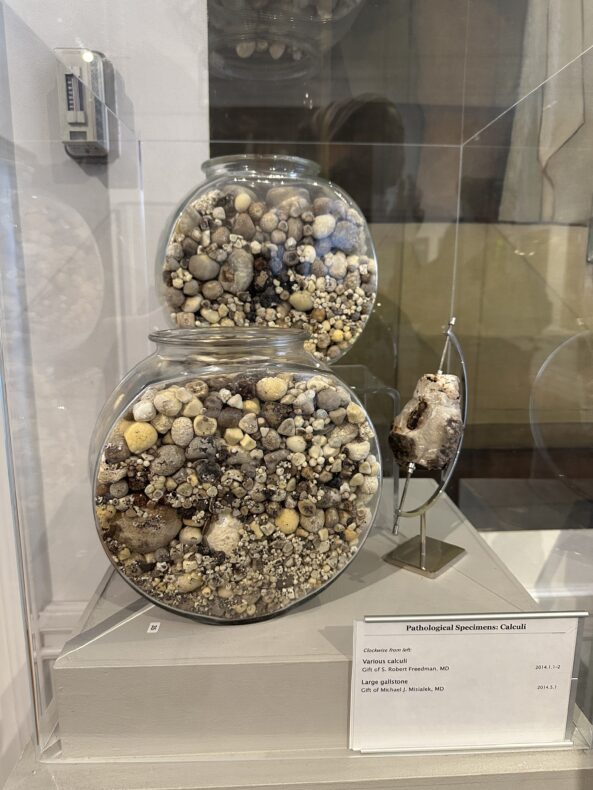
The International Museum of Surgical Science in Chicago holds many delights — an iron lung, a collection of old forceps, an X-ray shoe fitter. But none of them stuck with me quite like the glass case that held two fishbowls brimming with stones removed from people’s bodies. gallstones, kidney stones, and bladder stones. According to the placard, these were a gift from one Dr. S. Robert Freedman.
The display begs many questions. But let’s start with the obvious one: why? Why did Dr. Freedman keep so very many stones?
One cold night a couple of weeks ago, my family and I bundled up to bike out to a park in one of Seattle’s northern suburbs. We have a routine for such trips after all these years. First we layer, and then we bedeck our bikes with lights: front lights, back lights, hub lights, even flashing holiday lights sometimes. High-vis is key; as my wife says, “Trust no car.”
We were headed to a Star Party. I had never heard of a Star Party until my wife told me about it. “It’s basically a bunch of people set up big telescopes in a field and you go look at stars,” she said. She’s good at finding out about these sorts of things—gatherings you had to be In The Know about, but quirky ones.
To try anything that depends on clear nights in the dead of the western Washington winter is to tempt fate, but the weather gods were feeling charitable. When we pedaled into the park, we could see the shadow of a man and a large telescope on the dark side of the public restrooms. He was drinking something steaming from a travel mug, and appeared to be alone.
It was a party, all right.
We ambled over. The telescope was pointed at some requisite bright dot just above the horizon that I could see through Seattle’s vague orange glow. I guessed the dot was a planet, but I wasn’t sure. Stars and their ilk are like plants for me, in that I find them benignly fascinating and even know a few of the more obvious ones. I don’t mean to sound dismissive. Every year, I pledge that this will be the year that I finally buckle down and learn more. But so far I have yet to.
“Wanna take a look?” the man asked us. “It’s on Jupiter.”
I sensed my daughter stiffen next to me. She is in the midst of a Greek Myths phase, and sometimes takes it as a personal affront whenever anyone refers to a member of the Greek Pantheon by their Roman name. But she didn’t hold this fellow’s indiscretions against him, duly clambering up on the milk crate he had set out as a step stool so she could look through the eyepiece.
“See Jupiter?” the man asked.
“Uh-huh,” my daughter said.
“And those dots around it?” the man said. “Those are the Galilean moons: Io, Europa, Ganymede and Callisto.”
“Io!” My daughter perked up, the skies coming alive for her. “She was the cow!” She started rattling off bits of story about Io and Zeus and Hera and Hermes, and then Europa, and Ganymede and Zeus, and other figures whose names I could sort of recall, both from her researches, and also my own Greek Myths phase from decades ago.
A small group approached with a couple of kids. They stood behind us to wait their turn. “That one’s moving!” one of the kids shouted. “Is it a shooting star?”
“That’s a plane,” the man said. He turned to the adults. “Jet City,” he said in a What can you do? kind of way. “And I work at Boeing,” he added, perhaps as an apology.
We left him and went to another part of the field, where two other telescopes were set up. Here there actually was a party. Maybe fifteen or twenty people were standing in the dark and enjoying light astronomical cocktail chatter while their kids scampered about. One fellow was gesturing into the sky with the most amazing laser pointer I had ever seen, using it to show the Pleiades, Sirius, Aldebaran in the constellation Taurus, other distant wonders. But most of the crowd had gathered around a big man who was holding forth in front of a commensurately big telescope.
“Are there any mothers here?” the man was saying when we sidled to the front. He was like a carnival barker. “Where are the mothers?”
For a couple of moments no one around us said a word. The man scanned the assembled before zeroing in on my wife and daughter and me, since we were, I realized, standing closest to him. He looked somewhat theatrically from my wife to the child at her side who was presumably hers, thus making her A Mother.
There seemed to be no point in denying it. My wife tentatively raised her hand.
“Excellent!” the man said. “C’mon over here.” My wife walked to his scope. “Know what you’re looking at?” he asked as she peered into the eyepiece.
My wife shook her head.
“I’ve got it just a little below Orion’s belt, on the sword,” the man said. “That’s the Orion Nebula. What you’re looking at is a star nursery. It’s where stars are born! Those are all baby stars!”
“Wow,” my wife said. “There are so many.”
After my daughter had a look and was suitably impressed, I took my turn. There was the immediate paradox of the eyepiece’s diameter against the breadth of the view it afforded: one inch, millions of miles. They were amazing, all the tiny points of light. I tried to do some rough conversions of scale as I stared: of how big those white dots actually are, how far the Earth is from them, how old they are becoming, how they’re expanding and gloriously hot and their light that I’m seeing now is already gone, and all the other perceptual gymnastics astronomy necessitates that in the end start to make my head hurt, but in a good way. I stepped away to give someone else a turn. I’ve known of Orion for how long? And all I ever saw were the biggest, brightest stars and Betelgeuse. How had I missed the rest of it all these years? There was so much scattered about, waiting to be noticed, blazing in silence, if only I could be bothered to look.
I found my wife and daughter and said something to this effect, full of feeling, with a certain amount of handwaving. “Mm-hm,” my wife said. “And yet, somehow, you still find a way to make it all about you.”
A fair point. But I am human. We are good at making it about us.
We thanked the man with the big telescope. By then it was getting late, so we went back to our bikes. We switched on all the lights and pedaled out of the parking lot, checked for cars, turned onto the street, headed for home. My wife and daughter took the lead on our tandem bike, while I rode behind. I watched my daughter gesturing, could hear her enthusing about something to my wife, the two of them talking, and all the while the hub lights pulsed and twinkled like little stars, saying, Here we are, here we are, here we are.