Two days after I moved with my family to the middle of Alaska I learned about the earthquakes.
Every 15 minutes or so, monitoring stations in the state detect one. Most aren’t large, or even felt far beyond their epicenters. Some begin far out to sea and appear as barely more than a tiny spike on a graph somewhere. Often they occur in the southeast, hundreds of miles from the small town near Fairbanks where we now live. In a very active period, tens of thousands of quakes may register, and in 2018—a banner year—the Alaska Earthquake Center recorded 54,000. Two days ago, on August 17, the day before my sons started classes at their new school, there were at least 28.
All this seismic action is generated by subduction, the process by which one of the earth’s massive crust plates slowly slips beneath another. In Alaska’s case, it’s the Pacific Plate pushing under the North American Plate, upon which the state sits. This movement isn’t smooth but stubborn and sticky, calling to mind—on a far small scale—the frustration of trying to force open a swollen old window frame. Tension builds along the zone where the two plates meet, and when this pent-up energy is released it pulses through the earth, sometimes close to the surface but often miles deep, where the resulting shock may be less than obvious, or even go unnoticed.
In Alaska, several of this week’s quakes were detected more than 50 miles down, within the region of relatively solid rock called the mantle. Many others were triggered much nearer to daylight. The one I’m thinking of happened just 3 miles below the surface, and less than 10 miles from my house.
*
When the quake struck, the five of us had just returned from an ice cream social at my sons’ school. This visit, on the evening before their first day, had caused tremors of its own, and brought home to the kids what was really happening—which is to say they finally understood that we were not going back to Brooklyn. Here were their smiling teachers, their classrooms clean and bright with posters, pictures, and maps. Here were their names, written on cards at the tops of their desks. And crowds of other students, too, most of them striding down the hallways with the confidence of those who’d returned, not the hesitant shuffle of us newbies. At a certain point my middle kid turned to me and said with an adult’s firmness, I am not coming here tomorrow.
These were the waves in which my partner and I were adrift at about around 6 p.m. We were kneeling on the floor, dividing up packs of crayons and colored pencils, erasers and scissors and boxes of Kleenex?—all the stuff you need these days for a successful elementary school education. The middle kid stomped toward the stairs of our rented house. You could feel him coming, feel his mood riding through the floor, shaking the joists. I looked at our neat little piles and worried. But he ignored them and growled I’m not going. Then he ran into the family room, and the rumble faded into thick carpet pile, the kind laid down against long, cold winters.
I felt for him. A few months earlier he’d been a pre-K kid in the New York public school system. Zohran Mamdani was his mayor, the Knicks were his team. He’d been loved. Embraced. That was bedrock. Now he knew not a single classmate and found himself surrounded by more trees than he’d ever seen in his life. Where were the buildings, the pigeons, the sirens? Where were his friends? Why was no one walking anywhere? Why had we done this?
Somewhere below us the earthquake passed. We didn’t notice. The world was already spinning.
*
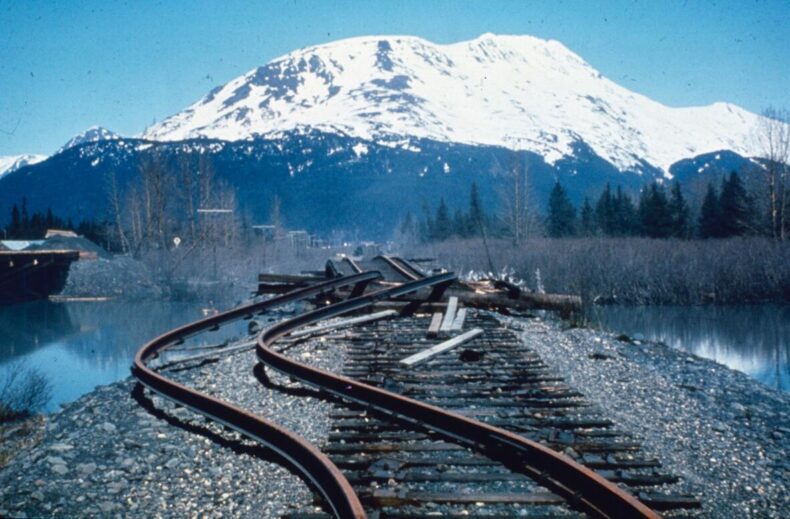
The real power of an earthquake is measured in magnitude. The higher the magnitude, the stronger the quake, though strength doesn’t necessarily equal destructive power. In 1964, the Great Alaska earthquake registered a magnitude of 9.2. It shook the ground for nearly five minutes and generated an enormous tsunami, which killed more than 100 people. The quake’s energy then rattled onward, through the crust and around the world, raising waves and sinking small boats as far away as Louisiana. There has never yet been a quake so powerful, though we’ve seen many deadlier, including ones earlier this year in Colombia and Venezuela. By way of comparison, the Great Tōhoku earthquake of 2011 struck Japan with a magnitude of 9.1. Collapsing buildings and the following tsunami killed some 15,000 people.
The earthquake that happened near our house was a baby, registering at 0.7 magnitude. Not long after it ended the Alaska Earthquake Center posted a few details about the event. Nothing much more than depth, location, time. I noticed, near the center of the page, a prominent clickable button. It read, Did You Feel It?
By then the kids were in bed and the day was done, though the aftershocks of our evening were still rolling in, shaking our home and our hearts. For a moment I let the mouse hover over the button, then I swiped it away
*
This post marks my one-year anniversary as a member of the LWON crew, and it’ll be my last post, at least for the time being. For the next few years I’ll be teaching journalism at the University of Alaska in Fairbanks, and most of my free time will be aimed at this work. I hope to return one day, and in the meantime I’ll be keeping up with the stories my wonderful colleagues post here. Thank you for reading, for being here!

loved the rei rei part. I felt like I was in that moment.
You’ve seen him at his best. And worst!