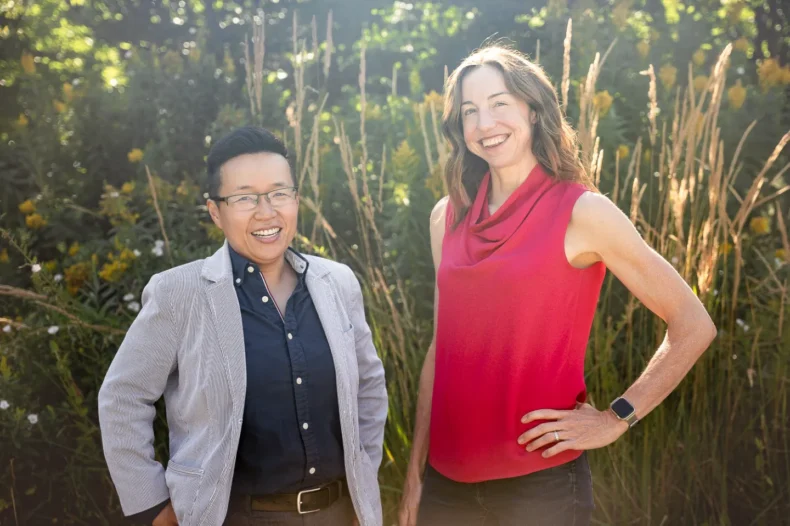
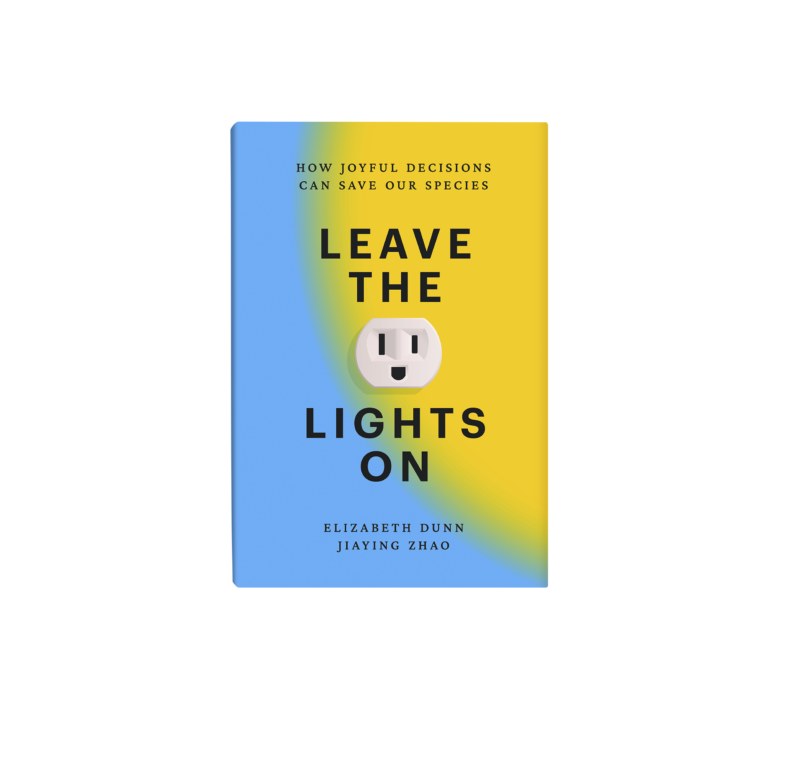
I’ve been following Liz Dunn’s happiness research for a while, and now she has co-written a new book, Leave the Lights On: How Joyful Decisions Can Save Our Species (Penguin Random House), about how joy could be the missing weapon in our fight against climate change. Here we sit down for a Q&A about her work.
Jessa: So you and Jiaying Zhao, colleagues at University of British Columbia, have co-written a book. What are your respective research foci and how do they fit together in this collaboration?
Liz: I’m a happiness researcher, and my work focuses on how to optimize our use of resources to maximize happiness. So time, money, technology—I studied AI and smartphones and things like that, and then I got interested in carbon as another one of these. In this case, we don’t want to create too much of it. JZ is one of the world’s leading experts on the behavioural side of climate change. So, how do we change human behaviour in a way that tackles climate change.
Our two specialties are usually on opposite sides of the room—we do not find ourselves next to each other at a cocktail party. But in this case, bringing our almost non-overlapping areas of expertise together has been really powerful. It creates dual lenses so we can find the sweet spot between having a genuine impact on climate change and what makes people happier.
Jessa: One of the concepts in the book that really rang true for me was hedonic adaptation. What people think will make them happy only does up to a point. How does that manifest in our daily lives?
Liz: Yeah, so hedonic adaptation is like the gravity of happiness research—it keeps us from floating away with joy. Whatever happens to us in life, we tend to adapt to it. That’s good because we are pretty good at recovering from bad things, but we also recover from good ones. Somebody from the Renaissance would be blown away by the comforts and conveniences of our daily lives, but we don’t walk around marveling at them. We get used to them.
This is important for thinking about climate change, because it can be tempting to overconsume, ratcheting up our desires and feeling like we need more. The mistake we make is thinking the 10th pair of designer shoes will give us the same level of pleasure the first one did.
Jessa: And it sounds like that goes for bigger items, too. At LWON, we sometimes discuss our decisions around having children, and part of the picture is climate change. How do you find the sweet spot there?
Liz: This idea that has really gotten out there, that if you care about climate change, you shouldn’t have any children, we think that is a misinterpretation. In fact, we interviewed for the book the person who is famous for this idea and he said he never meant for that to be the takeaway. Part of ‘saving the planet’ for us is saving out own species, so not having any children probably isn’t the solution.
Of course, if you don’t want to have kids, great. But for many people having children is an important thing they want out of life, and it’s one of the most potentially joyful and meaningful things we do in life. But that said, maybe you don’t want to have five kids if you care about climate change.
Jessa: You shouldn’t have a soccer team?
Liz: Even a basketball team might be a little much. We get hedonic adaptation even with having children, so that the fifth kid does not actually seem to deliver as much pleasure as the first kid (no offence to fifth children!). If you’re somebody who has always dreamed of having a big family, concern with climate change doesn’t necessarily need to crush that dream, but then we would say, think really carefully about where you live.
The first thought is often to move to the suburbs where you can get a big house, but we think the first thought should also be to move somewhere with clean energy. That way your children are actually going to have a very small impact. So there’s a more joyful way to approach attaining a lower carbon impact for your family if you have agency in terms of where you live.
Jessa: We also have some devoted dog-lovers in our team. How should we be thinking about pets?
Liz: My collaborator JZ has a bunny, which is a very low carbon pet. She finds that because she stocks her fridge with more fruits and vegetables for the bunny, she ends up eating more like a bunny herself. I do have a dog, but she’s just a 30-pound doodle and eats one cup of food per day.
Pets do provide a lot of happiness, and I think our dog is everyone’s favourite family member, so a pet can be an opportunity for low carbon happiness. The size of your dog matters, so if you really want to keep your carbon impact low over the course of the lifetime of your pet, having a small dog can bring almost as much joy and love as a really big one.
Jessa: I wanted to take a quick detour, because our LWON readership is science-y and will probably be aware of the replication crisis in psychology. You mentioned in the book how the field has changed and strengthened in response to this since you or I were first studying it in university.
Liz: It really has undergone a revolution, and pre-registration is one of the most important components of this. We basically call our shot before we take it like you would in pool. So you can’t just accidentally knock some other ball in and claim that’s what you expected all along. It’s so easy to convince ourselves that, oh, of course I just needed to combine these two dependent measures into one, or I should control for gender. But we’re motivated as scientists to choose the analysis that best supports out hypothesis or provides the most exciting, interesting result. Getting published is also the currency of academia.
My field, social psychology, was one of the worst offenders in terms of p-hacking, but we’ve also been some of the most rapid adopters of these changes. So pre-registration ties our hands and makes us pre-commit to how the analysis will be done before you know what the results look like.
Jessa: The idea for your collaboration came when you were cycling to work. You were really enjoying the biking and of course it’s a very low-carbon way to commute, so you put the two concepts together. If you could redesign everybody’s commute from scratch, how would you have it?
Liz: Oh interesting. First off, I wouldn’t create just one pathway. Biking to work is not possible for everybody, even in terms of their physical capabilities, but I would want to create safe bike lanes in every urban area as well as access to e-bikes they could pick up and drop off at various points around the city.
I would want clean EVs providing Waymo-style driverless service, which could remove the need for a personal car. And then really clean, efficient and pleasant public transit. I would pay attention to noise and comfort so that the time people spend on public transit actually felt enjoyable.
Jessa: Have you changed anything in your own life as a result of the research for your book?
Liz: By nature, I’m not a light packer. As a result of doing this work, I learned that a typical checked bag you take on a plane is the equivalent to bringing an extra six-year-old child with you, and I had never thought about that. So I have adopted a pretty strict policy with myself of only taking a carry-on bag. Sometimes this involves me sitting on this bag to be able to close it, but it’s a hard constraint that limits how much I bring with me on trips.
And in terms of happiness, it eliminates the time spent at the baggage carousel which is inevitably the worst part of our trip, waiting anxiously to see whether our bag even made it. I’ve also thought more about vacationing locally. This summer my family is taking only vacations within our province. So we’re going to Whistler for mountain biking and Tofino for surfing. Residents of London, on average, have visited fewer tourist attractions than visitors who have been there for two weeks, so there are plenty of reasons to experience the place you already live.
Last summer, I booked a beautiful Air BnB and stayed there with my closest friends in Vancouver, twenty minutes from my house. We were removed enough from our children and jobs and laptops that it was a special experience, and we were able to splurge on the accommodations because we weren’t paying for flights. We didn’t waste any time traveling there. So 99.9% of the weekend was just spent together enjoying this beautiful spot.
