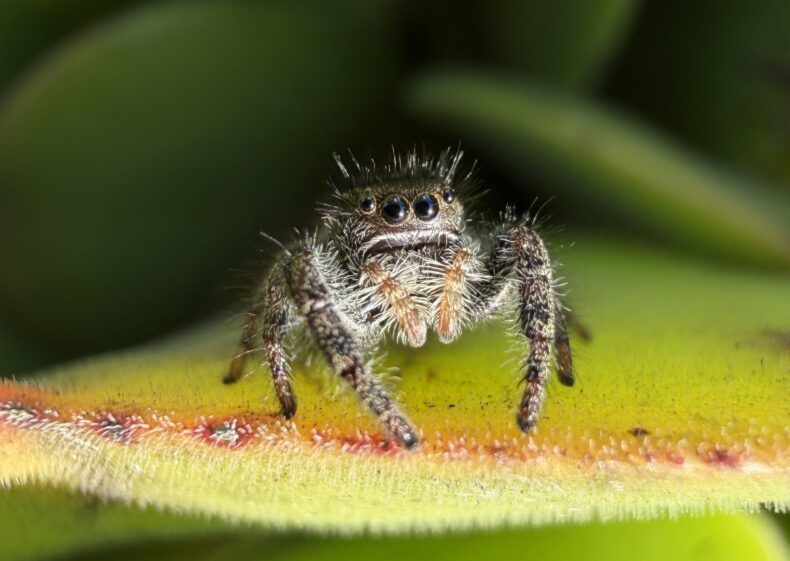
I think about jumping spiders a lot. If you have had a conversation with me in the last several years that lasted more than 5 minutes, you already know this. But what are the spiders thinking?
A friend once bought me a mug with a spider on it that reads “Sometimes I wonder if jumping spiders are thinking about me too.” The spider has a little thought bubble that says “Betsy.” I literally wonder this very thing, nearly every day. I may never know for sure, but I recently got a little closer to the answer, thanks to a clever new study.
As I wrote in a previous post, I recognize individual jumping spiders in my neighborhood based on where they hang out, how they look, and most importantly, how they behave. On my daily dog walks, I’ll often see the same spider on the same succulent for days and even weeks.
Some are consistently curious and will let me get very close and take lots of photos. Some like to jump on my phone or my hand if I offer a slightly higher perch. (Before they jump, they stretch their front two legs out toward their destination for a second or two, like a toddler asking to be picked up. It’s adorable.) Other spiders are quite timid, ducking behind a leaf the moment they see me coming and remaining hidden as long as I’m there.
A lot of jumping spiders will let me approach if I am careful, but hide if I move too quickly, or get too close, or stick around too long. It’s as if they are curious, but lose their nerve. It’s these spiders who make me wonder if they might eventually recognize me like I recognize them. There’s one such spider currently living on an aeonium around the corner from my house, a young Phiddipus johnsoni I call Frieda. Could she come to know I’m not a threat? Could we become friends?
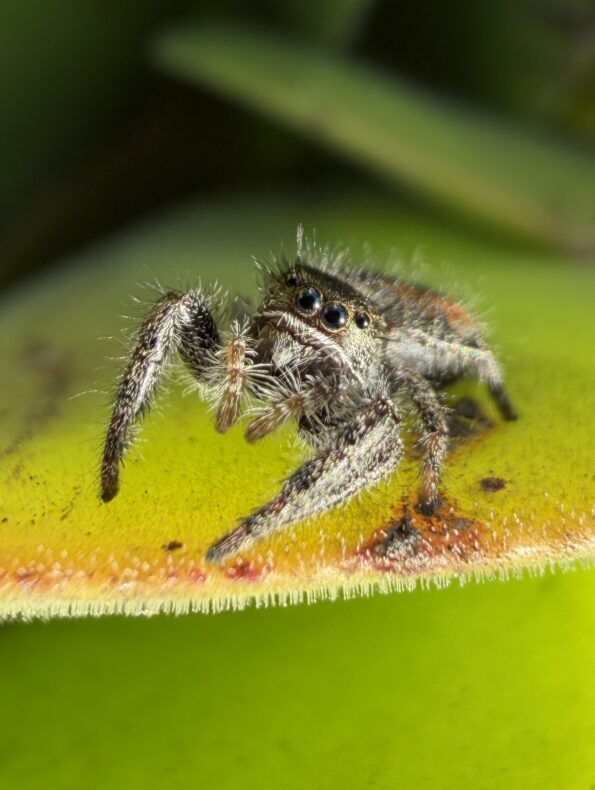
I’ve thought about what recognizing me would require cognitively. Frieda would need to be able to remember something for at least a day. And she’d need to be able to use her memories to ascertain that I’m not going to harm her — she’d need to be able to learn.
There is research to suggest that at least some jumping spider species are capable of both remembering and learning. Scientists in New Zealand tested the memory of Portia africana and found they could remember the type and number of prey items they had seen during trials that lasted up to 30 minutes. And they are able to learn exactly how to vibrate the silk of other spiders’ webs to trick them into coming close enough to pounce on them.
Portia species are known for being particularly clever jumping spiders, but let’s give Frieda the benefit of the doubt and assume she can remember and learn too.
So far so good. But there’s one more requisite ability: Frieda will need to recognize me. How plausible is that “Betsy” thought bubble?
Jumping spiders have astonishingly good vision. Their two primary eyes have boomerang-shaped retinas that curve toward each other such that the center of the boomerangs can overlap. In that little spot, jumping spiders have color vision and can see with the range and acuity of a house cat. (A cat! In case you have forgotten, these spiders are often just a few millimeters long. I’m not even going to try to do the math on how much smaller they are than cats.) So I’m pretty sure Frieda has the physiology to see me in enough detail to distinguish me from the rest of the (mostly) spider-hating humans out there.
Still, jumping spiders are generally not social animals. Outside of courtship and territory defense, they are mostly solitary. So it’s unclear if there’s any reason for a jumping spider to be able to recognize other individual spiders, let alone members of other species.
Many mammals, such as dogs, can clearly recognize different humans. The same goes for cats, cows, and chickens. Crows have been known to remember individual people for years (and to hold a grudge against those they see as a threat). All of these animals are social creatures who need to keep track of relationships with other individuals in order to thrive. Jumping spiders do not.
This brings us to the new research. A study published in November found that jumping spiders can indeed recognize other individual jumping spiders.
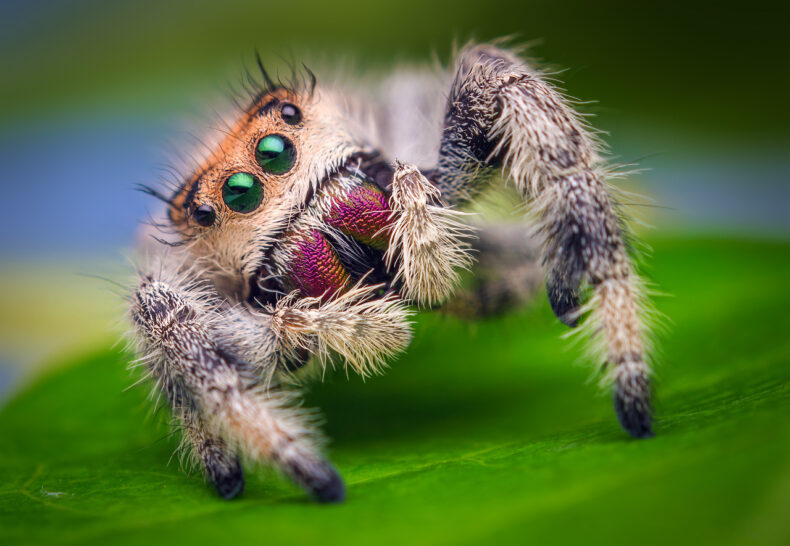
Here’s how Christoph Dahl and Yaling Chen of Taipei Medical University tested Phiddipus regius (a.k.a the regal jumping spider, and a relative of Phiddipus johnsoni spiders like Frieda and Diego). They set up “face-to-face” meetings between spiders (separated by a clear acrylic sheet), and watched how they reacted to each other during a 7-minute trial, measuring the amount of time they spent near each other as a proxy for interest. The first time a pair of spiders met, they typically approached each other. They then had a 3-minute break before their next encounter. If the same two spiders met again, they stayed further apart. But if after the break there was a new spider instead, they would come closer.
Three dozen spiders showed this same reaction over many trials, growing less and less interested in the familiar spiders. But even after many rounds of testing, a new spider would elicit renewed interest. The spiders were able to recognize which spiders they had seen before and which were new, even after hours of being presented with different spiders.
While I am not entirely surprised by this, it is, scientifically speaking, a very surprising result. There is a long-held assumption in the field of animal cognition that complex mental abilities are the exclusive purview of animals with spines, large brains, and complex social lives. A leading hypothesis is that it is precisely the demands of being social that necessitate more cognitive capacities. Because complex cognition requires a lot of brain power, which requires a lot of energy, the thinking goes, animals wouldn’t evolve these abilities if they weren’t getting a huge social benefit from them.
But evidence has been accumulating that small-brained invertebrates are capable of some pretty impressive mental feats. Bees are a great example, as are jumping spiders.
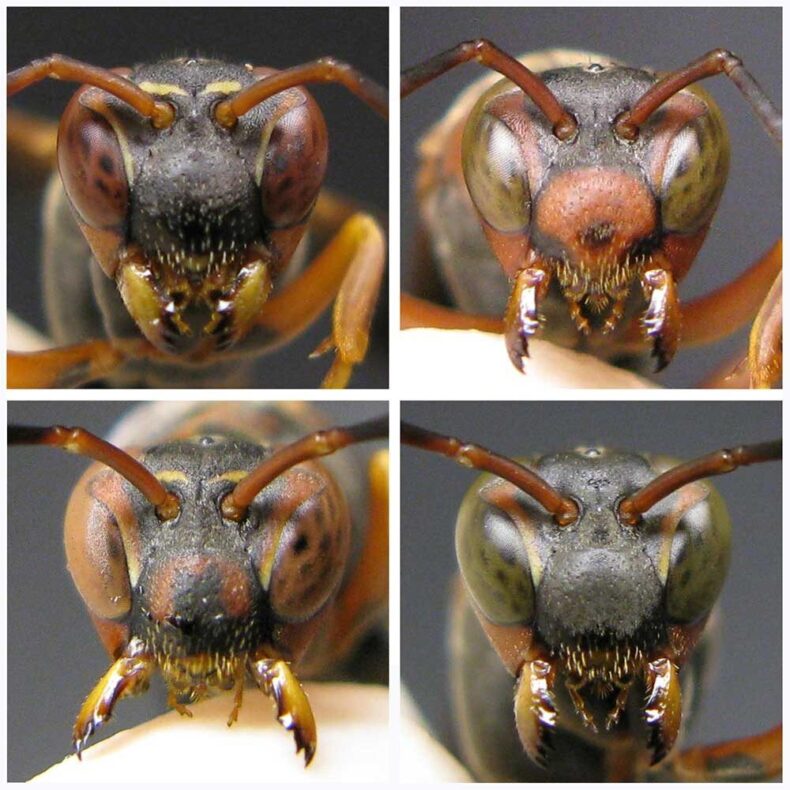
Research has also shown that paper wasps are quite good at identifying the faces of other individual wasps and can keep those faces in memory for at least eight days. This makes sense because these insects are also social animals. Jumping spiders are not.
Which is why the new study is surprising. “These findings invite a shift in perspective,” Dahl and Chen write. “If a tiny, mostly solitary spider can recognise individuals, how much brain is really needed for flexible social memory?”
Jumping spider brains — which are the size of a poppyseed — may be capable of far more than we thought. “We may underrate animals with compact nervous systems because we treat brain size as a stand-in for cognition,” the authors write. “What do such abilities imply for debates about animal consciousness? Behaviour cannot prove subjective experience, but it narrows what kinds of minds are plausible.”
More importantly, what does this imply for me and Frieda? I may just be seeing what I want to see, but I think she’s already grown less afraid of me. I’ve worn the same fleece on my visits the last several days, in case that helps her remember me. Today she spent several minutes tracking me and waving her pedipalps as I moved around. Then she started to back away, so I gave her some space and hung out with the spider on the aeonium next to hers for a bit.
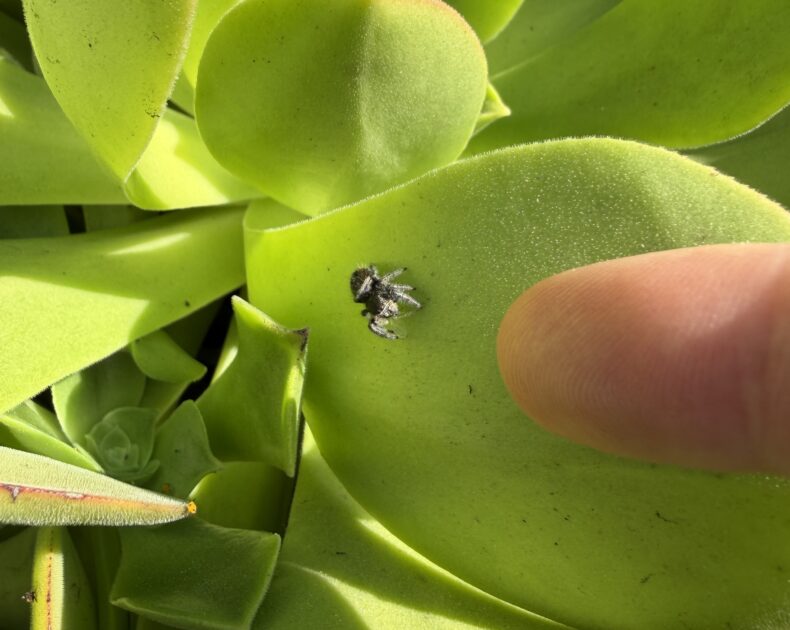
When I returned, Frieda sat still, watching as I slowly reached my finger toward her until it was just an inch away. I took a photo to capture the moment, and when I zoomed in to see if it was in focus, I noticed that while I was away, Frieda had caught a fly. Perhaps I’ll bring a sandwich when I visit tomorrow, and see if we might have lunch together.


My wife is a keen gardener, often spending hours in our small yard doing unnecessary tasks just so she can hang out with her plants. The lizards in our yard appear to recognize her and will emerge from hiding to sun themselves in her presence (perhaps taking advantage of the protection she offers from predation?). They don’t do this for anyone else in the family. Only her. Maybe you offer the same protection for Frieda.
I love that your wife has lizard friends! I think you could be right that they understand they’re safer when she is around — the human-shield effect. Scientists think one reason some animals gravitate toward urban areas is that there are fewer predators. I wonder if that might be part of why some jumping spiders venture into houses (in addition to warmth).
I also think about jumping spiders a lot. They are some of the most beautiful creatures on Earth. The males in particular but even the females in their drab colors are adorable. But we can’t really perceive them with the naked eye! It takes HD photography to capture how magnificent they are. A whole world of magnificence that is hidden from us. How many more such worlds are yet to be discovered?
Maybe their social activity is just the males showing off, because they know they are fabulous, and females checking out the males, perhaps mating with them, perhaps eating them afterward. That’s social, isn’t it? It revolves around mating and eating just like human social activity tends to do. Maybe one day the females will ogle the pretty boys together.
We get large, scary spiders on our porch sometimes. There was one living above our mailbox and I had to move her because I didn’t want to subject the postlady to arachnohorror every day, but otherwise we just leave them alone. They’re fine. But they’re not jumping spiders. I can’t befriend jumping spiders because I have no photography skills. I cannot perceive them in the real world, only online. In the real world, they all look the same.
Hi Terez,
Thank you for relocating your mailbox spider rather than killing her, and for generally letting your spiders be!
I do think you may be able to befriend some jumping spiders though. It’s true, they are small, but you can definitely see them with the naked eye! It’s a little hard to make out the details on the tiny ones without some magnification, but even then, I can see what they are doing, and I can see when they spin around to look at me. There are tons of Habronattus pyrrithrix spiders in my neighborhood, which are very small and prefer to be on the ground, and this makes them harder to see. They are usually around 5 or 6 mm full grown, but I can still see the brilliant red masks of the males with just my eyes and it’s easy to see the difference in color/size/shape between the males and females. I can see even a baby Habronattus from several feet away because they move in such a characteristic way. On the other hand, species like those in the Phidippus genus are often more than a centimeter long, and sometimes more than a half inch. They are quite easy to see and interact with. I’d be willing to bet you could find a Phidippus spider to befriend in your neighborhood if not in your own garden. And because jumping spiders are out during the day, they are pretty easy to find and hang out with.
Though the males of many species are more colorful, that’s not always the case, and Phidippus spiders are again a good example. The Phidippus regius photo in my post is a female — the males of this species are usually black and white with brilliant green/blue chelicerae, but the females can be bright orange and have shimmering, neon pink chelicerae. And female Phidippus are almost universally fuzzier, particularly as adults when the males lose some of that cute fuzz. I’ve also found that females are on average more willing to interact with me than males:)