A conversation struck up at a writing workshop a few weeks ago between me and a computational biologist who studies the molecular biology and population genetics of the HIV virus and other virulent diseases including Ebola, Hepatitis, and Covid. She’s what you would call a veteran virus tracker, compiling and interpreting viral genetic sequences and medical alerts from around the world. She’s one of those who raises her finger and says something’s going on here.
We were eating lunch beneath the copious shade of an alder tree along the Gila River in southern New Mexico. She was talking about her HIV work with studies being halted and USAID shut down during a dismantling of public health architecture. This dismantling, she said, was creating a perfect environment to enable rapid evolution of drug resistant HIV, nothing better for diversifying strains than medication slowing and being misused and underused worldwide. She explained that access suddenly ending means many people with HIV will share what few doses of medication they have left with loved ones, or get inadequate doses, or get ineffective treatments on the black market and this creates the possibility of an evolutionary flashpoint as mutations in medication-avoidant viruses look for hosts. This is how HIV is unleashed back into the wilderness.
I often get scientists in these workshops. They are the ones here to relearn storytelling, the challenging ones, but she was making it easy for me. I was sending her off to write about anything but science. No talk of virulence or pandemics, we instead wrote about the sound of moving water. We climbed a ridge and used boulders for chairs, looking across folds of wild country, furry mountain ranges dropping into canyon after canyon, which we described in our notebooks so someone far away in a different time might see the picture. For days we did this sort of thing. After field class we’d return to an old wood lodge that leans slightly, squeaky wood floors, front porch dressed up with rocking chairs and couches. It was a casual, unguarded atmosphere, and I did ask her permission to write this, especially since she called what she had to say a warning, a red light flashing on the control panel.
Our lunch today was a riverside circle of a dozen people, some scribbling in notebooks while the clear Gila flowed beside us hugged by cliffs. We were on a pebbly shoal, a half-moon classroom where after lunch we’d stand beneath the low-hanging alder canopy and read our day’s writing to each other then pack up and walk a couple miles back to the lodge.
She talked about work partly because I kept asking while we idled over egg salad and kale. I was looking for an update not through media or rumor but from the source. She’s been watching grants sink left and right, an incredible amount of money wasted, studies costing tens of millions of dollars over many years halted before completion. So much of the medical research that is left unfinished is now made useless, she told me, science full of promise and breakthroughs-in-the-making stopped abruptly, from cancer to immunology. Funds were found at the last minute so that her tracking of mutations worldwide of SARS-CoV-2 (the virus that causes COVID) might continue another year. Her findings she then shares with the National Institute of Health, the World Health Organization, policy makers, colleagues, and the public on request. She dropped everything to write a small proposal to be able to continue the work. The virus keeps evolving whether we are watching or not, and she said she finds it prudent to keep watching.
The problem with scientists is that they speak a language most people don’t, necessitated by their disciplines. They get lost in the weedy difference between correlation and causation, which, it turns out, matters. At their most fundamental level, scientists work as our eyes, seeing what is actually occurring in the world rather than what is taken on hunches. They note when new trends are spotted, what few might recognize, a nearby star that’s begun to throb, a longstanding ocean current turning around for the first time in thousands of years, a surge in a disease that if unchecked could wipe out most of a critical livestock species on Earth, for example, chickens. That sort of thing.
~
During the class she took a quick 7-word prompt about something remembered from the day and later shared it:
“Craig asks for one, he gets four.”
“Heaven holds your spin vibrant blue planet”
“Pithouse ruin a rain bowl, piñon drinks.”
“Irrigation ditch burbles. Dog barks. Worried chicken.”
~
I’ve heard plenty of arguments that it’s all observer bias and cures are worse than diseases. Drilled into my head by loved ones: immunologists are crooks, scientists are caught up in mass delusional hoaxes. If these loved ones spent much time with scientists they’d find most of them to be restrictively-unbiased-number-crunchers, some of whom enjoy writing. Each is focused on incredible minutiae, and many are concerned about the health of humans and all life on Earth, an agreeable slant. They are the ones to point out something like HIV in strong decline due to sound science and a global effort, followed by a comeback being staged for the disease, something that might not be noticed amidst all the noise.
~
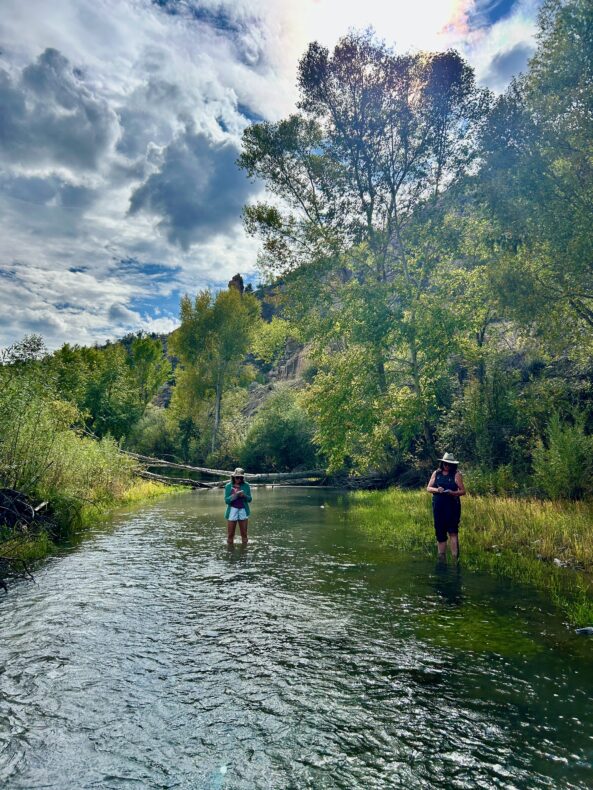
On our last day as our final exercise we walked calf-deep into the river and wrote in our notebooks, and this is needed, too.
Photo by cc

Was there in May for the Dark Sky weekend. Can’t wait to go back! A sacred, inspiring land.
The damage is done, but hopefully this insanity passes soon so we can begin repairs.
The diaspora of scientists leaving the US is one possible good that might come from this systematic destruction of the scientific community here. A few giant old trees like the NIH and CDC will now become a myriad seedlings spread around the globe. Each hopefully shooting up to more mature forests of protection. Making science as a whole harder to disassemble and giving us more points of observation and warning.
I sure do like that take, Dr D, using the evolutionary noggin.