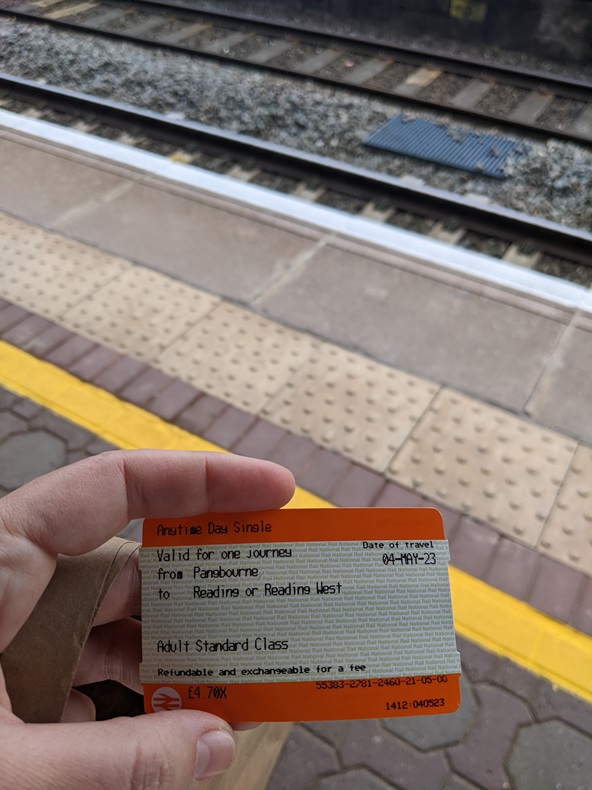
Let me share a travel tip with you.
You will not use it.
The tip: When you come home from visiting a country with different currency from your own – say, in Europe – hang onto your change. You could spend all your centimes or marks or groschen on airport chocolates, to lighten your wallet. But someday, maybe you’ll come back and you’ll be standing, bleary-eyed, at an airport public transit hub, in front of a ticket machine that only takes coins, and you’ll be a lot happier if you have some of those coins with you.
You see why you won’t be using this advice? First of all, those currencies don’t exist. But much more galling, to me: those damn ticket machines now take my American credit cards. In some places I can even tap my credit card when I get on. I may never have to keep track of a charming foreign subway ticket again. Last year I went to the UK for a week and never even felt the need to get cash.
I used to be an expert of Western European transit ticket buying. What am I supposed to do with my obsolete knowledge now?
It isn’t just tickets. I have a lot of knowledge that I painstakingly acquired and can no longer use. Like knowing how to get to places. I love maps! I know all the good routes in my hometown! But, over the last 20 years, my expertise has been gradually usurped, first by Mapquest and then by various apps.
Even my language skills are losing their value. For a whole year of my life, in the previous century, I spent 20 hours a week in language class in southwestern Japan. A few years ago, I sat down with American friends in a cafe in the western reaches of Tokyo, picked up a menu, began to read out loud – this says black tea, this says green tea, this one has strawberries – and was shocked, even a little crestfallen, when one of them got out her phone, pointed it at the menu, and read it for herself. Google Translate trounced my weak reading skills.
My feelings about all of this increased convenience are complicated. I love when I go to an unfamiliar city and can ride public buses with ease, because my phone tells me where to stand and what number to look for. It’s not really fair that I got to spend a year in my 20s studying a language full-time; that’s an extremely high, expensive barrier to engaging with another society, and it’s nice that other people can do it more easily. And the other day I wanted to read some instructions in Japanese and, yeah, I whipped out my phone.
But, at the same time, acquiring these bodies of knowledge is part of what makes life great. Learning a new language is brain-melting, soul-enlarging. Learning your way around a town builds a mental map of surprises and one-way streets. Hoarding coins for next time means you have happy little envelopes and baggies of metal tucked away in a drawer, carrying hopes of future travels, for your children to find after you die.
Obviously I’m part of a long tradition of people complaining about technological change. The kids these days, they just go out and buy a shirt! In my day, we had to harvest the flax and weave it ourselves! And anyone who’s spent the last few decades chasing computer technology probably knows the feeling. My dad did the data analysis for his PhD with stacks of punch cards; no wonder he struggled to understand how to interact with an app. I still use keyboard shortcuts from an old version of Microsoft Word and live in mild dread of the day when my brain is too creaky to navigate the implants we’re using to order our sub-orbital rocket taxis or whatever.
I’m reminded of Our Tom’s essay In Praise of Crap Technology, in which he lovingly describes his $20 digital music player. Should I take inspiration from Tom? Boycott contactless credit cards in favor of pockets full of euros? Lug around my 4-pound Japanese-English Character Dictionary, just in case I need to decipher a sign? Maybe I should find a paper map of my area, if any still exist, and find my own route to a new destination, current traffic conditions be damned?
But these seem like really pointless protests. Maybe I should just sit back, play a game on my phone, and remember the glory days when I knew something useful.
Photo: Helen Fields, obviously

I have a bag full of francs, Swiss, French, and Belgian, guilders, marks, pesetas, colones, euros, Canadian dollars, and pounds. For a while I had a UK bank account, and with that card I could tap my way cashless throughout Europe before our cards even had chips.
We spent December in New Zealand and never took out any cash.
Even though technologies have been evolving faster these past decades, the “obsolete knowledge” is a generational phenomenon. My grand-parents couldn’t be bothered with a microwave. My grandmother knew everything on how to feed a large family a warm, delicious meal with little money and a lot of skills. She also could knit beautiful sweater before someone invented a way to automate complex pattern sweater.
I’m of the generation who last knew childhood without mobile phone and Internet. I remember being outside with no lifeline as a kid. Or not knowing something and it being VERY HARD to find the answer, even with access to the library.
It’s not becoming obsolete: it’s just becoming older. My kids are playing video games with a VR set that will probably look medieval to their own kids. They have learn to face a pandemic and to deal with “smoke day” (when a giant forest fire’s smoke cover the city), to use a computer for everything from information to entertainment to ordering food, and to make friends in a world that isolate more and more people. They will probably talk about this as useless skills if their generation manage to makes things better…
Your skills, by the way, make beautiful stories for the younger ones. They love listening to how it was before.
My favorite song of 2025 is by the NZ band The Beths, called “Expert in a Dying Field.” It is about relationships ending, but it is also about aging and feeling lost. The video is charming, with a Dad soldering on a hi-fi amplifier, film cameras, turntables, etc.
We too have a drawer of envelopes of currencies , some obsolete. However, in countries like Fiji cash is still king (away from the resorts).
I still buy maps (the paper variety!)
Beautifully written! I think, though, that all of these skills are a pleasure when you don’t have to rely on them. Language learning under threat of not understanding a single conversation or sign in a foreign country is stressful and exhausting; language learning for a hobby or pastime is wonderful. Having to read a map at 2am after a long day of travel on a dark road to find your way to a hotel is horrible; reading a map for a day’s hike in a national park, knowing you have GPS/satellite is great.
While you say you regret these skills not being needed any more, it’s probably a boon. Now you can enjoy them, voluntarily, without being forced into them with no other option!