My tooth aches. I feel it with each plodding step over the stone-stubbled tundra. It’s not so much painful as just there: a sensation of pressure in a left lower molar followed by a jolt of worry for what it might mean. I have not seen a dentist in years.
Teeth are on my mind as I wander across the remains of a medieval Norse farm set on the edge of a fjord in southern Greenland. The burials here, and in other fjords nearby, are not only old but they seem to be disintegrating faster during our time than they did just a few decades earlier. I have heard archeologists describe the human bones they uncover in terms such as “wet biscuit,” and even “peanut butter,” which is to say, spreadable. These are corpses you could smear across toast.
It isn’t clear what’s causing the old skeletons to deteriorate so quickly, though a going theory is—you guessed it—climate change. No direct causal relationship has been established; I can’t simply tell you that rising temperatures are melting bones the same way they’re melting the permafrost, or the glaciers. But some theories make sense long before you prove them, and in any case the bones appear to disappear faster than scientists can get them out of the ground.
This problem immediately raises two questions in my mind.
First, why take them out of the ground in the at all?
Then: what about the teeth?
———
There are 32 teeth in an adult human’s mouth. Children have fewer, about 22, and occasionally someone will have more or less. Generally speaking, though, teeth are fixed equipment. You get what you get: eight incisors, four canines, eight premolars and 12 molars.
Teeth are bones, but unlike tibia or femurs or jawbones, they are coated with mineral-dense layers of enamel. This makes them the hardest, most enduring bones in the body. It doesn’t mean, as we all know, that they’re indestructible. Aside from collisions and falls, teeth can be swiftly corroded by bacteria, which thrive on our sugar-rich modern diets.This is why we’re told—as children, as adults, all the time—to brush brush brush. Even as I write this a voice from childhood—a cartoon character from some television PSA—rises up from memory to shout “Teeth are meant to last a lifetime!”
Very often, they last longer.
I am hiking toward an ancient churchyard that sits on a hill above a river. More and steeper hills rise to the west and beyond them are mountains. Beyond the mountains lies the massive ice sheet that dominates the interior of this enormous island. For nearly 500 years, from the early 980s AD to around 1450, the Norse lived in the fjords below the ice sheet. They raised sheep, goats, cows, and horses. They hunted caribou, seals, and walrus. The built stout stone houses and cathedrals with walls five feet thick. Then, without much warning, they vanished.
The Norse Greenlanders left no documents. They do not speak to us through songs or folk tales of their own creation. The cause of their colony’s collapse remains mysterious, though the going theory is that one of the culprits was—you guessed it—climate change. In the case of the Norse, however, their world got colder.
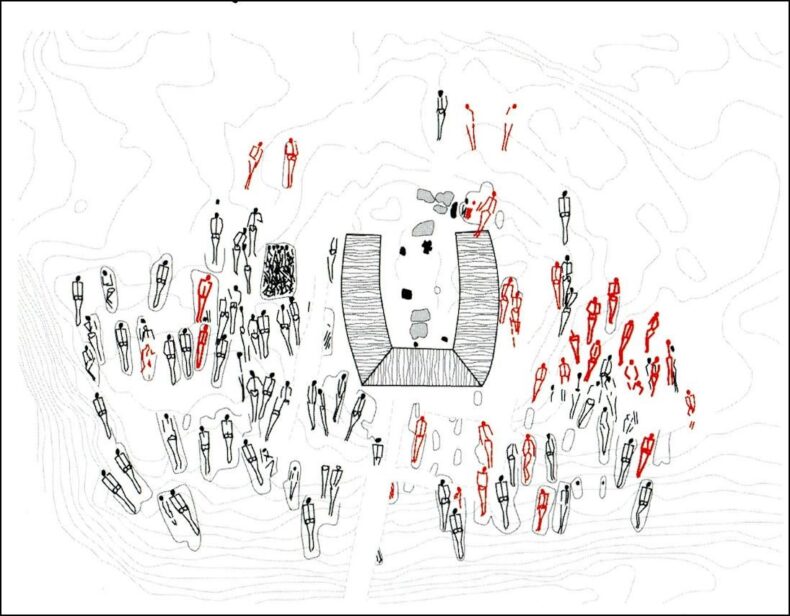
The old churchyard is among the greenest spots I have ever seen, and it’s striking in this almost-Arctic place. Thick grass, tangled and sweet. Fertilized for centuries from both directions: by Norse sheep leaving their droppings above and Norse Catholics burying their dead down below. In the early 1960s archeologists found 155 skeletons here. All were buried facing east, all were arranged in a loose circle around the remains of what seemed to be a small chapel.
A few decades later a strontium analysis of teeth gathered from this site revealed that many of the skeletons—the people—appeared to have been born in Iceland. Some of the bones were among the oldest Norse remains ever found in Greenland, which suggests they may have been among the original colonists. Their church may also have been the very first ever built in North America.
Below on the fjord blue icebergs drift in an ebbing tide. For some reason I kneel where the old church stood and when my knee hits ground a vibration shudders up through my body to my jaw, where it rumbles through my molar. When the sensation fades I try to do some quick math: all those Norse bodies times all of their teeth. There had been thousands of them, waiting like jewels in the darkness.
———
Many years ago I traveled to the far end of Virginia, to Appalachia, to report on a pop-up health clinic that provided, among other things, free dental care to rural people. I arrived late in the day, and already the empty field beside the high school had filled with cars and trucks. In the morning the clinic would serve patients on a first-come-first served basis, and everyone I spoke to planned to sleep in their vehicle so they might wake up early and get a good spot.
When the clinic opened hundreds of people stumbled out of their cars and tottered through the frost-covered grass. Dentists and dental students in neat bright scrubs patrolled the line, assessing everyone’s teeth and inviting the worst cases to step aside. By worst cases I mean people whose teeth were so rotten they needed to be extracted immediately.
For a few hours I floated through the gymnasium, talking with dentists and patients, stunned at the state of teeth in America. Dentists clutching gleaming steel tools stood on foot ladders and tugged molars from the mouths of stunned mothers, fathers, teenagers. It was hard work. Sweat beaded on the faces of the dentists.
Later, when I asked one of them why people let their teeth get into such bad shape he said, Unfortunately low-income families tend not to prioritize their oral hygiene.
When I asked people standing in line the same question they told me that dentists were simply a luxury they couldn’t afford.
The clinic was held in the autumn of 2008, just before the election of Barack Obama. The season of Yes We Can. I didn’t know it then, but I was a few weeks away from losing my regular job and with it my health and dental insurance.
Walking through the clinic at the end of that long day I noticed, sitting on a table top, a large pickle jar. It was filled with blood-streaked teeth.
———
So far as I can tell, very few studies have focused on dental health in the ancient Norse era. Aside from the work with strontium, which can tell you where a person was born but not, for example, exactly what they ate, only a couple of papers seems to have touched the topic.
Among them is one that examined the teeth of Icelanders who lived around the first millennium AD. Their teeth showed signs of heavy wear and erosion. The wear was attributed to a diet of rough leathery meat and fish. The erosion was apparently caused by the consumption of acid-rich dairy products, including whey and skyr. Generally-speaking, younger people had better teeth and older men had the worst teeth of all.
I sit reading these papers late one night in Nuuk, the capital of Greenland, a few days after my visit to the oldest church in North America. I read about methods, sample sizes, results. I can hear the Appalachian dentist in the back of my mind—Unfortunately low-income Norsemen tended not to prioritize their oral hygiene.
But I can also peer forward, to the moment far from now, when my own teeth are unburied and studied. The ache in my molar has subsided, and I no longer feel it with every footfall or sense it when the morning cold sinks over the crown. Still, because it is late and I haven’t slept much, I worry irrationally about how future scientists will judge me.
Strontium ratios will show I was born on the East Coast. A simple magnifying glass will reveal chipped enamel from falls and collisions. It’s obvious I never wore braces. But there will be no documents to explain exactly how, in one of the largest and richest nations on earth, during an era of unprecedented prosperity, I could not afford to visit a dentist. I suppose that will be easy enough to read in the bone.
