My violin teacher had a special style. When I had finished fussing with my shoulder rest and rosined up my bow, I would step up to the music stand where she was waiting for me, her own resonant, professional instrument in hand. Together, we would play the assigned music.
I don’t remember ever feeling alone or judged in that carpeted basement with my father waiting in her family’s living room upstairs. Whether I had practiced at home or not, we were two friends playing music together. She would take me to concerts at the arts center and when I giggled at the funny way the pianist bounced out of his seat playing the stronger chords, she would giggle along with me.
I once took a babysitting course where the most valuable instruction was that on meeting a new child I was not to go up to the kid and start asking questions. Rather, I was to sit on the floor and engage myself with play. Soon enough the child would come over to see what was so interesting, and I would invite them to join in the construction or crafting or make-believe scenario, whatever the play was. Before long the project would be under the child’s direction, with my role to facilitate and offer the odd suggestion.
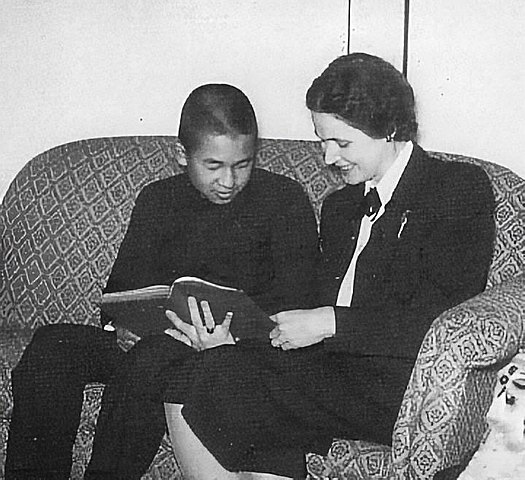
This natural way of learning works well for collaborative work, for modes of expression like music, and also for language. Vocabulary lists and ‘repeat after me’ have never given a single student fluency, because communication is a shared activity. That’s why Elizabeth Gray Vining, the American Quaker who tutored the Crown Prince of Japan after World War Two, started his English lessons by playing tennis with him. She managed to impart the idea of a world without war while gradually building his English proficiency through natural conversation from ages 12 through 16.
I don’t think this style of teaching needs to be one-on-one, but it’s hard to deliver as a system. You find the child’s zone of proximal development—a level of performance they can’t reach alone yet but can do with a bit of scaffolding—and you just explore it together. It’s a form of cognitive apprenticeship that may be what some unschooling parents are aiming for these days in their home schooling.
As AI tutors start rolling out, there is potential for this feeling of solidarity in learning at scale. OpenAI has a model spec called “Seek the truth together” that expresses it well, and I sometimes have the sense—in glimpses, at least—that I’m working alongside a curious companion.
In a time when it’s not at all obvious what we should be teaching children to prepare them for the near-future world, perhaps it’s time to let go of adversarial, evaluative instruction altogether and simply explore together. The teacher of the 21st century is, whether she likes it or not, a novice. She might as well walk alongside a child, equal but for the length of her stride and the measure of her days.

What a lovely meditation on human connection and teaching skills. I’m so sorry to hear that you’re turning to environmentally destructive statistical LLMs for a simulated glimpse of that. Wishing you a return of the real thing in your life, since there are already so many skilled humans in the world.