I am not a person who grew up with dogs. Taiga—my first and only—came into my life when I was 29, an adventure companion that outshone all others. She is the muttiest of mutts, small and trim with foxy, rabbit-soft ears. Until recently, when people asked me what kind of dog she is, I would simply say that she’s “the best kind.” Then a lady at the post office exclaimed that Taiga was, in actuality, “a special tiny wolf,” and by Jove, that lady had it right. I introduce her properly now.
Taiga is north of 15 these days, and I’m well north of 40. She has been here for me through so much, the confidant and keeper of my good and bad times, the head hugger and delight bringer of my homecomings. She is more present through my days than any person in my life. The boyfriends that have come and gone—those I wish had stayed and those I was glad to see leave. The dear friends nearer and farther, in loose or close touch. Even my family, each of whom I adore.
Taiga is my constant. She carries all our shared miles and mountains, the states and towns and cities where we’ve lived. The stars we’ve slept under, the lakes and rivers where we’ve dunked, where she’s swum in circles after fish she had no hope of catching. The cowshit and chickenshit and god-knows-what-else that she’s rolled in. All the people we’ve loved, together.
Our story is one story, is my story. I used to tell her that she wasn’t allowed to die first, and that I planned to live past 80, so she should be prepared to stick around for a while. But Robert Frost had it right; nothing gold can stay.
This past year, all Taiga’s age seems to have come on at once. She has arthritis and takes thyroid meds and eats a diet gentle to her kidneys. In these waning days of her life, however many she has left, I try to absorb as much of the light she gives as possible. It is like a sunset, her gold, somehow warmer and more vivid at this descending angle and still increasing in intensity.
She is so limited, she has changed so much. She can no longer run at full stretch full speed beside me as I skate ski, or spend days walking and running through the mountains with me. Suddenly she has an appetite to eat everything, including the poop she once would have rolled in and the flat mouse corpses that melt out from under winter snowbanks. She can’t jump on the couch or jump from the floor into my arms anymore. She no longer understands commands or howls along when I howl, or barks to applause as she once did at a friend’s memorial service. The highlight of her days sometimes seems to be the long happy minutes she spends licking skin salt off my shins or licking up whatever I have spilled on the floor. Sometimes, it is hard for her even to lay down and she orbits in little circles looking pained, until she finally descends to the rug—like a kid who’s had to work up to leaping from the high dive.
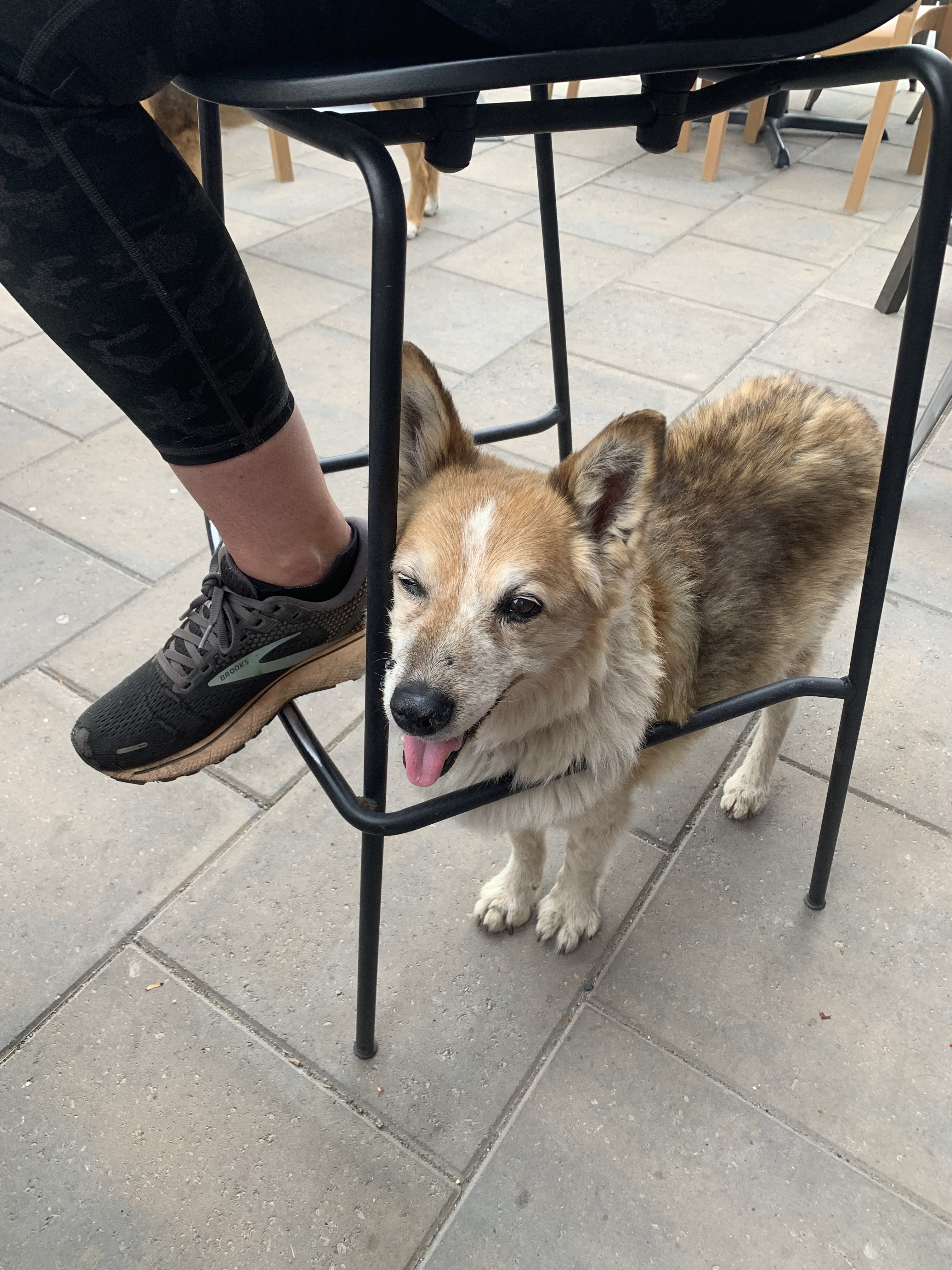
And somehow through all this, she is sweeter and more tender and more special-wolf-woolly than ever. She tolerates small children when once she would have nipped them to rein in their chaos. She rides placidly in my backpack and periscopes her head to take in the sights. She no longer fears or ever attacks other dogs, only minds her own way, snuffling every wonder of every scent on every surface. She stays close to me and leans her face on my calves as I wash the dishes, or sit with friends. She lets the young cat who has become our companion lick the insides of her ears and sometimes even sleep in the same bed. She is my shadow, and the cat is slowly becoming hers. The three of us wend around the neighborhood and through the fields behind my house and watch the birds, the murderous does defending their fawns, the super-blooming wildflowers followed by the super-blooming weeds.
I don’t know what I will do without Taiga, or the parts of myself that will die with her. All I know is that I’m so grateful we have had all these years, and that we have this slower time, too; I learn something new from her strangeness and her peace almost every day.
Last night the cat found a wolf spider on the stairs and then Taiga found it alongside her and I kneeled on the floor to watch them hunt together. I was so transfixed that I failed to notice the spider—large enough to span a silver dollar—was sprinting towards my bare legs. When I saw its hurky-jerky scurry between my knees, I jumped to my feet with a yelp.
The cat, braver than me, pursued the fleeing spider across the living room. Taiga toddled after the cat. They spent a long time smelling the spot below the fan where the beast found refuge, their heads bent together, their pointed ears—one pair the miniature, rabbit-soft double of the other—forward in complete attention, hungry for even this smallest of the world’s delights.
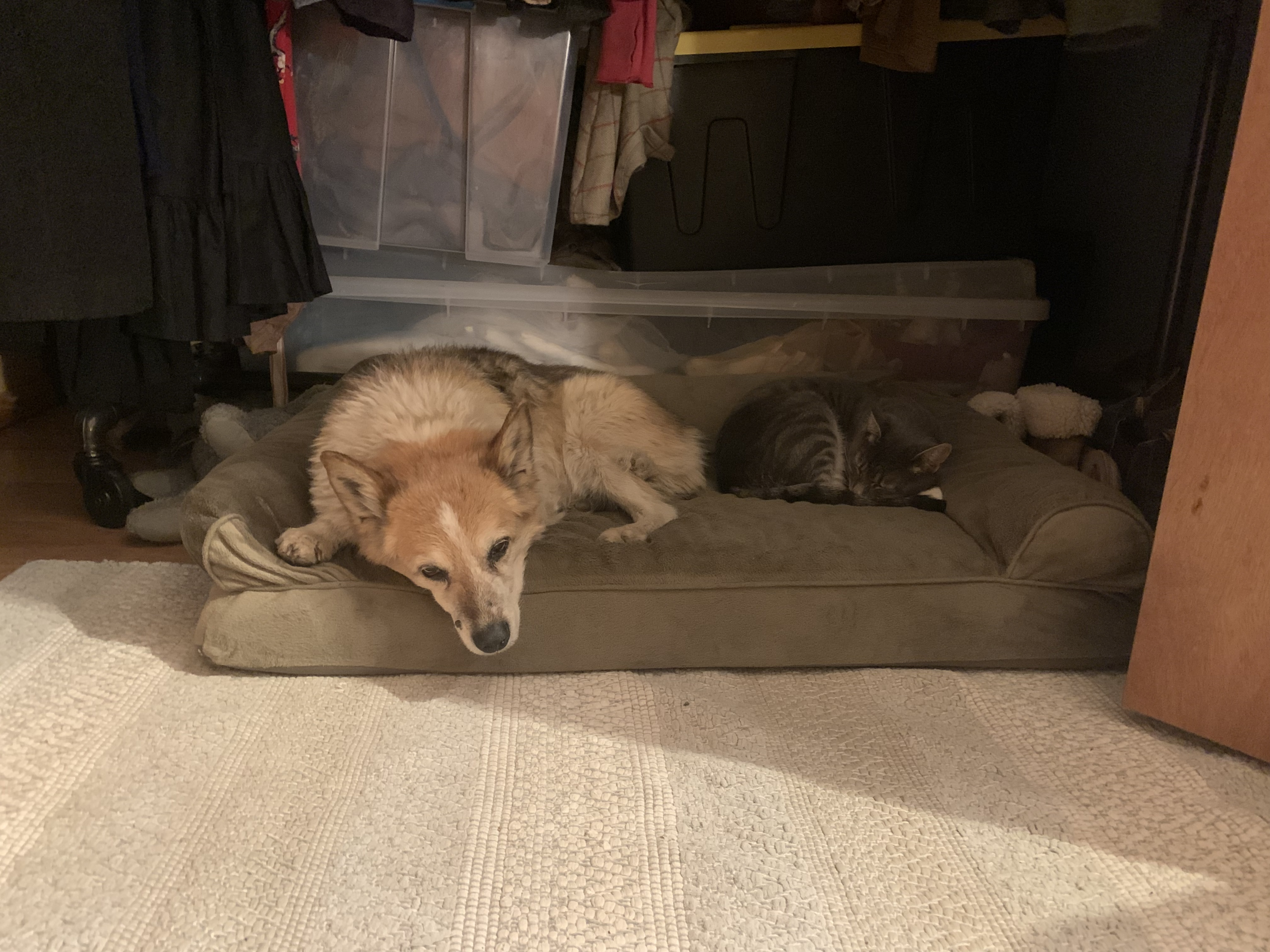

Master and student, and another student behind the camera. Dogs are the best teachers. Part of them lives an in us, a precious cargo to carry. May you both cherish the rest of your time together.
I don’t have a dog.
Because I live alone and the nearest neighbor is a half mile distant, I’m often asked why I don’t have one for companionship. My ready-made answer is that taking care of myself is chore enough.
But your essay unearthed a more primal reason: I just don’t want to deal with loss. It’s a shame their lifespans are so brief; in an ideal world they’d live as long as parrots, or better still, tortoises. I’m glad that you’re able to soak in all the moments now that Taiga has aged. That takes a special kind of strength, and a special talent to express those emotions in writing.
I wish you both well in the time you have together; you’ve written such a wonderful tribute that it even resonated with a petless reader.