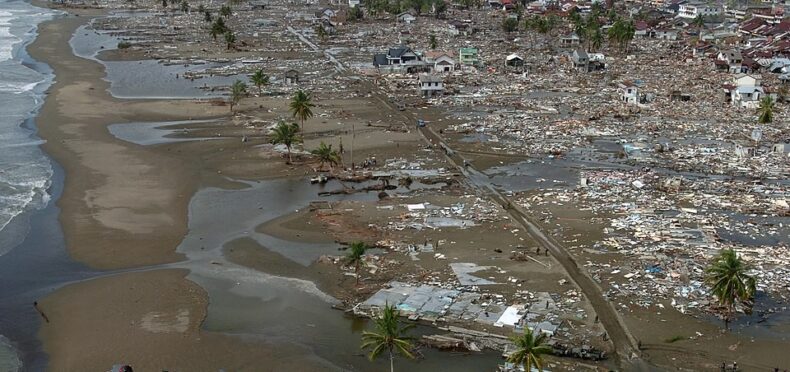
Last Monday, 7/14/2025, NPR ran an interview with a woman who lived through the flood on Texas’s Guadalupe River, a terrible story and I paraphrase:
The flood blew down her back door and filled the house, water pressure wouldn’t let her open the door to her 95-year old mother’s bedroom, so she had to get out and leave her mother there, she thought her mother was dead. Turns out her mother had floated on her mattress up to the ceiling where there was an air pocket, and when the flood receded, the mother on her mattress floated back down, quite alive.
But the woman’s house and everything else was gone. And I’m thinking, after that experience I don’t see how she’s upright. And then she says she won’t move away: “I love it here. I’ve made a life here, you know? And this is my community . . . Look, it’s gorgeous.” And I think — with admiration, respect, and sympathy — that is just purely bug-nuts.
Once you know that your home is in disaster’s cross-hairs, wouldn’t you leave your home? go find a better home? In 1811 and 1812, enormous earthquakes hit New Madrid, Missouri and spread to the surrounding states; a man who lived through it swore he’d move his wife and family to Indiana and he did; and two years later he wrote, “We did not lose any lives but we had aplenty troubles. As much as I love my place in Kentucy – I never want to go back.”
He sounds like a sensible man. Natural disasters like earthquakes, flood, tornadoes, hurricanes, and tsunamis are bigger than we are; they can’t be controlled; all you can do is survive if lucky and clean up afterward. Natural disasters happen pretty unpredictably but in pretty predictable places. Wouldn’t sensible people abandon those places and live elsewhere? Who are those people who stay put? Is that what resilience is?
Once I wrote a story about the indigenous tribes who’d lived in the Pacific Northwest for the same 10,000 years that the Pacific Northwest had been having earthquakes, big ones that top out the Richter scale, ones that cause tsunamis that wipe out not just homes but villages, flatten them, nothing left. And when archeologists looked for evidence that afterward the tribes abandoned their homes, there was no evidence. The people went back to the same places and built their homes and villages again. “In the short term, the earthquake must have been horribly traumatic,” said one archeologist, but in the long term, “I don’t think it made a difference.”
Is that resilience? I don’t know, but I know that I, in Maryland, am positive the lady in Texas should get outa Dodge. She lost everything and was lucky to still have a mother, not to mention the dog. But I also understand the alternative, I understand the weight of a place that’s home and the people you know. And I thoroughly understand the unknown is unknown, that if you know how to live in Indiana, you might not know how to live in Kentucky. And I’m getting no closer to understanding resilience. Except, the older I get the more I think that resilience is a blessed gift, a faith that’s evidence of things unseen. It’s the best I could wish for humanity, resilience is just about everything.
NPR talked to another Texas resident on the Guadalupe River “I don’t know that anyone’s ever going to stop building next to the river because that’s the river,” she said. “That’s what we do.” She laughed. “We want to be near the river.” And then two days later, NPR talked to another Texas resident on another river that flooded a decade ago and destroyed her house. She stayed in the same area, but as she says, “Never again will we live on the river.”
Maybe they’re both resilient, both the woman who won’t give up on her river and the woman who faced the changes of a new life. Maybe you can’t define resilience for everybody, maybe it looks different for different people.
Old age can be its own kind of natural disaster. An old — very old — scientist I’ve known ever since he was younger and more important even eminent, goes to the same farmers’ market I do at the same time I do. I didn’t see him last winter but come spring, there he is, a little tottery, cane and all. He shouts when he talks, always has, he’s full of beans.
“ANNIE,” he yells.
“Oh yay!” I yell back, “we made it through the winter!”
“BY THE SKIN OF OUR TEETH,” he yells. He’s really loud.
“But we made it, we made it,” I yell. You can picture two elderly people the middle of a busy market, holding up traffic, yelling at each other.
“AND IF WE DID IT ONCE,” he yells, “WE CAN DO IT AGAIN!” He waves his cane in the air.
And there, in one sentence, is everything a person might want to know about resilience.
_________
Flood: via Wikimedia, By Mate 1st Class Bart A. Bauer – This image was released by the United States Navy with the ID 050110-N-7586B-120 −www.news.navy.mil/management/photodb/photos/050110-N-7586B-120.jpg, Public Domain, https://commons.wikimedia.org/w/index.php?curid=41083

When Wall Street types move to Miami, of course they talk about taxes and regulations, but they always mention the weather, how nice it is. Never once do they mention hurricanes.
What I’d be interested in is what those Wall Street types do after their first couple of hurricanes.
I often wonder how much of this is resilience and how much is fear of the unknown. People continue to live in war zones, they stay in abusive relationships, they abide all sorts of upheaval. Why? Is it because ripping up our roots and jumping into the unknown is perceived as a bigger risk than the threats we think we know? (Sure the river floods every now and then but we’ll get through it.) (Mostly the fighting is over in the next valley.)
I think of the US as a place that was founded by and is constantly infused with people who’ve had enough of the persecutions / wars / famines / disasters and have jumped into the unknown to start a new life. And then … we stay in flood plains after the floods, build on fault lines, etc… It’s odd.
I hadn’t thought of that, Dr. D, and maybe the people who stay in flood plains and build on fault lines are also jumping into the unknown — as you said, we’ll get through it.
Tragedy or trauma violates one’s life and decisions are made…one can fight or flee, whether internally or externally or both. Questions then arise as to whether those decisions were best, or not. Time passes and previous questions are re-questioned as whether those decisions were best or not. Sometimes the questions and re-questioning are as impactful as the original tragedy or trauma. I reckon what I have found most profound is in the not giving up, regardless the decision one makes, and being present, to one’s self, and to one another.
Not giving up, staying present — I wish I’d said that.
The thing is, in this particular case, you don’t have to leave your community. You just need to build your house or move your RV outside of the floodplain. Same community, different view/access to river. Deadly flooding is not a new phenomanom for that area.
And there, Amy, is the voice of rational common sense.