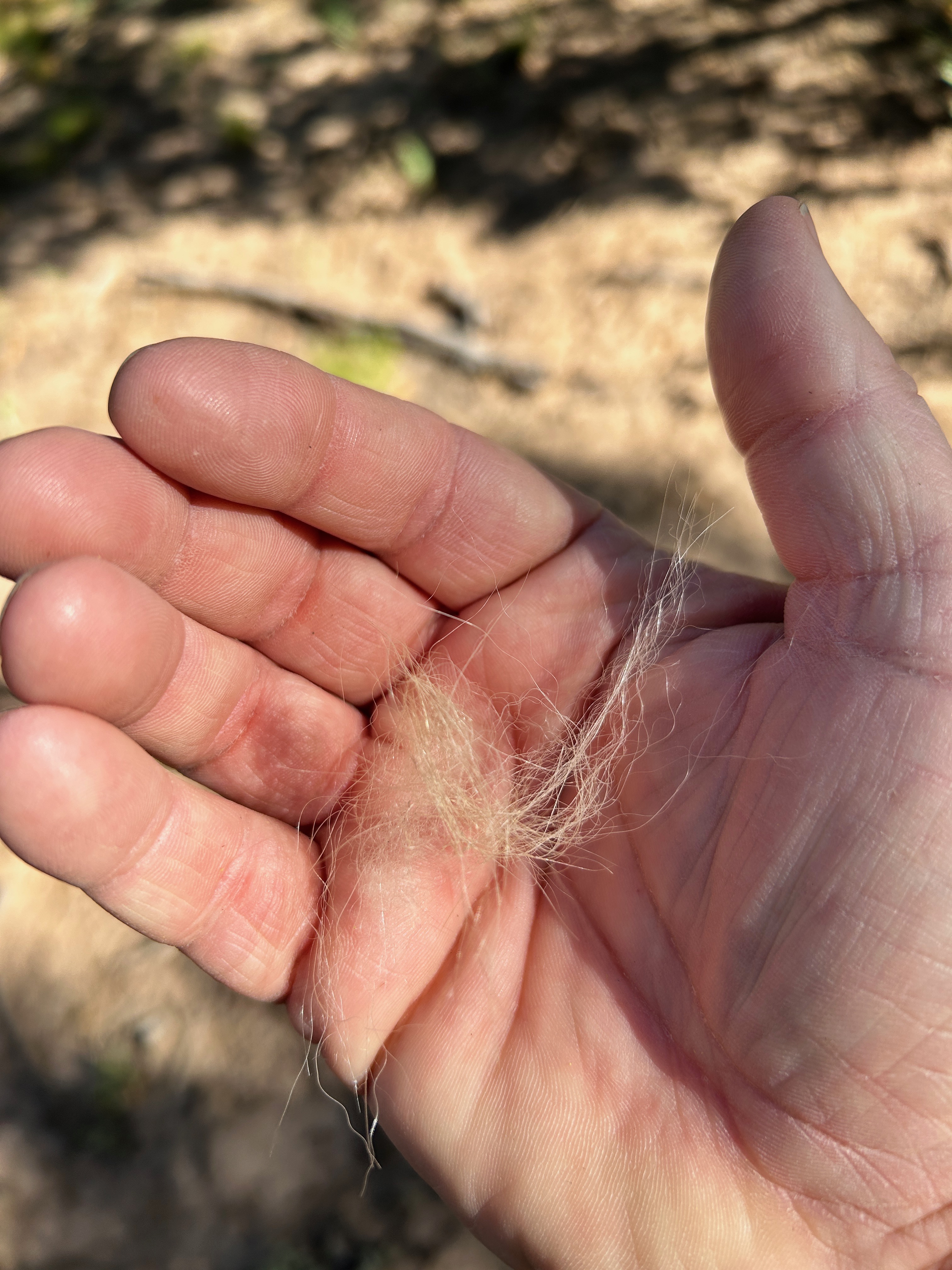
The picture is of a bit of soft mountain lion fur plucked off the barb of a sagging barbed wire fence. I’m on day 87 of 100 walking 200 square miles around my house in Colorado, mostly on public lands where wild animals hold sway. Today was a steep, wooded draw choked with boulders and their puzzles of green, crusty lichens. I’ve come down this draw a couple times since last winter when I followed fresh mountain lion tracks into a snowy slope of boulders as big as garbage trucks and the ringing in my head grew loud enough I decided to stop and not follow the cat any farther. I was coming into ambush terrain and though chances of an attack or any negative encounter are astronomically small, I heeded the bell.
What I’ve learned in 87 days has come slowly and steadily. I started following animal trails a year ago for a book I’m working on in western Colorado almost to the Utah line, transecting this 200-square-mile area back and forth through gullies, canyons, mountains, and mesas. Pretty much every day has significantly upped the learning curve. Today’s recognition was that the map in my head is becoming a map in my body. I don’t mean this on any grand scale, but the draw I walked down I could feel coming for miles. I no longer refer to the map on my phone. I’m going by memory, which is how a mountain lion would perceive geography, knowing this draw like many animals do — the deer, elk, bobcats, bears — as a ladder connecting into a lower, deeper canyon where a crystalline creek babbles day and night. I wouldn’t say I’m no longer capable of being lost as I have been a few times so far, my heart beating faster among columns of ponderosa pines that have started to look all the same. I can still get lost, can still screw up, but my senses tingled with a fresh awareness of how the land lies.
Four years ago a friend of mine from Utah, a wildlife photographer, left a trail cam to capture images of anything that moves in this mangy, shaded drainage and though he gave me the coordinates of exactly where he’d strapped the camera to a tree I couldn’t find it to save my life. There are no human trails through here. Hunters might use the animal paths, but climbing over toppled trees and working boulder to boulder down this steep gully keeps their numbers down. Plump old bear scat and beaded elk droppings speak to who claims this place.
By day 70 I had settled into a state of meditation while I was out, letting the jabber of my mind fade away, sometimes going barefoot to train my attention. I no longer rehearse something important I’m supposed to say or recite birthdays in my head. I’ve more or less stopped the hours spent scribbling in my journal. Now I just move and the only noise might be the last song I heard on the radio as if left on in a room where no one is listening.
Today I felt my body becoming a compass. Some people might be born with this sense, but not me. I pride myself on the ability to get lost. I live for the feeling, looking around thinking where the hell am I? These months of walking have been an effort to answer that question, to bow my head and see what the animals see. In particular, what the mountain lion sees, keeping their own home ranges around here, especially females who tend to stay near where they were born, compared to males who make larger territories and often have to leave to find a place without other fearsome males to contend with. They weave all over my many and not enought square miles, leaving scat and tracks, scat so fresh a buzz has risen up my spine as I tapped a log of digested deer meat with my boot toe, finding it soft and wet, the cat just ahead of me, or maybe, by now, behind.
Do mountain lions get lost? I don’t think so. They know where they are at all times. It’s a cat thing. They are themselves points of awareness in wild country. They pay attention to everything.
Animals are part of the compass. You’re not just feeling the lay of the land, but how animals move through it. My buddy the photographer was one of them, his camera somewhere out here, its place chosen because he could feel the attraction in his animal body. He saw mountain lion scrapes at the base of bigger trees and the way the draw opened as it came uphill told everyone to come through here. You could almost find it with your eyes closed. In a way I was glad I didn’t find his camera. I just knew he’d have bear and elk, and, if lucky, a muscular, honey-colored cat and its long tail, the gateway animal to all the others. His camera trap would have caught photographic evidence of what we don’t see, which might be going against what I’m trying to learn, how to witness with all my senses what is right in front of me. Like I said, learning’s been slow and steady. I could have gone through tracking courses, and that would have helped, but I decided to go first hand, to step out my front door and walk.
Photo: C. Childs

My best friends’ father spent over 2 years in NW Burma during WW2, part of the OSS behind enemy lines. As he experienced, more than once, the resident tigers stayed always above the fray and hunted all prey, including opposing enemy patrols and armies with equal efficiency.