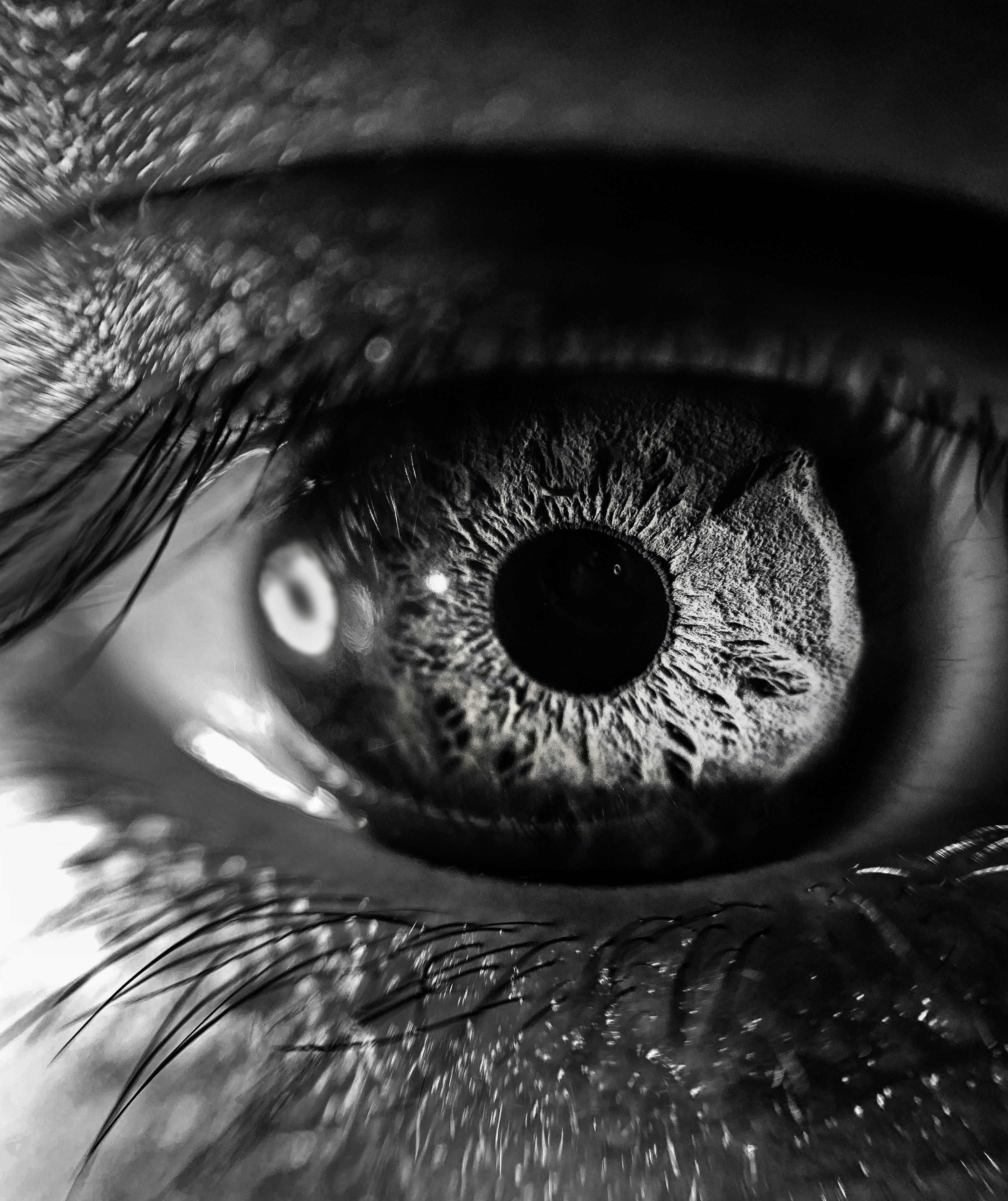
When you hear the words “big green apple,” can you picture the fruit in your mind? Or is it represented some other way rather than as a vivid, or perhaps less vivid but still identifiable, visual image?
I think most of us assume we all have the same ability to “see” beyond our eyes, to generate a mental image of an object, a face, a moment in time. But recently, my dear friend Annika said when she thinks about a person, place, or thing, her mind’s eye sees nothing at all. In fact, more than five decades into her life she had no idea other people can truly “see” with their eyes closed, or beyond what’s in front of them with eyes open. She didn’t think “mind’s eye” was literal. She wasn’t happy about this news.
Annika’s dreams are visual experiences, but when she’s awake, she is, if I may, memory blind. At night, lying in the dark, she can’t envision her mom’s face or a sunflower or the words on her to-do list. (I suspect related: Her mind’s ear can’t “hear” a song being played or sung if it’s not actually audible.) “I know things, and I think about what I need to do and problems I have, but I can’t see anything,” she said. She can’t quite explain that “knowing,” but her organizational, artistic, and other abilities have not suffered in the least: The girl is a super computer when it comes to generating ideas and moving them from thought to reality. She happens to have a terrific eye for color and room design, in fact, and mixes and matches beautifully—which impresses me all the more now that I know she doesn’t get a preview of her choices.
Aphantasia is the term for the inability to form a mental picture, and I suspect some people reading this live with its effects. Scientists suggest about one in 100 people lack a functioning mind’s eye, but I wonder if it’s actually more common and we don’t know because, assuming parity, few of us bother to ask around.
Talking this through with my aphantasic (?) friend and her family members, we concluded we’re all on a spectrum when it comes to mental imaging. Her son bragged about his super-vivid mental pictures in 3-D, which he can flip and turn, and grow and shrink, as if maneuvering them on a computer screen. My friend’s sister is similarly well equipped.
As for me, I can generate images, but the more I try to zoom in on the details, especially of faces, the more they seem to scoot away; I have to chase them around in the back of my head as they’re fading from view. I’m quite sure both my parents had a solid mind’s eye; I recall my dad, especially, squinting into the air to peer inside his brain when trying to come up with “the actor who was in that movie” or an elusive line of poetry or a memorable story. My brother, too, looks off into the distance to where his visual memories lurk.
Recently scientists discovered that in people with aphantasia who attempt to form a mental picture, visual processing areas of the brain light up even if no image appears. The study, published in January in Current Biology, suggests aphantasia is not caused by a complete deficit in visual processing (as previously thought), but that the processing activity simply doesn’t translate into conscious experience. There’s a missing link.
This all makes me wonder, as visual-reconstruction AI becomes more of a thing, what will IT recreate from the brain of someone without a working mind’s eye? Can it see what the person can’t?
Then we had a lower-tech idea. What if Annika and her son, with their very different “seeing” ability, each described the same person to a courtroom illustrator? Would her son’s description be more detailed and accurate because of the mental image he’s working from? Or does my friend’s hard-to-describe “knowing” give her an edge of some kind?
I hope we’ll actually get to do this, because it would be pretty neat. Even neater, of course, would be to strap her into that visual AI technology and see what comes out. Either way, if we follow through, I’ll tell you all about it here.
[Photo by Nathan DeFiesta on Unsplash]

So very interesting! I never knew about this. Thank you!
I was also surprised, and fascinated!!
I’m an aphantasic, Jenny! I see it as neurodivergence rather than a deficit. Aphantasia guides my film scholarship; I write about film and the senses!
Sophie! I now remember talking to you about this many moons ago! I didn’t believe it was a thing…I figured we just weren’t communicating very well. (; So glad you have made good use of it and see it in a positive light. I’d love to talk about it more sometime; I have lots more questions.
I would love to chat about aphantasia and also catch up in general! I attended a conference about aphantasia. There were neurologists presenting their research (some of whom were aphantasics) and it was surreal to understand how my brain was processing information /data. I participated in an early study with Adam Zeman about aphantasia. The learning continues…..
xoxo,
Sophie
So very cool! As well as those who have great mental vision! Sometimes I can read something I see in my head, but I know there are people who do that was better than I.
I’m not sure what category I’m in. I can “see” the faces of people I knew decades ago, but it’s not visual. I’m “seeing” my mother’s face as I type these words, but my eyes are seeing the screen and keyboard. Unlike seeing with my eyes, I can’t look at different parts of her face; it’s more static and much more ethereal than that. I feel as though I’m not really explaining this very well.
Mike, I think I know what you mean, and I think my mind’s eye is more like yours than like my friend’s son’s. It’s not like I’m seeing with my eyes, but with my brain, and what I’m seeing can be vague or sort of breathy… it really IS hard to explain. Thanks for sharing.
Jennifer, it sounds like you really do know what I mean!