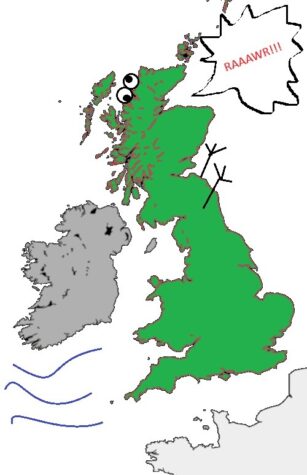
If you really squint at a map and spin up your full kindergarten imagination, Great Britain looks like a little cartoon dinosaur roaring at Europe, its tail pointing back across the Atlantic ocean. Zoom in on the tip of that squat tail: this is Cornwall, home of clotted cream and dramatic coastal walks.
Right at the end you’ll find a shaggy little town called Hayle. Hayle’s defining feature is an exceptionally enormous beach, but that’s also pretty much its only feature. That was exactly what we were after. For a few days this summer, we escaped the heat and crowd and stench of London for a settlement of little one-story hobbit houses pressed into the dunes.
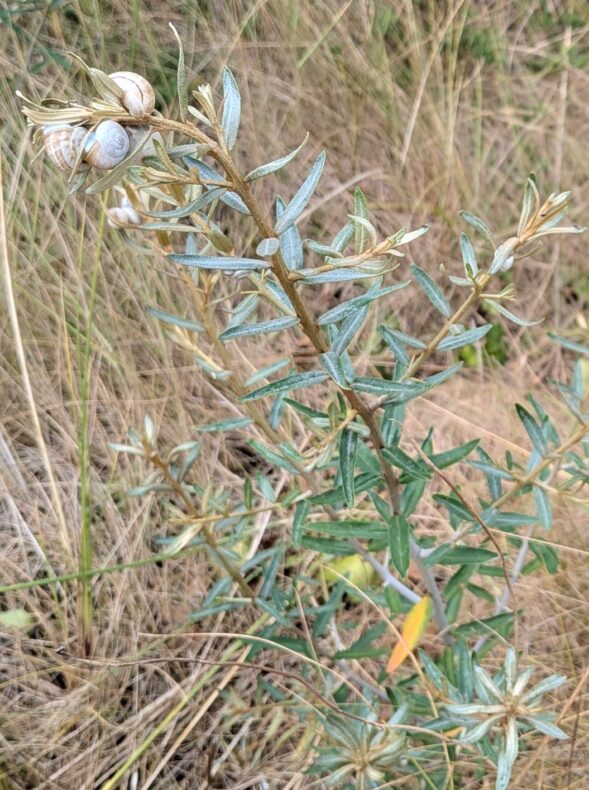
The path from our particular hobbit house to the beach wound along barely existent paths through dry, sharp grasses and brambles that nipped at our ankles and calves. I started to notice that some of these grasses bloomed with an intriguing flower I had never seen, whose pale white whorls looked almost snail-like. I examined them more closely.
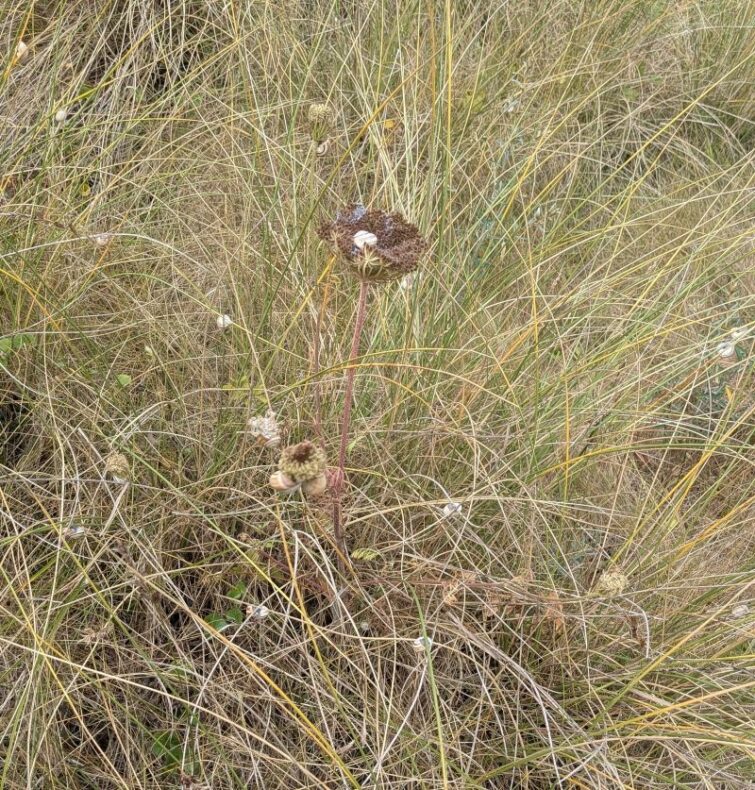
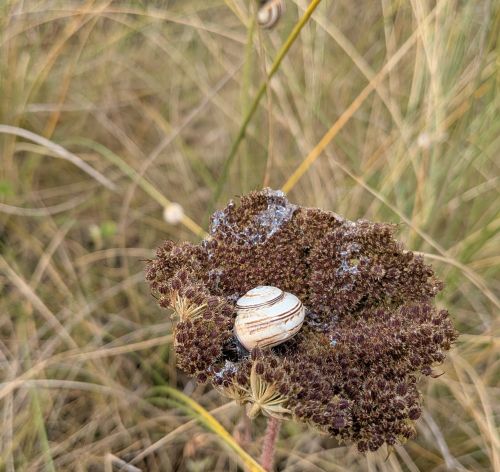
Oh. Not snail-like. These were actual snails. Which had climbed to the top of tall grass stalks, sometimes alone and sometimes in groups, forming the little clusters I had mistaken for exotic Cornish flora.

But why?
It turns out a stalk of grass is as good as a wall for slithering up, and they slither up both for the same reasons: evade predators, and of course get out of the interminable heat. Somewhat counterintuitively, it’s cooler a bit further up than it is on the ground.
The snails may also go up there to estivate. This process is how they survive periods of drought or extreme heat, plugging up their shell entrance with sticky mucus to keep in the moisture. Thus sealed inside their shell, they hit pause on life as they wait for conditions to improve (NB I’m in midst of a life stage that’s making me consider the same approach).
There’s an interesting question in the fact that I found snails doing this in the UK. It seems like this behaviour is much more typical of snails in Mediterranean regions. A nature illustrator called John Muir Laws, whose Instagram is a buffet of gorgeous drawings, captured snails estivating in Santorini, a sunwashed Greek island whose weather didn’t resemble ours in the UK until this year. His artworks show the much more populous and elaborate structures they form out there.
And yet, like me, he also seemed to get hung up on the climbing behaviour. “Why go up?” he muses in looping calligraphy. And then, in the lower left corner, a note hints at a much more horrifying reason a snail will seek higher ground.
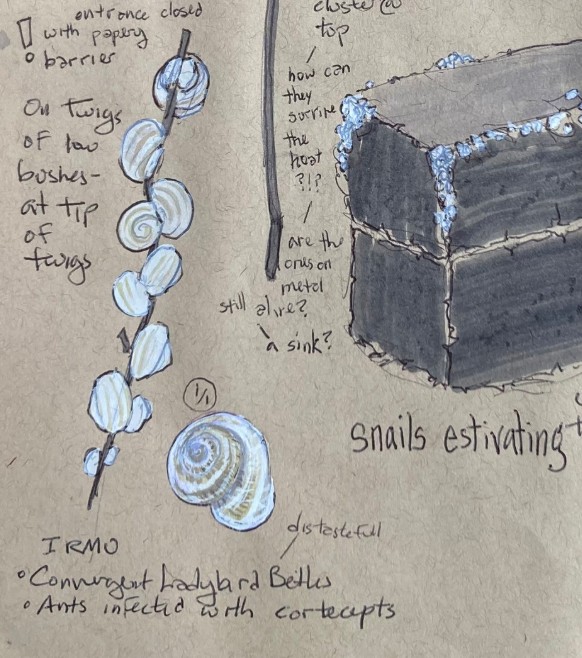
“Ants infected with cordyceps”
If you read LWON there’s a good chance you’re familiar with the villainous serial killer Ophiocordyceps Unilateralis. When this murderous parasitic fungus hijacks an ant’s nervous system, it overrides the ant’s life goals with its own. The parasitized ant, instead of sneaking around in the underbrush, now feels an overwhelming need to climb to high ground. Once there, the fungus’ final act of brutality is to punch a mushroom through the ant’s head like the chestburster in Alien, which waves around its grotesque little head until it explodes in a shower of spores that disperse in the breeze and will infect any ants unlucky enough to be downwind. Lather, rinse, repeat.
Well, cordyceps is not the only psycho killer on the loose: the parasitic worm Leucochloridium paradoxum (AKA “green-banded brood sack”, which is less ‘illuminating alias’ than ‘insult you’d find in The Princess Bride‘) hijacks snails to the same devious ends. First, the snails eat the eggs of the parasitic worm when they eat infected bird poo.
(Sorry to interrupt. I’ve just clocked that snails eat bird poo. That seems like a terrible idea. And this story was already so disgusting without that note. But it’s not the worst thing they eat. They’re cannibals, so they also eat other snails. Some of which have undoubtedly eaten worm-egg-laced bird poo. God, it’s just a nesting doll of abominations.)
Anyway, after they eat the bird poo, the eggs hatch in the snail and the worms make their way to the snail’s nervous system, hijack the snail command centre, and send it scuttling up a tall structure all the better to get in view of a bird.
And because snails are too plodding to seize even the most caffeinated bird’s attention, the worm now reveals its grossest trick. It has also invaded the snail’s eye stalks. The infection causes these to swell, pulsate, and manifest undulating bands of green and white.

They wave around on the snail’s face until a passing bird thinks “oooh! caterpillar!” and swoops in. (Cornwall police were unable to provide data for how many snails survive these encounters with their eye stalks pecked off versus how many are eaten in one gulp.)
Having eaten its infected lunch, the bird then lets its poo fly where it may, and where another snail cannibal squad stands ready to play its part in the worm’s life cycle.
It was unclear to me from the snail shell flowers I passed whether they still contained their sleeping occupants.
It wasn’t exactly Midsommar Murders out here, but we did have bucolic British countryside, eccentric behaviour, and a possible body count. If there is a moral to the tale of the snails from Hayle? Don’t eat bird poo.
Image credits:
The snail lollipop image, which is much prettier than any of my janky mobile phone photography, was taken by BlueBreezeWiki. It shows a cluster of white heath snails (Xerolenta obvia) in Provence.
Snail illustration detail: John Muir Laws, original here.
The infected snail with its throbbing eyes is by Eveline van der Jagt. It shows an infected amber snail in the Netherlands.
Other images are by me.
- Some of you are going to be thinking the word “inconthievable” for the rest of the day. You are welcome.
