Innovation is one of those abilities we used to think only humans possessed. But you’ve probably heard about the creative problem solving of New Caledonian crows who are able to build tools by bedding wires to fish food out of holes. Captive orcas have been observed chewing up the dead fish they are fed and spitting them onto the surface of their pools to attract gulls that they then prey on. And elephants are known to pile logs onto electric fences to create a safe crossing.
Most animals that are widely considered capable of innovation are mammals and birds, and scientists point to three things these these species have that are likely prerequisites for this ability: big brains, long lifespans, and complex social lives.
Spiders, on the other hand, are tiny, short-lived, and mostly solitary. They seem like unlikely innovators, but a new study suggests we may have underestimated spiders’ cognitive capabilities. Again.
It may be hard to believe that a spider could be capable of innovation, but as I reported for Knowable Magazine, jumping spiders have already been shown to have several other surprising capabilities, including counting, learning, and planning.
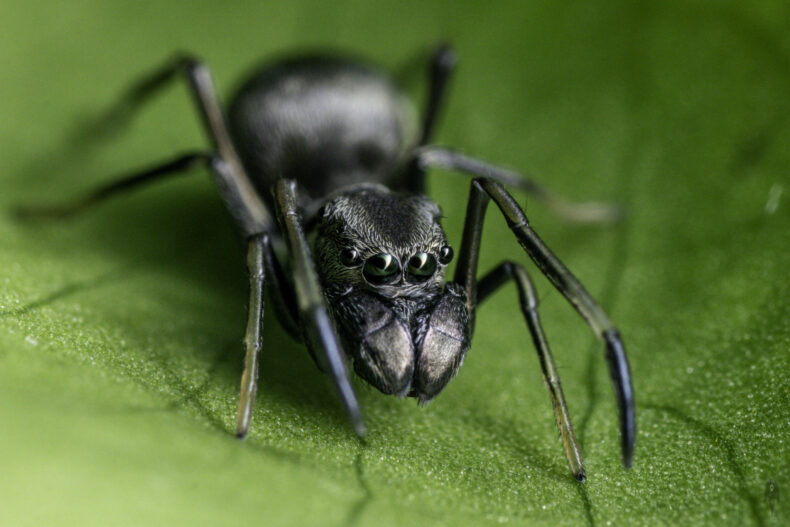
The spider in the new study is Toxeus maxillosus, a Southeast Asian ant-mimicking jumping spider that measures just 6.5 millimeters in length, weighs in at .025 grams, and lives an average of 10 months. But T. maxillosus is one of the very rare species of spiders that are at least somewhat social.
Previous research showed that females care for their offspring in the nest until they become subadults, and they are the only spider known to provide their young with “milk,” caring for spiderlings in the nest for up to 38 days — even though the they are capable of hunting on their own after 20 days.
The lead author of that study, Zhanqi Chen of the Chinese Academy of Sciences in Yunnan, is the senior author of the new paper on spider innovation in press at Zoological Research. Chen’s team tested the nest building capabilities of lab-raised female T. maxillosus spiders under various challenging conditions.
In the first experiment, spiders who had just been impregnated were put into a transparent dome with a tray of water covered with gauze on the bottom. These spiders like to tuck nests into dry, protected corners, so this situation was far from ideal. Still, all but two of the 38 spiders tested built nests, and in a way the scientists had not previously seen: They stretched silk lines across an area of the dome to create a flat layer and then built the nest in the space between the silk layer and the curved ceiling. A pretty neat trick.
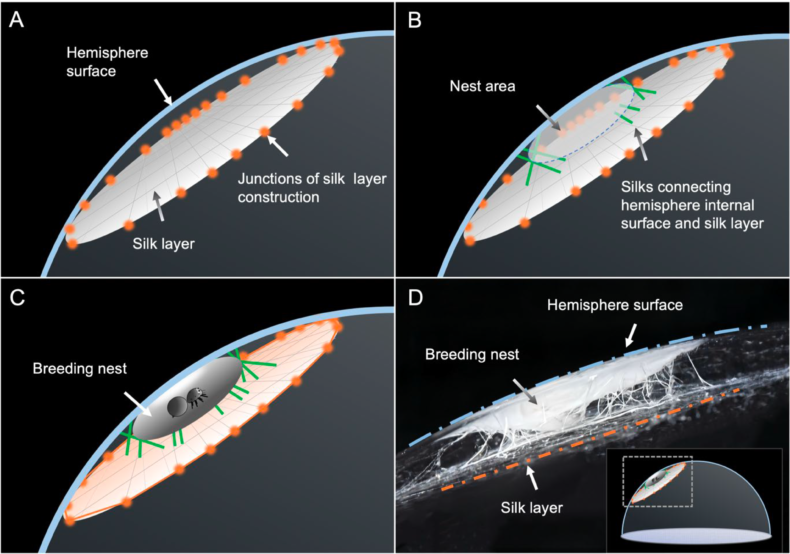
But what’s more interesting is that compared to spiders who were allowed to build in a square box, the spiders in the dome took twice as long to size up the situation before they started building — an average of nearly 19 hours, with some taking nearly 36 hours. After that period, the spiders abruptly began building the nest, working furiously without stopping until it was finished (which took an average of 30 hours, three times longer than in the square box).
“This extended delay, followed by an abrupt, continuous bout of silk deposition, is consistent with prolonged spatial assessment and prospective planning prior to an insight-like resolution,” the authors write. In other words, the spiders had something like an aha moment.
The second experiment was even more impressive. This time, the scientists suspended a piece of sponge by a string attached to the dome, a version of a classic experiment used to test different species (mostly mammals and birds) for various abilities, including planning and insight. The scientists wanted to see if the spiders could figure out how to use the sponge to create a space for nest building.
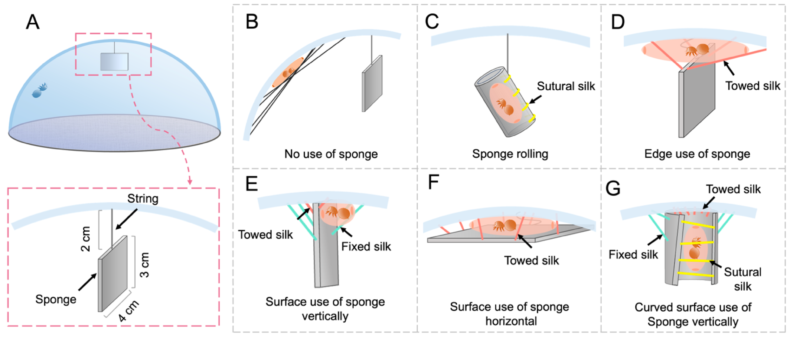
Of the 33 spiders in this experiment, two didn’t build nests and 15 built nests without using the sponge. But the rest incorporated the vertically hanging sponge in various creative ways.
— Some attached silk to the sponge and lifted it 1.5 centimeters until there was a half-centimeter space between the top edge of the sponge and the dome ceiling, and then built a nest in the gap.
— Some lifted the sponge and attached it vertically to the ceiling with silk and then built their nest in the corner that was created.
— Some pulled the sponge into a horizontal position, creating a flat surface similar to the silk floors constructed in the previous experiment, and then built their nest between the sponge and the dome.
— And some attached the sponge vertically, half rolled the sponge lengthwise to create a vertical cylinder that they then closed up with silk and built a nest inside!
According to the 2003 textbook Animal Innovation, there are four key components required for an animal’s behavior to be deemed innovative: flexible behavior, insight, planning, and multi-step problem solving. I think these spiders clearly checked all four boxes.
