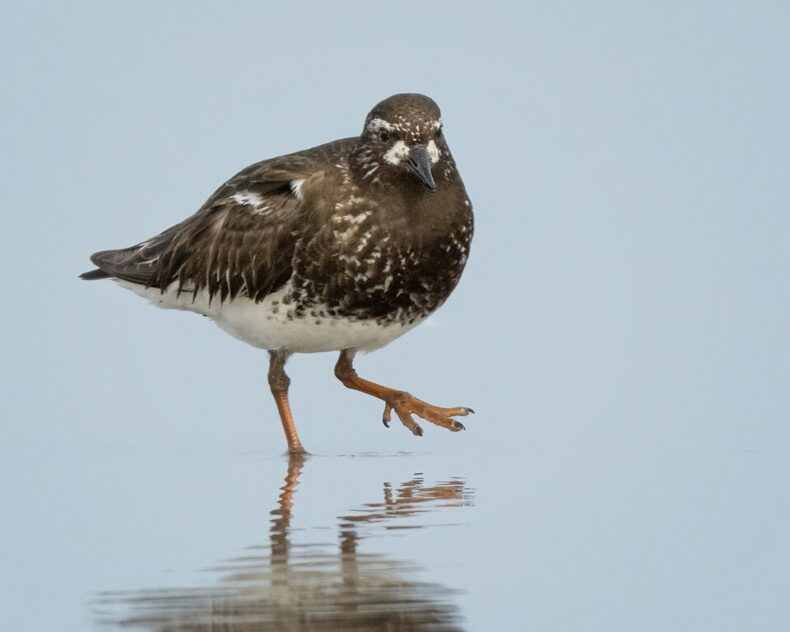
We were walking past a line of shorebirds on the harbor’s breakwater when my son stopped me and pointed. “Does that bird only have one leg?”
About two dozen black turnstones — I didn’t recognize them at the time, I had to use All About Birds later — faced into the wind, broadside to the incoming waves. One of them was standing on one leg.
We peered at the bird. Was that another leg tucked up against its belly? Hard to say. We studied the other birds. Most of them were standing on one leg, too. “That would be a lot of one-legged birds,” we told each other. We tried balancing on one leg. “Seems tiring,” we agreed.
Why do birds rest on one leg? Researchers have suggested that this balancing act might help regulate heat. In a study of nine species, they found that birds with longer legs seem to rely on this strategy more often than birds with shorter legs, which have less leg surface area to keep warm.
There were many things to wonder about on our walk home on two legs. For one, when do the birds switch legs? There’s a summer camp skit that starts with a line of kids sitting on a bench, each one asking the next if it’s time. No, not yet, they say, one to the other, back down the line. This happens over and over, until finally a counselor walks in, checks their watch, and says that it’s time. All the kids uncross their legs and then recross them, the other way, together. “Do you think they do that, like the skit?” we asked each other. “All at once? Who tells them that it’s time?”
Maybe it’s just a feeling they get. To ready ourselves for the new season of Ted Lasso, we did a marathon of the previous seasons, which seemed even better and more poignant knowing where it was all headed. One of my favorite scenes was when a group of the coaches and other AFC Richmond folks gather in Ted’s office and talk about how people aren’t perfect, but the world has a few perfect things. Perfect films, perfect hair. The other side of the pillow.
Maybe the feeling of changing the leg you stand on is the same as the one when you turn to the cool side of the pillow.
When I get overwhelmed, I forget to turn the pillow over. My body feels like a giant lollipop on a stick — a rainbow whirl of head and face, with nothing beneath it. Or like an enormous eye that’s stuck open. On other days, when we walk and the sun is low and at our backs, we make giant eyes with our shadows. Hands on head, elbows out to the side, and your head becomes the pupil and the iris, your elbows the corners of your eyes from which tears and the leftovers of sleep emerge.
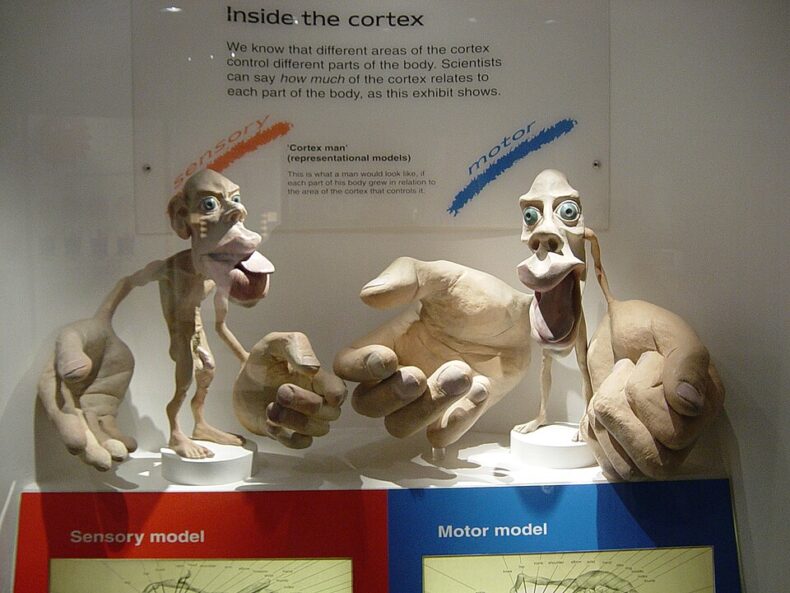
I’d been looking at images of a cortical homunculus — a representation of the body drawn how the brain might “see” it. As illustrated in a 1937 paper in the journal Brain, the hands are enormous, and so are the eyes, the lips, the tongue. (I’ve been married long enough that I can ask the question my husband would: don’t worry, people are working on that, too.)
While more recent research has refined and complicated the picture, these areas of the body — the hands and feet, the face, lips, and tongue — take up a vast portion of the signals zipping to and from the brain. And when there are changes in the body, the brain can respond. A recent study of children who were born with only one hand had brains that completely remapped the perception of their bodies. These new maps remained in place in adults who had spent their lives moving through the world with a single hand.
On the walk home from the harbor, we talked more about being birds. We tried balancing on one leg again, and imagined how it might be restful, might feel warmer if the wind was blowing. I imagined the map of a black turnstone’s brain and how it might know when it’s time to change. When my head grows heavy and too warm with thinking, I will try to remember the shorebirds, too, imagine that the rest of me is, like them, all wing.
*
Black turnstone at Sands Beach by Sue Cook/Wikimedia Commons

.jpg)