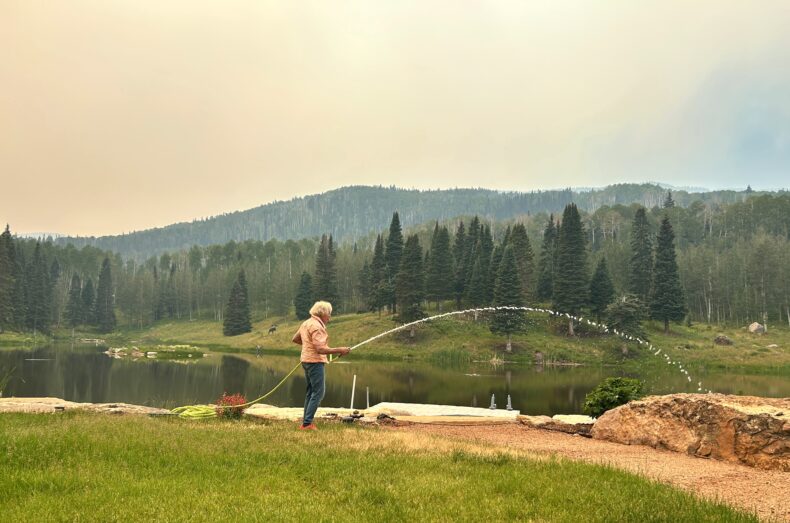
My mom watering her flowers as a wildfire approaches
I’m helping my mom evacuate, the air getting harder to breathe in this charred perfume, 23 square miles of conifers and oakbrush gone up in flames several miles away. Last report, the fire was about to crest the ridge at 10,000 feet where the front line is being slurried and fought with trenches and hand tools. It’s called the Gold Mountain Fire, started four days ago outside of Ouray, Colorado, from powerlines downed in a windstorm. That wind hasn’t let up. Ash twirls down on us like snow.
My mom and I carry out furniture she built, heavy oak productions that we load in our two trucks, plus my stepdad’s laptop, a Navajo rug, and a copper bucket containing a box of matches, anything that just can’t be replaced.
Hold up, I say to the copper bucket and its matches. Why are we taking this?
My mom puzzles the question. She looks exhausted. She says, In case it gets so hot in the house they light.
If it’s that hot, it’s too late.
I think she’s gotten four hours sleep in the last two nights, and she’s 80, and like feathers of mascara, ashes have landed on her cheeks and shoulders. My stepdad would be here but he had surgery yesterday and is down at their place in town recovering.
Anyone who’s evacuated this close to a wildfire knows this moment, looking at the spread of your things, saving an electric drill, a circular saw, not sure what else to grab. A favorite mirror, a wooden bench. Soon, you can’t tell the difference between a hairdryer and a beloved necklace.
The air smells like burnt sugar. There’s a copper hue to everything, getting darker in the middle of the day, almost chilly. Plumes of black are followed by bright white as a stand of trees on the other side of the ridge smolders darkly, heating, blackening, and all at once lights up. It’s like turning a key on an ignition, sputtering, choking out exhaust, and then the forest kicks over, starts sucking oxygen, becoming its own internal combustion engine.
Firefighters in their stained, sweaty-yellow Nomex come by every half hour or so, soot-darkened ball caps, a scarred hardhat, hair pulled back and braided. They are a wildlands crew out of Gunnison, Colorado, getting the lay of our steep dirt roads and scattered mountain homes.
My mom perks for two young, strapping gentlemen in Nomex. She sets down whatever she’s carrying to say hello. They wear serious expressions, but we see them smiling underneath, friendly as can be. It’s the start of the season, their first big fire, and everyone who comes by seems a little giddy, pumped for a full frontal engagement, which looks like they’re about to get.
The last thing she does is water her flowers and we caravan our two truckloads out of there, no idea when we’ll be back, or if we’ll see it like this again.
****
The Southwest fire season started with a bang, every state around us drought-thirsty and burdened with dry woods, and currently riddled with wildfires. I get my mom into town and unloaded, and am on my way home myself, an hour and a half through the smoke of other fires, one called Babylon kicking up a hundred miles to the west just inside the Utah border, and another called Ferris about thirty miles from where my wife and I live. We’re smack in a flaming triangle.
On the highway home, I stop at a mountain divide and stand with other people to see the conflagration I just drove out of, the one threatening every living thing in the valley where my folks live. I’m embarrassed to say how spectacular the fire looks from a distance, nicking the stratosphere with its bone-white pyrocumulus clouds. Those of us watching talk a little with each other, voices concerned, a story, a memory, a hope.
The drive down the other side takes me into the smoky wool of the Ferris Fire, also started four days ago and 35,000 acres so far, the great wooded canyons of the Dolores River up in flames. I’ve fully inhaled three distinct fires today, three swaths of destruction, every possible habitat and home turned to ash and smoke. I think I can tell the difference in how they smell, something you start doing in fire season.
****
At home, we keep the doors and windows closed, but it’s a drafty old adobe and some rooms you don’t want to stay in for long. This goes on for a week and a half, my wife religiously checking updates on the Watch Duty app, phone buzzing, alerting who’s in Ready Stage to evacuate, who’s in Set Stage, and who is Go.
At any little cloud of sprinkling rain, we go out and dance, or stand with our mouths open.
Nine days in, the dead blue of the sky breaks. Day after day we are struck by sudden torrents of rain and hail and half-night drizzles. My folk’s place in the mountains still stands. The fire twenty miles from us has been soaked, 89 percent contained at nearly 17,000 acres, while the neighboring one in Utah is 95 percent contained at 107,189 acres. In the rain, the air smells like oxygen and the unburned sweetness of petrichor, and I realize how despairing it’s been to sit in smoke for days.
One problem is traded for another. Now it’s flooding, towns near us taking a hard hit, mudslides shutting down the highway, and the dirt road to our house washes into gullies. We’re on our knees mopping up rainwater running under the doors, a metal bowl in the entryway chiming from a dripping ceiling.
****
As I write this post, a lightning-filled deluge just passed and I get up from my computer and come to the window with binoculars. This planet keeps you on your toes, and I appreciate that. Some places have hurricanes or tornadoes, some have earthquakes. We have this. My wife rises and looks with me. A white minaret lifts from the woods a couple miles away where we’d seen strokes of lightning hours earlier. For as wet as it is, everything is still dry to the core. The smoke-like drift rises slowly, too slowly for firesmoke, and it disperses.
It’s a little cloud on the ground, I say.
Phew, my wife says and goes back to what she was doing.

Always loved your perspective. Seeing the earth and heavens from your eyes.
I saw fire come over the mountains once in Lolo, Montana…such a powerful force.
I feel I’ve missed out on life, never having met your mom in person. Thanks for the literary glimpses!
We have to scatter like ants sometimes. After the huge fire in the Catalinas a few years ago, I saw the debris in the washes after the monsoons – just piles of gray ash and sludge and burnt tree limbs.
Yes, we were evacuated twice years apart from two different homes. I spent the days before cutting and raking away dead grass and some shrubs that were too near. And we’re both homes I left with the water running and sprinklers on the roof. Fortunately, both houses were spared. But watching fire approach your home with trees going off like Roman candles is something you’ll never forget.