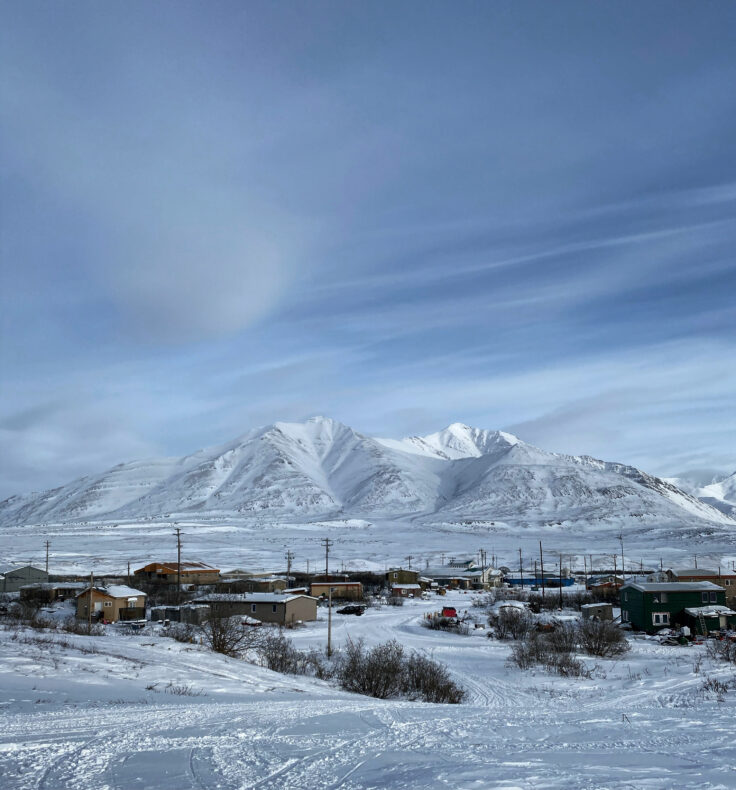
In May, Doug Burgum, the U.S. Secretary of the Interior, traveled to the tiny town of Anaktuvuk Pass, Alaska, to announce a new policy: caribou hunters will soon be allowed to use all-terrain vehicles inside the Gates of the Arctic National Park and Preserve. Under most circumstances this would piss me off—another misguided plan from an administration that seems hell-bent on wrecking environmental protections and green energy initiatives, often for no reason beyond a desire to own the libs or, worse, line the pockets of Trump allies.
This sort of anti-life energy is unfolding before us in several parts of the Alaskan Arctic. One example is the so-called Ambler Road project, a 200-mile long mining track that will cut through another roadless wildland near the Kobuk River. I’ve written about the road before and the bullshit reasons given in support of it, while others have detailed how the mining companies behind the road are foreign-owned and Trump-friendly. Another example is the Trump administration’s recent reopening of the Arctic National Wildlife Refuge to oil drilling. That effort, at least, seems to have fizzled, though there’s no guarantee Trump officials won’t make some other lame move. Their approach was broadcasted clearly during Trump’s first administration, when former Secretary of Defense Mike Pompeo said “The Arctic is open for business.”
It’s been easy for me to oppose Ambler Road and the reopening of ANWR. I’ve worked in or near both places, studying the profoundly disturbing decline of Arctic caribou and the effects of climate change on the lives of people who depend on the animals. I’ve talked to many experts, the science kind and the hunting kind, who agree that roads, oil pads, helicopters, construction traffic, dynamite, chemicals and everything else that comes with Arctic development, are very clearly disruptive and harmful, not only for caribou, but also for the entangled ecosystems in which they are but one thread. And I’ve been able to feel certain, and probably a little too righteous, in my opinion because the science behind it is sound and, more important, because both Ambler Road and ANWR drilling are opposed by many Alaskan Natives—the people who live in and have long relationships with the land we’re talking about.
With this latest news, though, about hunters on ATVs chasing caribou inside America’s second-largest national park, I find myself suddenly on the other side. That is to say, I support this Trump policy.
How can I make such an abrupt turn? The simple answer is landback.
If you’ve never heard this term before, it has to do with returning sovereignty, often over land, to Indigenous people. Sometimes it’s as simple as the word itself implies—giving jurisdiction back to the original stewards of a particular place, or landscape. But it can mean much more than this. It’s also an approach to decolonization, to reparations, to better relationships with land, ecosystems, animals, and each other, for everyone. For a much more thorough discussion of what landback can mean, I encourage you to check out what the NDN Collective, an Indigenous-led grassroots organization, says about the term, and the many ideas it contains.
In the case of ATVs in the national park, and speaking only for myself, I support the new policy because the hunters who’ll benefit are people I know, and they are Alaska Natives, and this is what they’ve wanted this for years. The policy may be coming down from Trump administration officials, but it reflects the will of the people whose land it is. This is landback.
Here’s a bit more background. Anaktuvuk Pass is the only town of the Nunamiut, the people of the land. It sits in the middle of Alaska’s Brooks Range, about 150 miles from the nearest community, and no roads connect it to any other part of the state. It’s also completely surrounded by the Gates of the Arctic National Park and Preserve.
When the Nunamiut chose to settle here in the early 1950s, they did so because caribou—tuttu—in their language, passed through the area twice each year during their long migrations. At the time, the national park did not exist, and neither did the state of Alaska. Both later folded in around the Nunamiut, swallowing their town, their rivers and mountains, and the plains and passes over which they had traveled and hunted for generations. While state and the federal governments still allowed Nunamiut to hunt caribou within the park and beyond it, both have over many years placed restrictions on when and how they can do this. One of those restrictions, in place since the mid-1980s, has prevented Nunamiut hunters from entering the park on ATVs during the summer. This is the rule that was recently overturned.
Yesterday I reached out to a young hunter I know in Anaktuvuk and he told me he was thrilled with the change in federal policy. For him and his family, his neighbors, it had nothing to do with Trump, or with any other administration. It was simply about access, about animals, about a right returned and a wounded relationship made a little better.
“Our local leaders have fought [hard] for our right to access our hunting grounds in the park over the last two years,” he said. “Finally we can go anywhere in our lands.”
He went on to tell me the new policy would be helpful to his community after a hard winter in which there had been little snow, but many days of temperatures hovering around 50 degrees below zero. The extreme cold had led to a fuel shortage, he told me, which made it that much harder for people to go hunting.
Now, the new rule would allow younger Nunamiut to resume traditional practices in ways and in places their fathers and grandfathers had used. It wasn’t a complete return of jurisdiction, it wasn’t a transfer of land to the Nunamiut tribe. But in Anaktuvuk it was still taken as a victory.
During our conversation my friend never said landback. He didn’t have to.

Well done, Neil. I hold the same sentiments about each piece of your article. I was thrilled both times when there were no takers for oil leases in the ANWR. And I’m a solid supporter of Landback. My soul is grieved daily at the way America’s first people have been treated for centuries now.
Thank you, Bill!
i am so glad that something this administration has perpetrated might in fact NOT need to be undone – i only hope that burgum and ‘coalie’ don’t find out that they might have done something worthwhile…
It will be interesting to see if the pendulum swings back the other way…