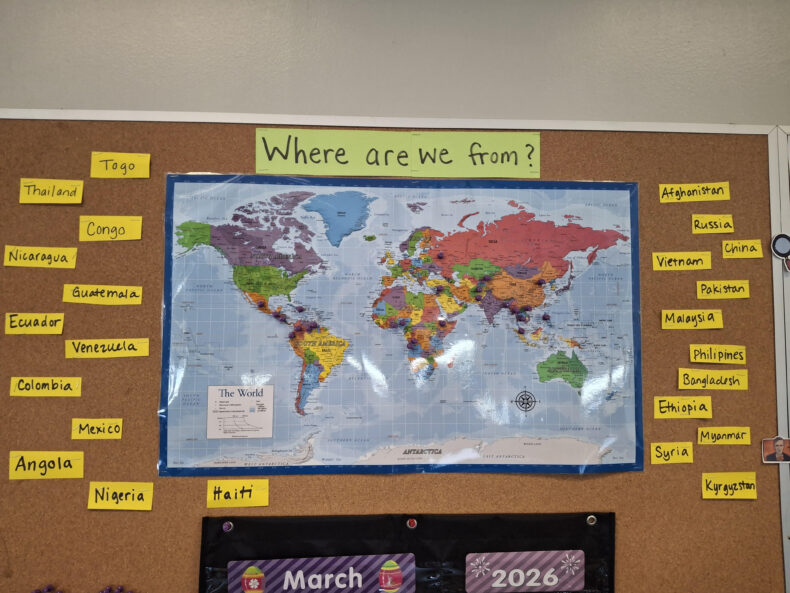
The Friday before spring break, the handful of students who haven’t cut out early or taken off for Eid are sharing some of their favorite new words gleaned from their independent reading: black hole, sound barrier, bookies, puppets, dime, wrist, Wyoming, information. We talk about what each of these mean, write sentences, consider what new worlds they allow us to either glimpse or explain. They dream up a reality to probe.
My students are all between fourteen and eighteen years old, new to the United States from what feels like everywhere, and learning English with the approximate average literacy level of a first grader. Like any child, their approach to language learning is curious, open, data based—in a word, scientific.
We have just wrapped up stoichiometry, or the “recipes” unit. You remember: How many grams of CO2 do you need to make 71 grams of C6H12O6? Some students speak math very well and this they like. Some students speak math very well but their sibling was just deported by ICE and we haven’t seen them in school for three months, so there’s that.
Chemistry has always been abstract—having taught all the other ones over the years, I find it the most hard to wrap our heads around. Physics is laws sterling yet transformable. You can approach it in any order and it builds and wraps back on itself. Biology is the beautiful scattershot, an exploration of how outrageously those laws can be expressed and an affirmation of how much even the sterling transformationists depend on chance or a nudge in one direction or another (you thought this was simply matter or antimatter, velocity or position? Explain what the hell reproduction is please). But chemistry is somewhere in the middle—sterling laws that explain sterling, if you’ll indulge me. Atoms and molecules that we can only grasp in bulk, obeying rules we can only explain in board game form—jump an electron up or down from this ring here, which isn’t really a ring, and also the electron isn’t really here—or elements we line up in a contentious table with a decidedly Earth-based bias. If that matters.
A table is this, I say patting the lab tables next to me. The tape peels off one of my word labels reading “table” like I also have “clock,” “faucet,” “projector screen” and as many other items as I could name and write in the furtive last days of the previous school year when you try to set up everything to make things easier, if only marginally so, for the following September. It can also mean a way to organize information, rows and columns, up and down, numbers or letters in order. Like your data tables. Like the periodic table. Yes, it is organized. We did a whole unit on it in November, periodic trends? You weren’t here yet. Right.
This class is a graduation requirement in the state of Illinois. Here, I point (of course I have a map). That means you can’t leave high school without this. Well you can, but you shouldn’t? A Pakistani girl is near tears telling me how many hours she studied for this test. Her mother has a masters in chemistry, surely knows more than me. I know, she wails, then says her mother can’t understand why she’s doing so poorly. The main problem, I explain, is that you need to be in school. But she needs to be out with her family, helping translate at the doctor’s office or going to other appointments. Her father will not let her stay late for tutoring or take the CTA alone. He’s not unreasonable. Even here, in the nice neighborhood where I live and raise my own children and to which hundreds of other children and their families have fled violence, persecution, and trauma, there is violence, persecution, and trauma. Sometimes against children on their way home from our very high school. Again, biology is nonsense. Humans and their choices only confound. Economics is the fakest of all the disciplines, and it is ours alone.
I find myself liking chemistry more and more, with my own tendencies to abstraction.
Let’s talk chemistry then. What’s the point? When will we use this? (For the record, this population of students asks this question far less than any other I’ve encountered.) So I have to ask myself the perrenial question: When our short time together runs out, which information will serve them most? (This question is fraught, relentless, and never fully answered by any educators I’ve met who give a damn.)
The mole. 6.02 x 10²³, or 602,000,000,000,000,000,000,000. That’s more than the estimated number of stars in the universe. It’s the number of molecules in 18 mL of water; about 1/26 of a pint.
I have gone hard on the mole this year, starting in August and then on repeat, repeat, repeat. It’s a number, like a dozen or a pair. It’s enough to break your brain. Anything you can see a mere one of with your eyes, I tell my students, is already too big to count in moles. I have them sort moles of things into columns: what you can see or what you can imagine (as in, this is only available as an idea, for example a mole of chickens or M&Ms). Over and over, mid-sentence, I reiterate with props (magnifying glasses) and a number line on the wall how insanely small atoms are and how big everything else is. What I want to convey but am sure I do not is how everything we are talking about might seem trivial, admissible, but is in fact astounding, intrinsic to ourselves, immutable in the face of the chaos of our lives.
We do the classic activity with molar mass: calculating how many grams of something—sugar, water, aluminum foil, baking soda—are in some number of moles, then massing it on a scale.
Look, you can hold more sugar molecules in the palm of your hand than there are stars in existence. We don’t need Whitman to tell us what we contain.
Yes, you need chemistry. You are atoms and the universe.
What can you see? What can you imagine?
_________
photo by Amy Dusto
__________
Amy Dusto is a writer and high school science teacher in Chicago. She’s posted on LWON before about being a part-time vegetarian and trying to figure out kids and quitting her teaching job. Apparently she didn’t quit teaching for long.
